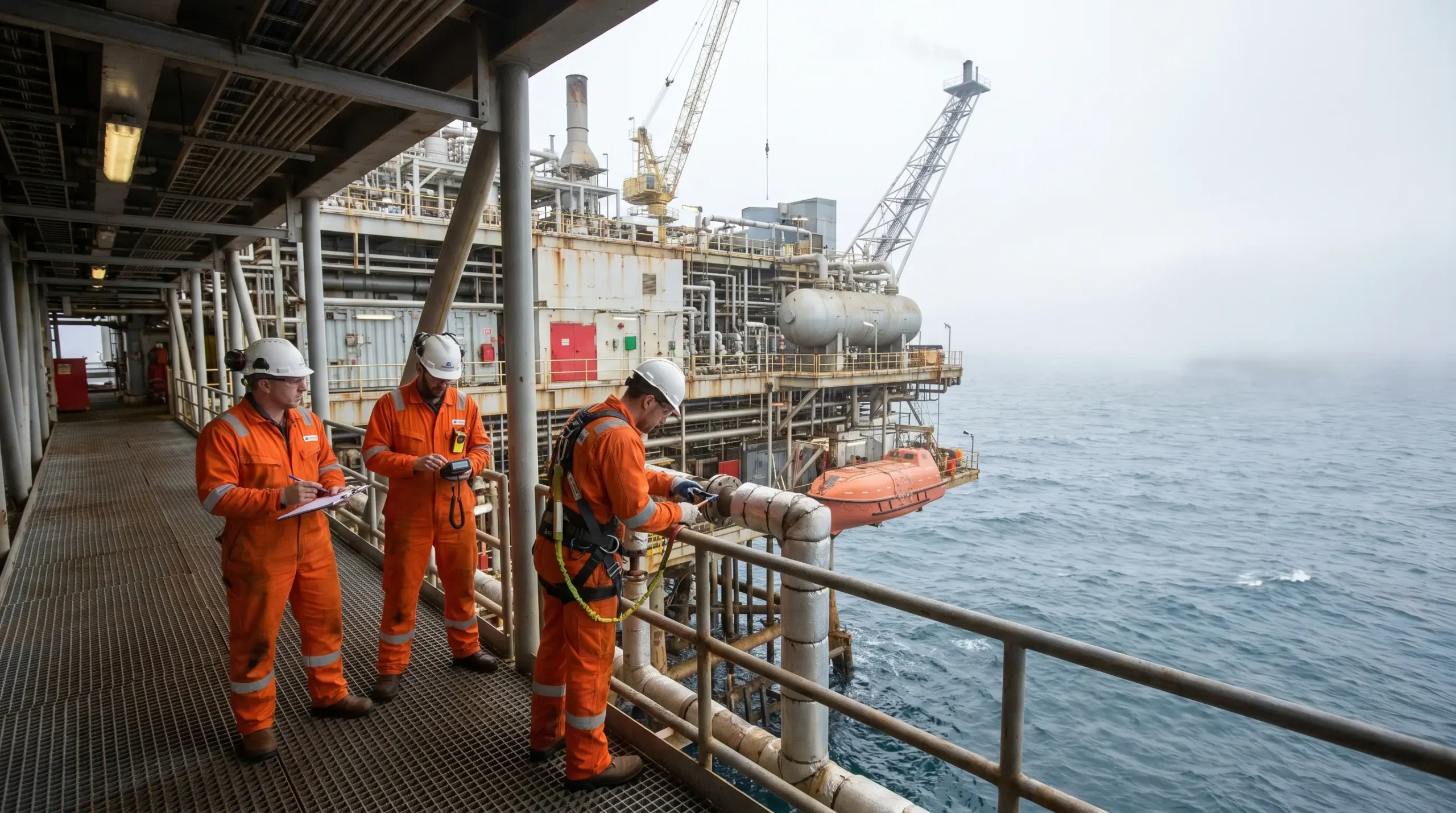
The horizon wraps the installation in a clean 360-degree line that never changes. Below the helideck, more than a hundred meters of cold grey water separate the jacket legs from the seabed. Winds across the cantilevered accommodation block average around 35 knots through the autumn months, and the nearest trauma hospital is a two-hour helicopter flight away on a calm-weather day. Every kilogram of food, diesel, spare part, and human being arrives by aircraft or by boat, and every cubic meter of produced hydrocarbon has to be processed, separated, and exported without ever touching the sea.
That is the defining context of offshore safety — a discipline forced to manage major accident hazards, occupational risk, marine exposure, and evacuation complexity all at once, on a structure the size of a few football fields. When it fails, the consequences are the kind the onshore world rarely sees: 167 killed at Piper Alpha, 11 killed at Deepwater Horizon, fields shut in for months, operators losing their licence to drill. This article walks through the three dimensions every duty holder, OIM, HSE lead, and offshore-bound worker needs to get straight — the risks that define the environment, the regulations that hold the industry to account, and the best practices that are actually driving injury and fatality rates down.
What Is Offshore Safety and Why It Demands a Unique Framework
Offshore safety is the discipline of protecting people, assets, and the marine environment across installations at sea — covering oil and gas exploration, drilling, production, decommissioning, and the rapidly expanding offshore wind sector. It sits at the intersection of occupational health and safety, process safety, marine safety, and aviation safety, and no single onshore framework covers it cleanly.
What makes offshore categorically different isn't one factor but the compounding of several. Isolation from emergency services turns what would be a manageable onshore incident into a survival scenario. Helicopter logistics make every crew change a separate high-consequence journey. High-energy hydrocarbon inventories sitting inside pressurized vessels only meters from sleeping quarters mean a single containment loss can kill everyone on board. And overlapping jurisdictions — flag state, coastal state, operator state, contractor state — can leave accountability blurred unless duty holder arrangements are formally bridged.
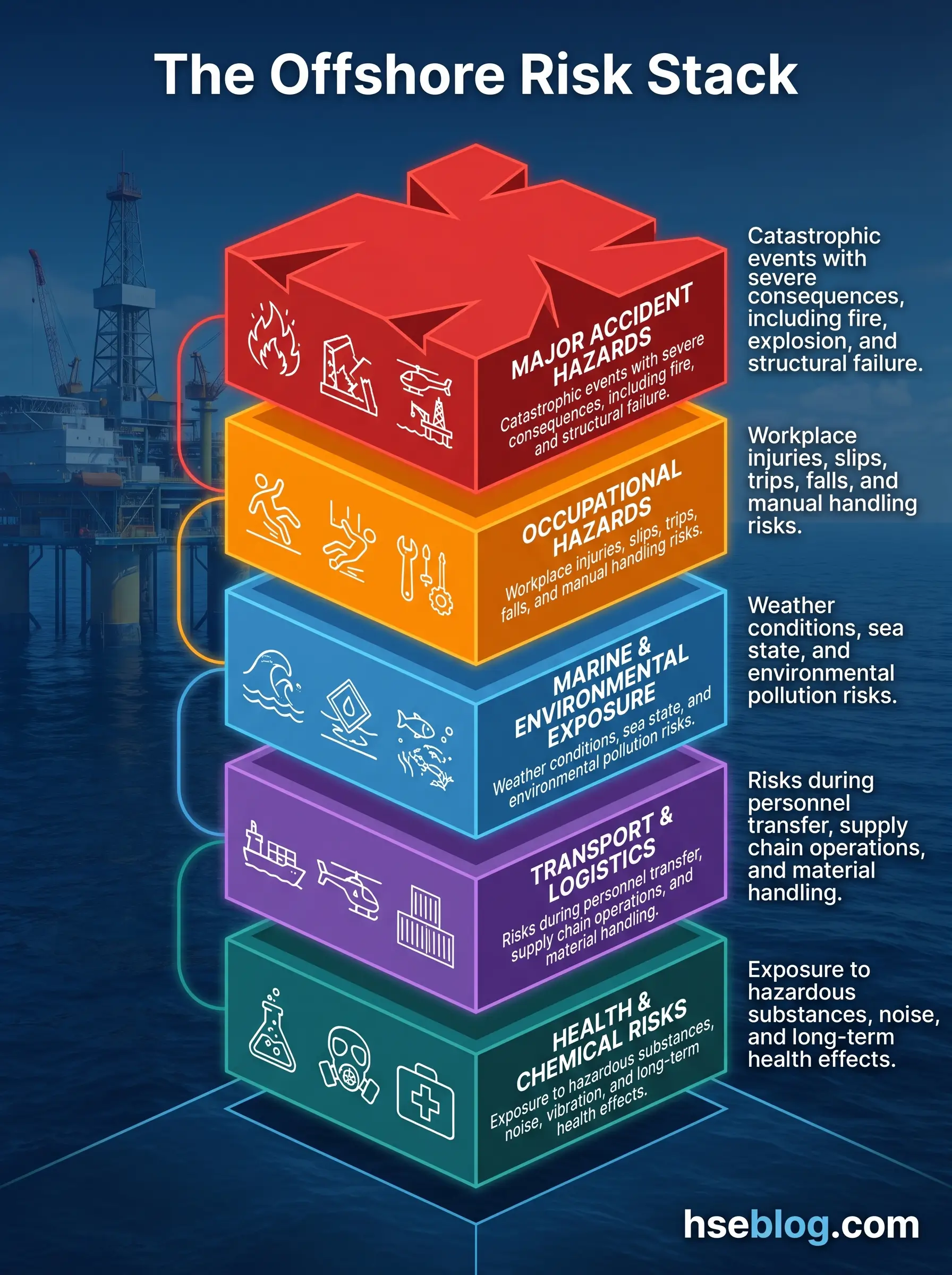
Practitioners tend to split offshore risk into two layers. The occupational layer covers the everyday hazards — dropped objects, falls, manual handling, slips on a wet grating deck. The major accident hazard (MAH) layer covers the low-frequency, high-consequence events that can destroy the installation or kill dozens at once: hydrocarbon releases, well blowouts, structural collapse, ship collision. Both layers are managed concurrently, but the MAH layer is what drives the regulatory architecture.
The key duty holders offshore are rarely just "the operator." A single platform typically involves the installation owner (often a contractor for mobile units), the operator of the hydrocarbon licence, the well operator, drilling contractors, catering and marine contractors, and specialist service companies. Offshore safety management only works when all of them are bound to a shared set of rules and a single authorised management system — which is why bridging documents and duty holder frameworks matter as much as the PPE on the rack.
The Offshore Risk Landscape: What Can Go Wrong at Sea
Walking the deck on a production platform, the risk map is almost tangible — you can smell the hydrocarbons through the firewall seals, hear the hum of the export compressors, feel the helideck flex when the Sikorsky sets down, and see the condition of the lifeboat davits under the salt corrosion. Categorizing these hazards by pathway is more useful for control design than a flat list, so the framework below groups them the way a safety case does.
Process and Major Accident Hazards
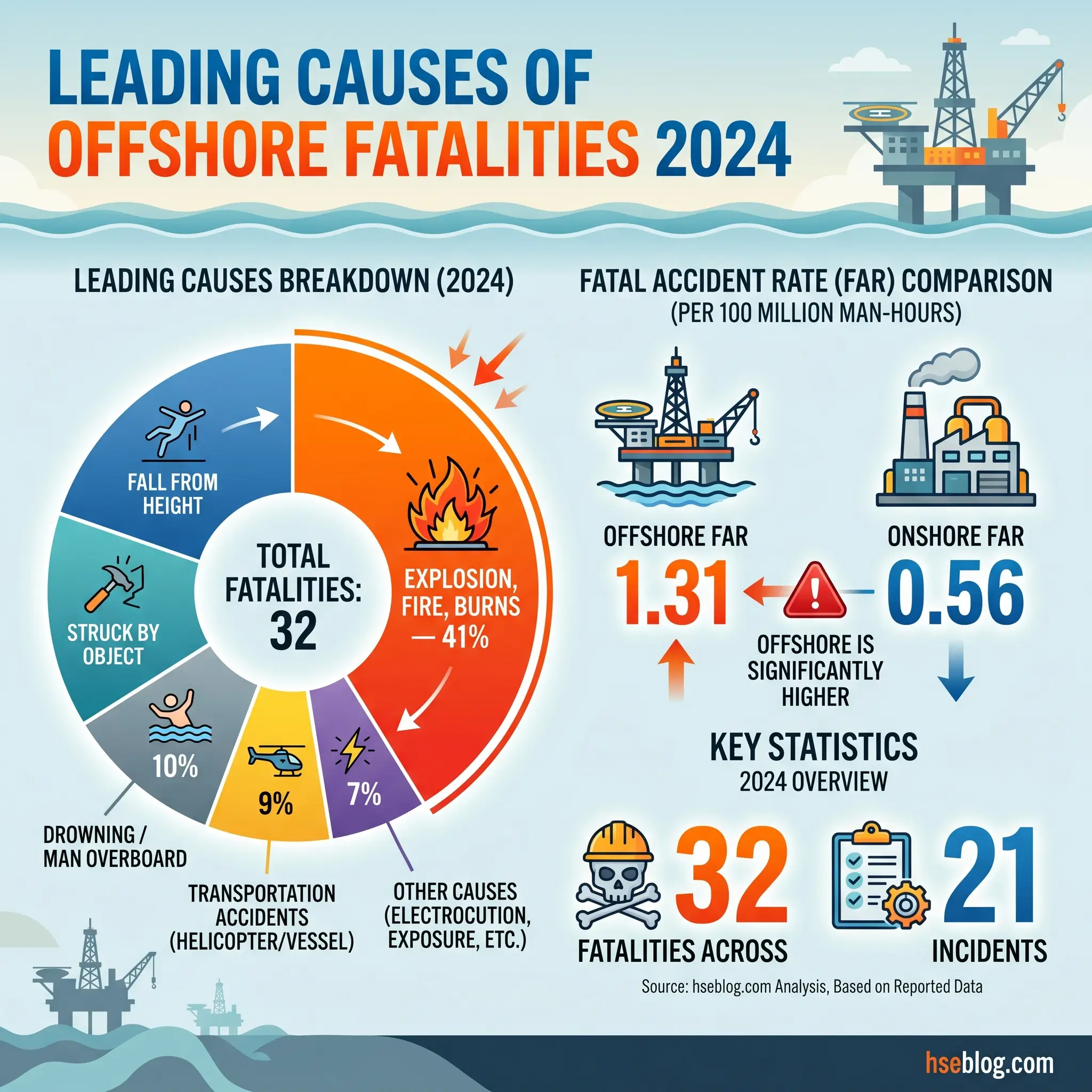
Hydrocarbon releases, pool and jet fires, vapour cloud explosions, loss of well control, blowouts, structural failure, and ship collision sit at the top of the risk register because any one of them can escalate into a multiple-fatality event. The IOGP Safety Performance Indicators for 2024 found that explosion, fire, or burns caused 41% of industry fatalities — 13 deaths across 5 incidents — making it the single largest cause category for the year. That pattern has been consistent across decades; it is the reason firewalls, blast walls, emergency shutdown logic, and temporary refuge endurance ratings are written into primary regulation rather than left to voluntary standards.
Occupational Hazards
Dropped objects from cranes and derricks, struck-by and caught-between incidents during lifting and rigging, falls from height on modules and flare stacks, confined space entry into process vessels, manual handling injuries in cargo operations, noise-induced hearing loss near gas turbines, and hand-arm vibration from impact tools all populate the occupational side. US OSHA data over the past decade has consistently shown struck-by, caught-in, and caught-between events accounting for roughly 60% of on-site oil and gas fatalities — which is why dropped object prevention schemes (DROPS) and lifting competence regimes are non-negotiable on any well-run installation.
Environmental and Marine Hazards
Hurricanes, winter storms, rogue waves, sea ice, dense fog, saltwater corrosion of safety-critical elements, and man-overboard risk all come with the territory. The 1982 Ocean Ranger capsizing off Newfoundland killed all 84 on board in a severe storm, and the 1989 DS Seacrest loss in the Gulf of Thailand claimed 91 lives after a typhoon — both disasters that ultimately drove improvements in MODU stability and weather-routing standards.
Transport Hazards
Helicopter transfer is the dominant crew-change method in most basins and remains the single riskiest part of most workers' rotation. That's why BOSIET and HUET training exist — not as box-ticking, but because the survival envelope in a helicopter ditching is measured in seconds, not minutes. Crew transfer vessel (CTV) boarding, gangway transfers, and walk-to-work systems in offshore wind add their own profile of trip, fall, and crush hazards.
Health and Chemical Hazards
Hydrogen sulphide (H₂S) remains the acute chemical hazard most offshore workers fear first — even low concentrations can incapacitate within seconds. Chronic exposures to benzene, drilling fluid additives, naturally occurring radioactive material (NORM) in scale, crystalline silica from proppant handling, and asbestos in legacy installations produce long-latency disease that rarely shows up until workers have left the industry. A good occupational hygiene program treats the long-latency risks with the same seriousness as the acute ones.
Human and Organisational Factors
Fatigue from 12-hour shifts on 2-week-on/2-week-off rotations, communication failures across shift handovers, procedural drift under production pressure, inadequate training for rare but critical tasks, and weak speak-up culture all keep appearing in incident investigations. Human factors were central findings in both the Cullen Inquiry into Piper Alpha and the US Presidential Commission on Deepwater Horizon — evidence that the occupational and major accident layers collapse into one whenever people feel unable to stop the job.
Lessons From Offshore Disasters That Shaped Modern Regulation
One hundred and sixty-seven people died on the night of 6 July 1988 when the Piper Alpha platform in the UK North Sea exploded and burned. Four offshore disasters in particular — Piper Alpha, Deepwater Horizon, Ocean Ranger, and Alexander L. Kielland — account for the shape of almost every major offshore regulation in force today.
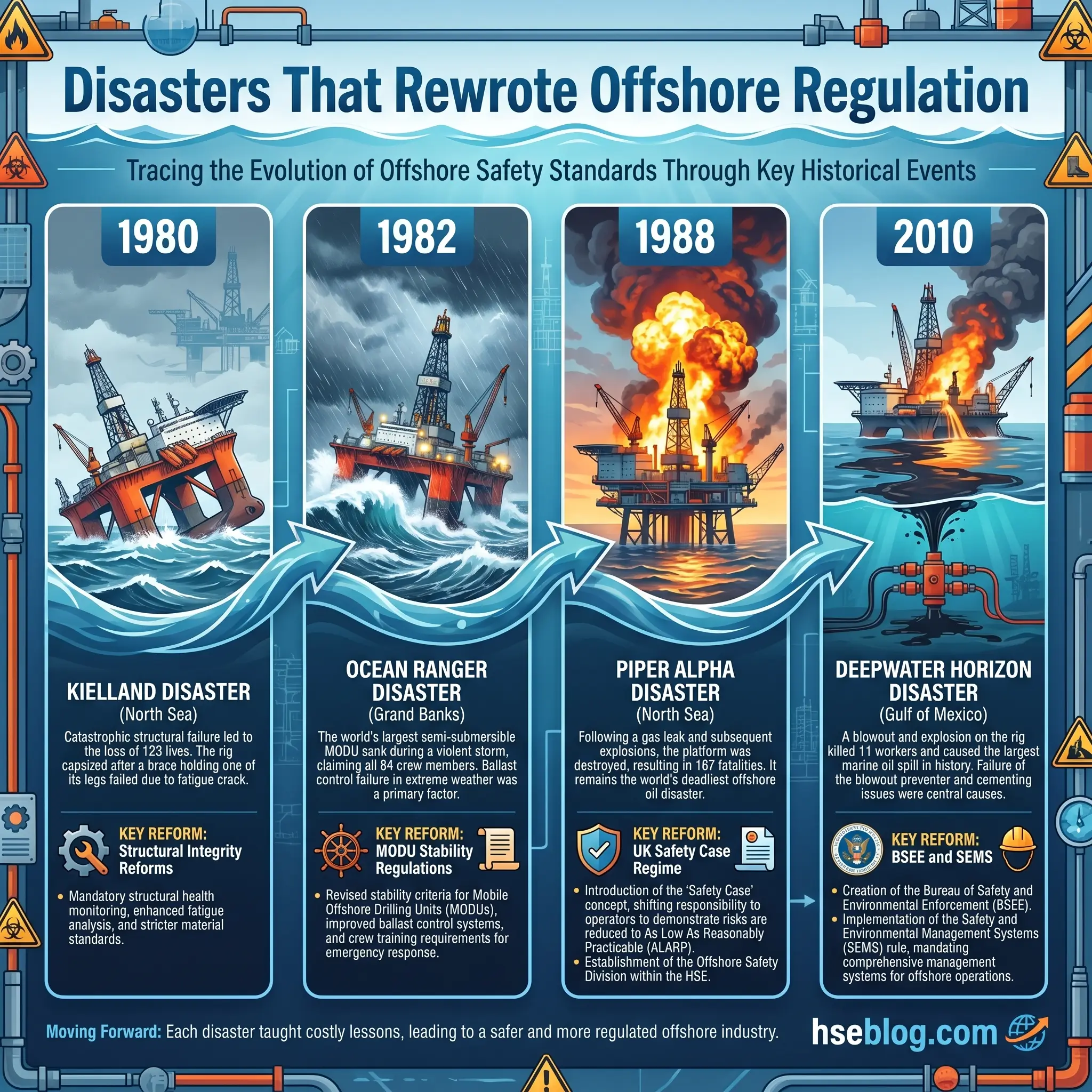
Piper Alpha (North Sea, 1988) killed 167 workers after a condensate leak from a pump whose pressure safety valve had been removed for maintenance ignited and escalated. The Cullen Inquiry identified permit-to-work breakdowns, inadequate shift handover, firewall weaknesses, and emergency shutdown failures. The regulatory consequence was the Offshore Installations (Safety Case) Regulations 1992 — the foundation of the UK goal-setting regime that still anchors the country's offshore safety architecture today.
Deepwater Horizon (Gulf of Mexico, 2010) killed 11 workers on the semi-submersible drilling unit and caused the largest marine oil spill in US history. The joint investigation identified blowout preventer failure, well design and cementing deficiencies, misinterpretation of negative pressure tests, and gaps in operator-contractor bridging. The regulatory response restructured US offshore oversight entirely, creating the Bureau of Safety and Environmental Enforcement (BSEE) in 2011 and making the SEMS rule under 30 CFR Part 250 Subpart S mandatory.
Ocean Ranger (Grand Banks, 1982) claimed 84 lives when the semi-submersible drilling rig capsized in a severe North Atlantic storm after ballast control flooding. The Royal Commission findings drove extensive revisions to MODU stability and ballast control training standards that now sit within the IMO MODU Code.
Alexander L. Kielland (North Sea, 1980) killed 123 workers after one of the pentagonal-shaped semi-submersible's legs fractured and the platform capsized in minutes. Investigation found a fatigue crack originating in a poorly welded hydrophone mounting — a reminder that safety-critical structural integrity management begins in the fabrication yard, not at operational handover.
Each of these incidents shifted the regulatory foundation. Understanding that lineage matters because compliance obligations written decades later still carry the forensic imprint of what went wrong.
Offshore Safety Regulations: A Global Overview
No single international regulation governs offshore safety. Instead, a patchwork of national regulators, coordinated international standards, and industry codes cover it — and duty holders operating across basins have to satisfy all of the ones that apply.
United Kingdom: The Safety Case Regime
UK offshore operations are regulated by the Offshore Major Accident Regulator (OMAR) — a partnership between the Health and Safety Executive (HSE) and the Offshore Petroleum Regulator for Environment and Decommissioning (OPRED). The four foundational instruments are the Offshore Installations (Offshore Safety Directive) (Safety Case etc.) Regulations 2015 (SCR 2015), the Prevention of Fire and Explosion, and Emergency Response Regulations 1995 (PFEER), the Offshore Installations and Wells (Design and Construction, etc.) Regulations 1996 (DCR), and the Management and Administration Regulations 1995 (MAR). SCR 2015 requires operators and owners to produce a safety case that HSE must formally accept before the installation can operate — the core of the UK's goal-setting model. The HSE offshore law summary remains the definitive starting point for anyone mapping obligations on the UK continental shelf.
European Union: Directive 2013/30/EU
The EU Offshore Safety Directive, adopted in direct response to Deepwater Horizon, requires Member States to licence only financially and technically capable operators, to establish independent competent authorities, and to require a Report on Major Hazards before any exploration or production activity in EU external waters. The European Union Offshore Oil and Gas Authorities Group (EUOAG) coordinates implementation across Member State regulators, aligning the EU broadly with the UK goal-setting philosophy.
United States: BSEE, SEMS, and the Well Control Rule
BSEE regulates offshore safety on the US Outer Continental Shelf under the Outer Continental Shelf Lands Act. The agency's program sits inside 30 CFR Part 250, with Subpart S making API RP 75 — the Safety and Environmental Management System standard — mandatory. The Well Control Rule, introduced post-Deepwater Horizon, sets specific standards for blowout preventer design, real-time well monitoring, and source control. The BSEE regulations index is the authoritative reference for the full rule set. BSEE conducts approximately 20,000 component inspections annually across more than 2,000 facilities in federal waters — a volume of regulatory presence that shapes day-to-day compliance culture on US installations.
Other Jurisdictions
Australia's Offshore Petroleum and Greenhouse Gas Storage (Safety) Regulations 2009, administered by NOPSEMA, mirror the UK safety case approach. Norway's Petroleum Safety Authority (PSA) regime is often regarded as the most mature, with heavy reliance on operator internal control and continuous regulator engagement. The International Maritime Organization's MODU Code and the SOLAS Convention apply to offshore units classified as ships — including most drilling units during transit and FPSOs in position.
Prescriptive vs Goal-Setting: Why Regimes Differ
The deepest divide in offshore regulation is philosophical. Prescriptive regimes — historically much of the US framework — tell the duty holder what equipment to install and what procedures to follow. Goal-setting regimes — UK, EU, Norway, Australia — tell the duty holder what outcome to achieve and require them to demonstrate risks are reduced to As Low As Reasonably Practicable (ALARP). BSEE today operates a hybrid model, keeping prescriptive elements for high-consequence equipment (like BOPs) while SEMS imports goal-setting principles from API RP 75. For duty holders operating across both hemispheres, the practical difference is whether compliance is demonstrated through evidence of outcomes or through evidence of rule-following — and that distinction changes how safety departments are staffed and how audits unfold.
| Jurisdiction | Regulator | Primary Instrument | Regulatory Approach |
|---|---|---|---|
| United Kingdom | HSE / OPRED (OMAR) | SCR 2015 | Goal-setting |
| European Union | National competent authorities | Directive 2013/30/EU | Goal-setting |
| United States | BSEE / USCG | 30 CFR Part 250 | Hybrid |
| Norway | Petroleum Safety Authority | Norwegian Petroleum Act | Goal-setting |
| Australia | NOPSEMA | Offshore Petroleum Regulations 2009 | Goal-setting |
| International (ship-like units) | IMO / Flag State | MODU Code, SOLAS | Prescriptive |
The Safety Case: What Duty Holders Must Demonstrate
Most compliance documents get filed, referenced occasionally, and ignored. The safety case is different — it is the document that proves the installation has a right to operate, and under SCR 2015 the operator cannot run hydrocarbons through the plant until HSE has formally accepted it.
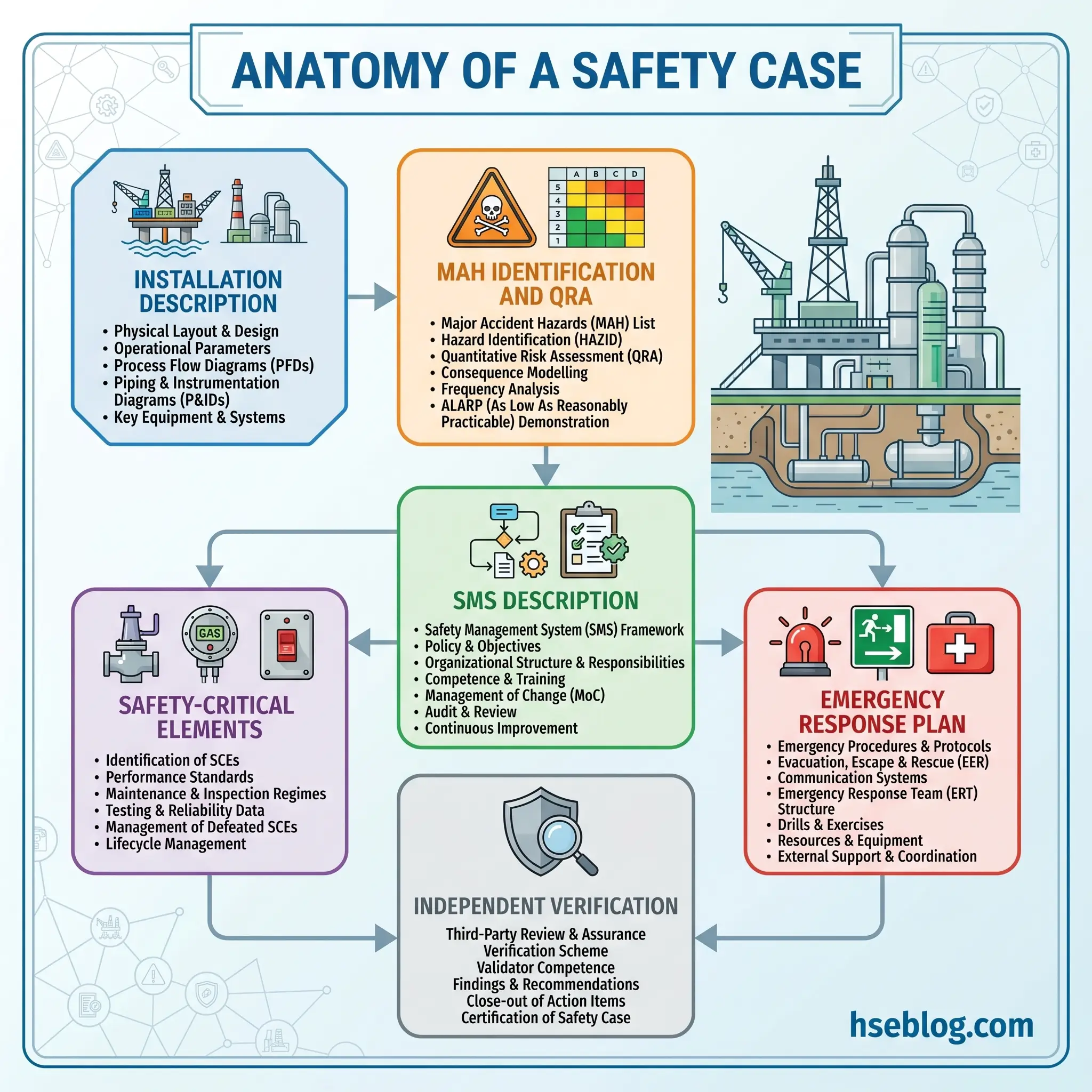
A safety case is a structured demonstration that the duty holder has identified the major accident hazards on the installation, assessed the risks arising from them, implemented controls that reduce those risks to ALARP, and has the emergency response capability to manage the residual risk. The document pulls together five core elements: a full installation description; the identification of major accident hazards with quantitative risk assessment (QRA); a description of the safety and environmental management system; the identification and performance standards for safety-critical elements (SCEs); and the emergency response plan including muster and evacuation arrangements.
ALARP is the principle that does the heavy lifting. Duty holders have to show that further risk reduction is either not reasonably practicable or grossly disproportionate to the benefit — and the burden of demonstration sits firmly on the operator, not the regulator. That framing is what forces design engineers to justify choices against alternatives rather than simply meet a minimum rule.
Independent verification of SCEs — BOPs, emergency shutdown valves, fire and gas detection, firewalls, TEMPSC — is a separate legal requirement. An independent and competent person confirms that each SCE meets its performance standard, and findings must be acted on. Safety cases also require revision when design notifications or material changes occur; duty holders cannot quietly modify an installation and update the paperwork years later.
Audit Point: When an auditor opens a safety case, the first check isn't the MAH list or the QRA calculations. It's whether the safety-critical element performance standards and their verification schedule line up with what the CMMS and the defect backlog are actually showing. That's where drift hides.
IOGP Life-Saving Rules and Process Safety Fundamentals
A data set of 1,484 fatal incidents between 1991 and 2010 sits underneath the nine IOGP Life-Saving Rules. IOGP analysis found that adherence to the behaviours the Rules describe could have prevented approximately 70% of those deaths — a finding that turned what could have been another voluntary code into the de facto behavioural safety standard across the global upstream industry.
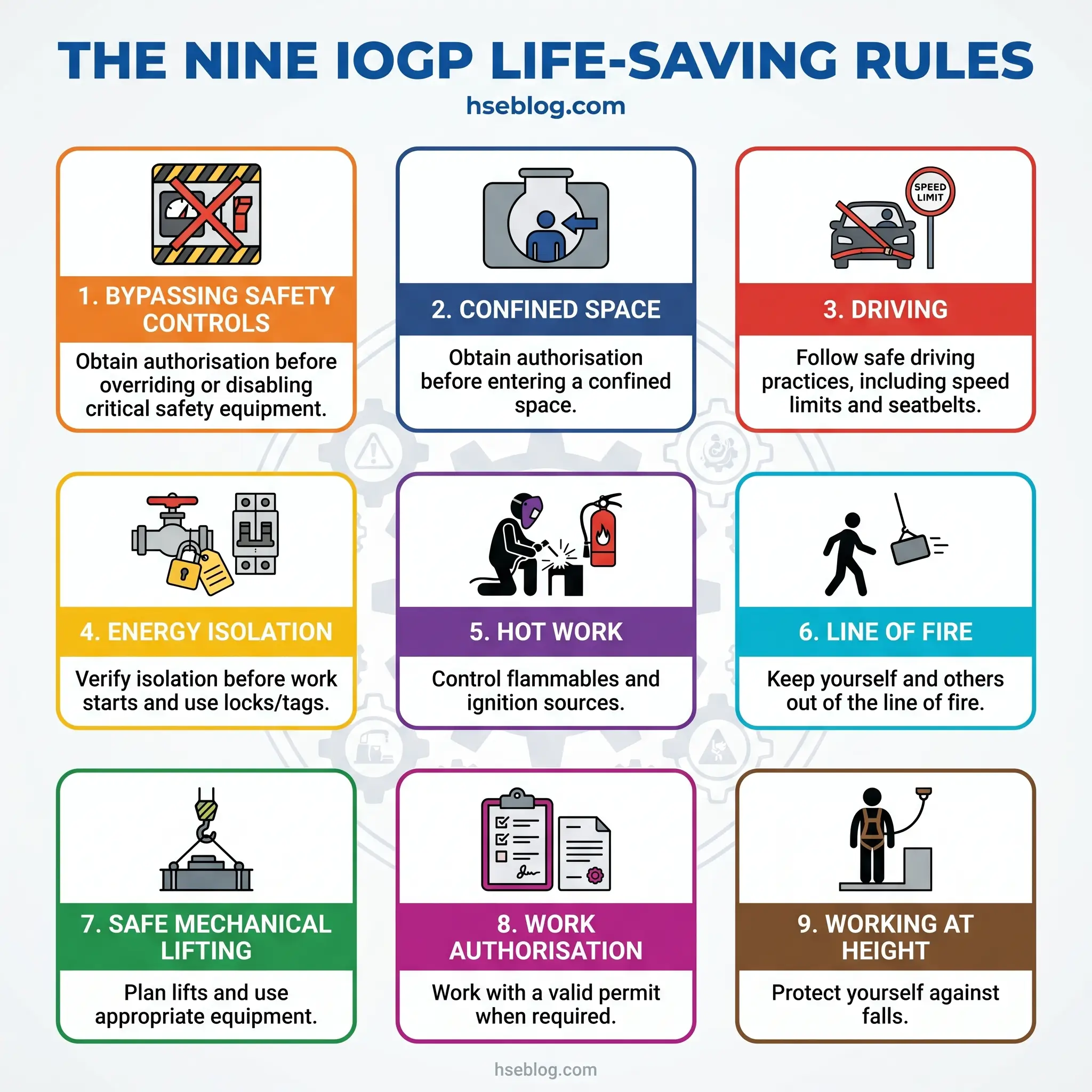
The Rules — explained in detail at the IOGP Life-Saving Rules library — cover the activities where fatalities concentrate. Each is deliberately framed as an individual worker behaviour rather than a management system element, because the failure mode being addressed is the moment of decision at the worksite. A rigger who won't stand in the line of fire of a suspended load, a fitter who refuses to break containment without an isolation certificate, a roustabout who stops the job when the harness anchor point is wrong — that's where the Rules live.
The Process Safety Fundamentals (PSFs) complement the Life-Saving Rules by addressing the process safety domain — the layer where major accidents originate. The ten PSFs include Maintain Safe Isolation, Walk the Line, Apply Procedures, Sustain Barriers, Stay Within Operating Limits, Respect Hazards, and others focused on integrity management, operating envelope discipline, and bypass control. Where the Life-Saving Rules protect the individual, the PSFs protect the inventory.
When I brief new arrivals at the induction room, the question that lands hardest isn't about the Rules themselves — it's "which one of these would have stopped Piper Alpha?" The answer is at least three: Bypassing Safety Controls, Work Authorisation, and Energy Isolation. That connection between a behaviour on the deck and a body count in history is what makes the Rules stick.
Offshore Safety Training and Competence
The failure mode that investigators find more often than equipment defects is an uncompetent person on a competent task. Offshore training requirements reflect that — and duty holders who treat the training stack as a compliance formality end up with audit findings, deployment delays, and sometimes worse.
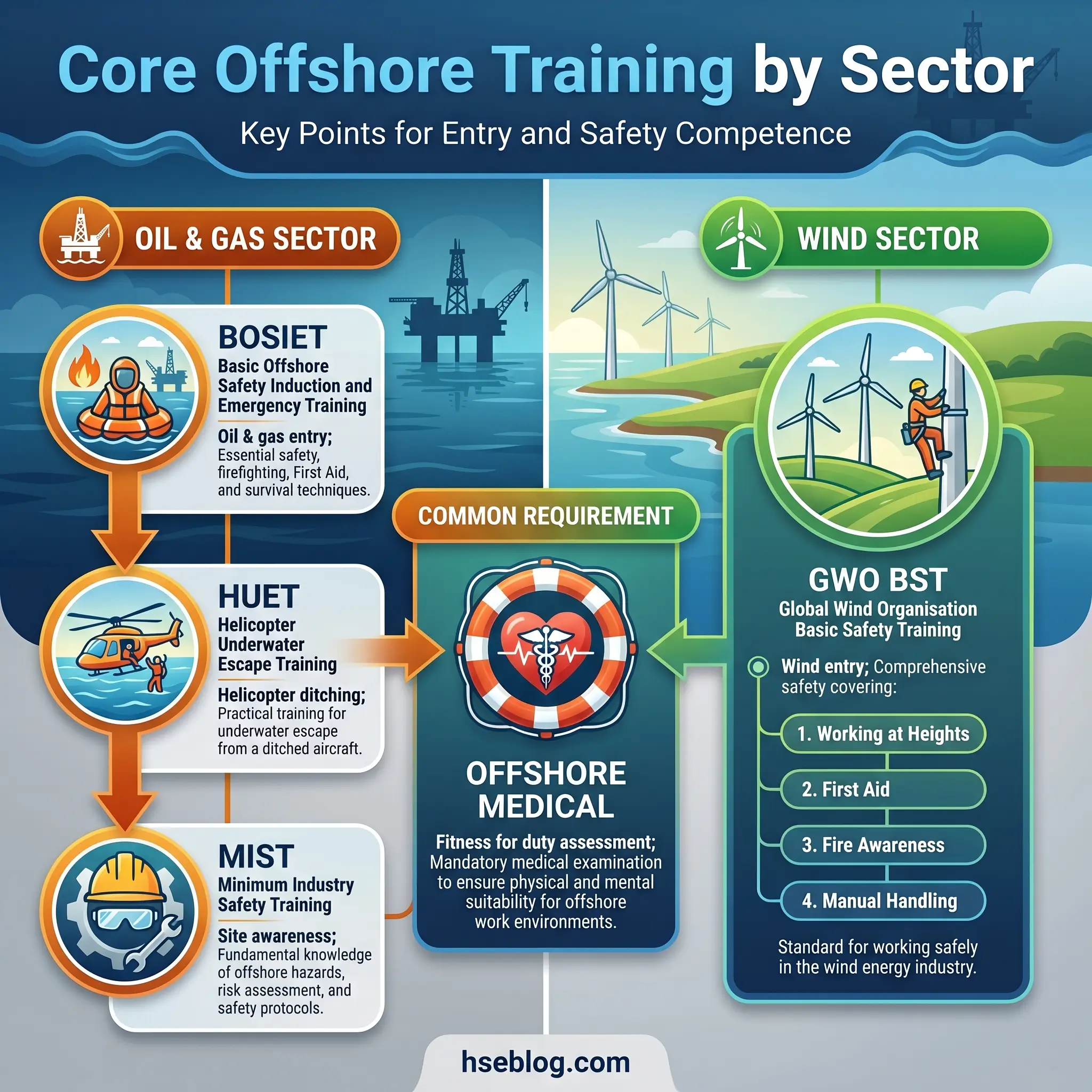
The training architecture is covered in detail at the OPITO standards library, but the core stack for oil and gas is straightforward. BOSIET — Basic Offshore Safety Induction and Emergency Training — is required for personnel new to or returning to offshore oil and gas, with variants including BOSIET with CA-EBS (for compressed air emergency breathing systems), BOSIET with EBS rebreather, and Tropical BOSIET for warm-water basins. The certificate is valid for four years and is refreshed through FOET — Further Offshore Emergency Training.
HUET — Helicopter Underwater Escape Training — is embedded in BOSIET but also exists as a standalone refresher for regular helicopter travellers. MIST or the international variant IMIST covers hazard awareness, working at height, confined spaces, manual handling, control of work, and H₂S awareness, with a two-year validity. Before any practical training, an OEUK offshore medical certificate (or jurisdictional equivalent) confirms fitness for the role.
Offshore wind runs on a parallel but distinct regime. The Global Wind Organisation's Basic Safety Training comprises five modules — Fire Awareness, First Aid, Manual Handling, Working at Heights, and Sea Survival (for offshore work). The detailed requirements sit in the GWO training standards, and each module has its own validity period, audited every two years by a GWO-accredited third party.
| Course | Governing Body | Who Needs It | Validity | Refresher |
|---|---|---|---|---|
| BOSIET | OPITO | Oil & gas offshore personnel | 4 years | FOET |
| HUET | OPITO | Helicopter travellers | 4 years | HUET refresher |
| MIST / IMIST | OPITO | All oil & gas offshore workers | 2 years | MIST refresher |
| GWO BST | GWO | Offshore wind personnel | 1–2 years per module | Module-specific |
| Offshore Medical | OEUK / national | All offshore workers | 2 years | Full re-assessment |
Role-specific competence layers sit on top of the entry stack. Control room operators need simulator-based competence in upset management. Well-site leaders need documented well-control certification (IWCF or equivalent). Crane operators, banksmen, and slinger-signallers need lifting competence under LOLER-equivalent schemes. A crew is only as competent as its least-competent authorised person on any given task.
Engineering Controls, PPE, and the Hierarchy of Control
PPE is the last line of defence, and any safety program that starts with PPE has already conceded the argument. The hierarchy of control works from the top down — elimination, substitution, engineering, administrative, PPE — and on a well-designed installation the first three layers do most of the work.
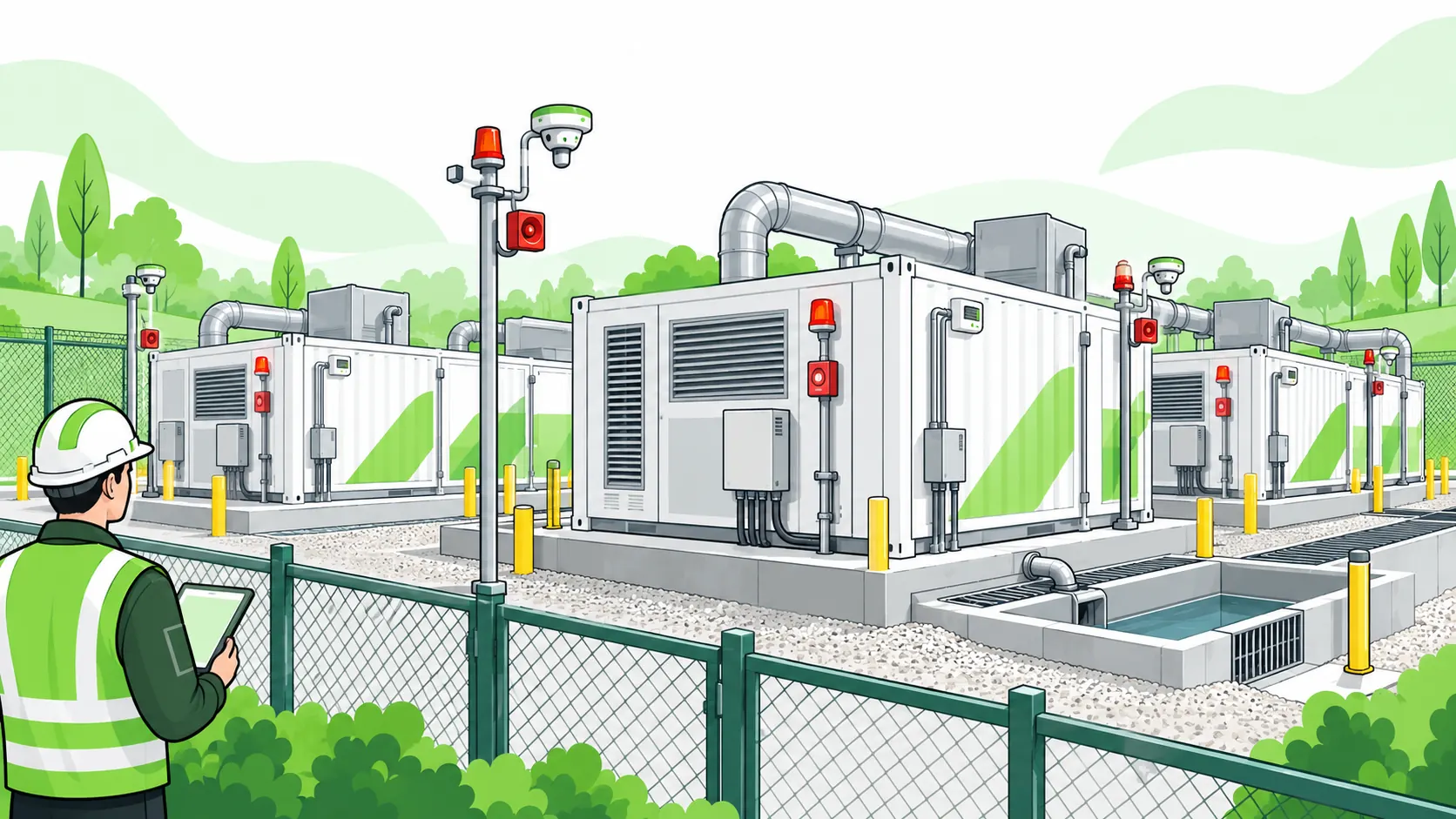
Engineering controls are where the capital investment shows. Blowout preventers (BOPs) sit on the wellhead as the primary barrier against loss of well control, with specific design, testing, and real-time monitoring requirements written into the US Well Control Rule and parallel UK and Norwegian standards. Emergency shutdown systems (ESD) segment the plant into isolated inventories so that a release in one section doesn't propagate. Fire and gas detection networks — increasingly wireless — flag leaks at ppm-level concentrations long before ignition thresholds. Firewalls and blast walls protect the temporary refuge (TR), which has a defined endurance rating against credible major accident scenarios. TEMPSC — totally enclosed motor propelled survival craft — provide the primary means of mass evacuation, and their davits sit on the maintenance schedule alongside the production turbines.
Hazardous area classification is the invisible engineering layer most visitors never notice. Under IEC 60079-10-1 and equivalents, every space on the platform is zoned — Zone 0, 1, or 2 for gas atmospheres — and electrical equipment in those zones must be certified to the appropriate Ex protection concept. A non-Ex-rated torch smuggled into a Zone 1 area is not a rule breach; it is a potential ignition source for a major accident.
PPE itself is specified to the hazard. The standard offshore stack includes flame-resistant coveralls, a hard hat with chin strap, impact-rated safety glasses, anti-slip steel-toe boots, hearing protection for designated zones, and fall-arrest harnesses for work at height. Where H₂S is present, a personal monitor and an escape hood or positive-pressure respirator are added. For helicopter transit, an immersion suit with integrated lifejacket and CA-EBS is mandatory in most cold-water basins.
Asset integrity ties it all together. Written schemes of examination for pressure systems, statutory thorough examinations for lifting equipment under LOLER-equivalent schemes, and SCE performance verification keep the engineering layer trustworthy. Without them, the hierarchy of control collapses back onto PPE — which is exactly where you don't want it.
Permit-to-Work, Risk Assessment, and Control of Work
The permit-to-work system is the single most visible operational control on any offshore installation, and its failure was at the heart of Piper Alpha. The permit that authorised the pump maintenance was not properly handed over to the control room before the backup pump was started — and the consequences killed 167 people.
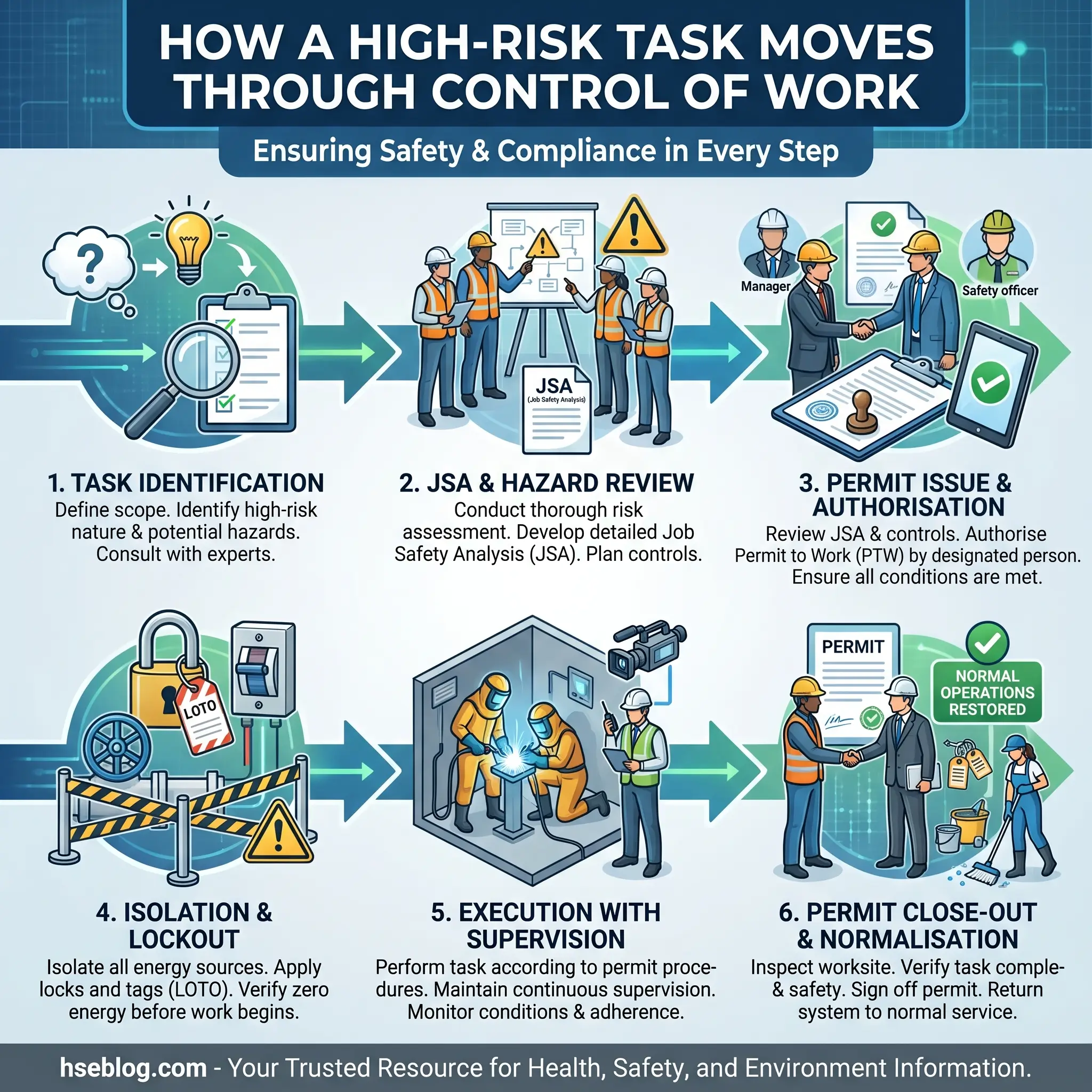
A typical high-risk task — say, replacing a section of hydrocarbon pipework inside a process module — flows through several gates. The task is identified and captured in the daily work plan. A Job Safety Analysis (JSA) or toolbox talk is held to walk the crew through the hazards and the controls. The permit-to-work is raised, reviewed against simultaneous operations (SIMOPS), authorised by the OIM or deputy, and signed by the performing authority. Energy isolation is applied under a lockout/tagout (LOTO) regime, verified by a second person, and tagged. The work is executed under supervision, with any changes triggering a stop-work and a re-authorisation. On completion, the permit is closed out, isolations are removed in a controlled sequence, and the system is normalised.
Simultaneous Operations (SIMOPS) is where the control of work process is tested hardest. When drilling is running alongside production, and well intervention is scheduled on the same shift as a confined space entry two decks below, the permit office becomes the nervous system of the installation. Weak SIMOPS management produces exactly the kind of cross-interaction incidents that kill people who had no involvement in either job.
Watch For: The quietest sign of a control-of-work system in trouble isn't a refused permit — it's a permit that gets signed without anyone asking the questions on the back of the form. The form is doing the work the conversation was supposed to do.
Management of Change (MOC) sits adjacent to PTW and governs any permanent or temporary modification to process, equipment, procedures, or personnel assignments. On a platform I worked on years earlier, a temporary bypass installed to troubleshoot a level transmitter stayed in place for two months after the troubleshooting ended — a minor MOC failure that could have become a major incident if a different upset had occurred. Bridging documents between operator and contractor safety management systems, and a genuinely exercised Stop Work Authority, complete the control-of-work picture.
Emergency Preparedness and Response
PFEER Regulation 8 in the UK, and equivalent provisions in the EU Directive and US SEMS framework, mandate an Emergency Response Plan that covers every credible scenario the safety case identifies. What sits under that requirement is more operationally complex than most plans admit.
Muster, escape, and evacuation have to work in the actual conditions — smoke filling a passageway, a listing platform, a storm outside making helicopter evacuation impossible. The evacuation hierarchy runs through several tiers, and drill realism is where most weaknesses show up.
The primary means of evacuation are typically:
- Helicopter lift from the helideck where weather and platform stability permit.
- TEMPSC launch from davits — totally enclosed motor propelled survival craft designed to drop into the sea and motor away.
- Life rafts as tertiary means, with controlled descent or scramble nets.
- Direct entry into the sea as the last resort, with immersion suit protection.
Temporary refuge integrity is the anchor concept. The TR is the designated safe area where personnel muster if the installation cannot be immediately evacuated, and it has an endurance rating — typically one or two hours — against the heat and smoke loads from credible major accident scenarios. If the TR integrity fails during an emergency, the entire emergency response logic collapses.
Search and rescue coordination with the national Coastguard and the standby vessel is written into the ERP, as is medical evacuation (medevac) arrangements — which, given the two-hour flight times in some basins, can be the difference between survival and fatality for a serious trauma case. Spill response capability under the Oil Pollution Emergency Plan (OPEP) required by OPRC 1990 covers the environmental response tier.
Drill realism is the honest test. Quarterly musters and annual full-scale exercises are the minimum — but a drill where the scenario is known in advance, no one is actually stressed, and the debrief is a formality doesn't prepare anyone for a real event. Good installations run drills with unannounced scenarios, deliberate equipment failures injected, and honest performance reviews that feed back into the safety case.
Offshore Wind Safety: A Distinct Discipline
The offshore wind sector now rivals offshore oil and gas in workforce size in several basins, and its hazard profile is different enough to demand a separate safety architecture. Hydrocarbons are absent, but working-at-height, electrical, and marine exposure dominate in their place.
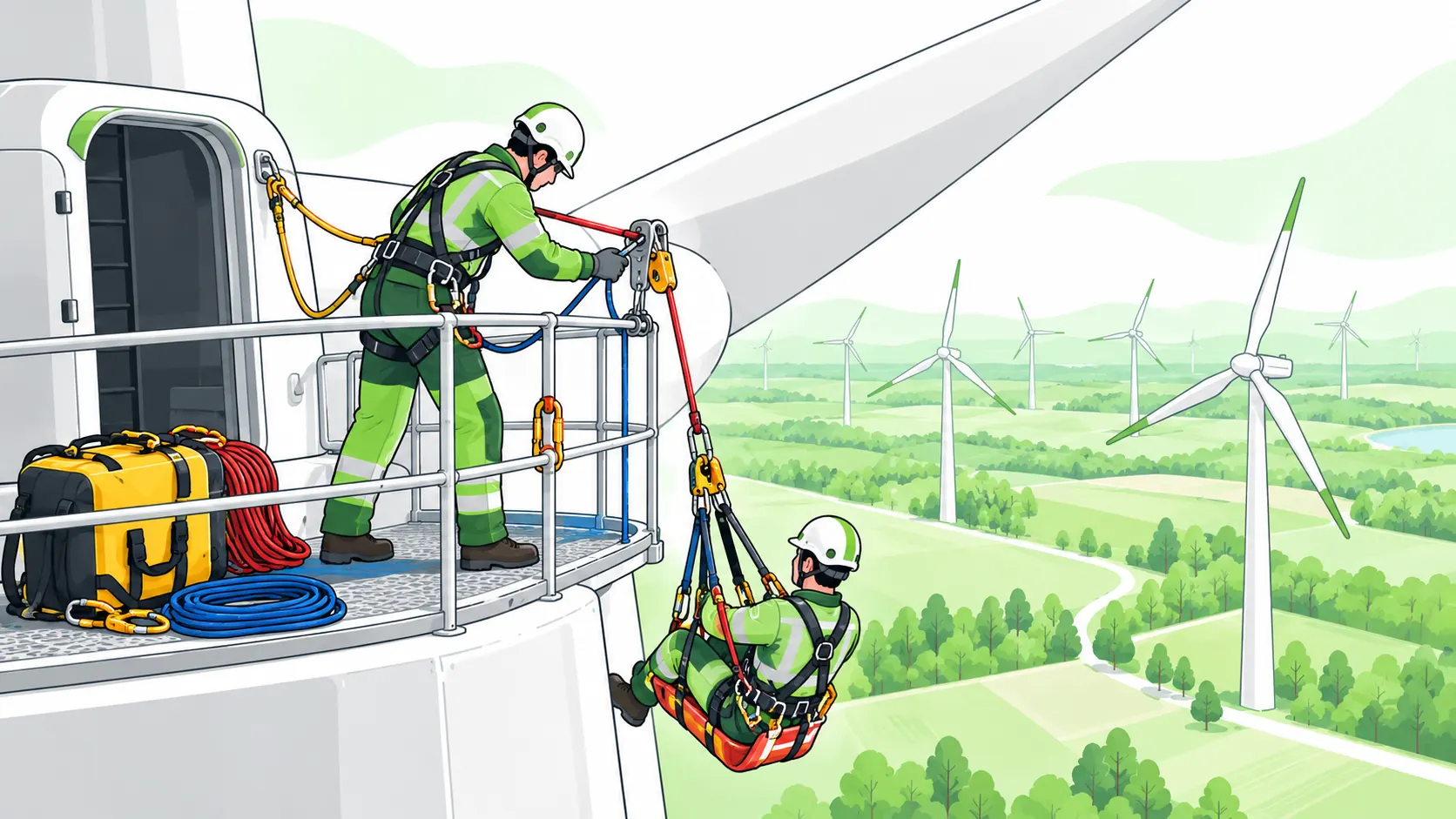
The physical reality is what sets the tone. Turbine hub heights on the current generation of offshore wind turbines range from around 80 metres to over 150 metres, with blade tips reaching beyond 260 metres. Technicians spend most of their working day in vertical exposure — climbing towers, working on nacelle platforms, performing blade inspections from suspended access, and transiting between turbines by crew transfer vessel (CTV) or helicopter. Electrical hazards inside the nacelle include live low-voltage and high-voltage systems with significant arc flash potential. Confined spaces in the hub and nacelle add another layer.
GWO standards dominate the training picture. The Basic Safety Training modules cover Fire Awareness, First Aid, Manual Handling, Working at Heights, and the offshore add-on of Sea Survival. Advanced Rescue Training (ART) and Blade Repair Technician standards build on the base. The G+ Global Offshore Wind Health and Safety Organisation shares incident data across member operators, driving industry-level learning in a sector still establishing its safety baseline.
Regulatory coverage differs from oil and gas. In the UK, offshore wind installations generally fall under the Health and Safety at Work Act 1974 and associated general regulations, with sector guidance from HSE and industry bodies rather than the SCR 2015 Safety Case regime — though larger operators increasingly apply safety case principles voluntarily as the sector scales. A colleague who moved from a mature North Sea oil and gas operator into a developer on a large offshore wind farm described it simply: "The hazards are different, the paperwork is thinner, and the learning curve on marine coordination is steeper than anyone admits."
Convergence points with oil and gas include helicopter transport (shared BOSIET/HUET principles increasingly cross-recognised), marine vessel coordination, and the application of EER (escape, evacuation, and rescue) frameworks. The sectors are beginning to share HSE talent, and that cross-pollination is producing better practice in both directions.
Emerging Technologies Changing Offshore Safety
The technologies coming into offshore safety over the past two years are doing more than incremental improvement — they are removing people from high-risk environments in categories of work that used to demand physical presence. That shift matters because the most effective safety control remains the one that eliminates human exposure entirely.
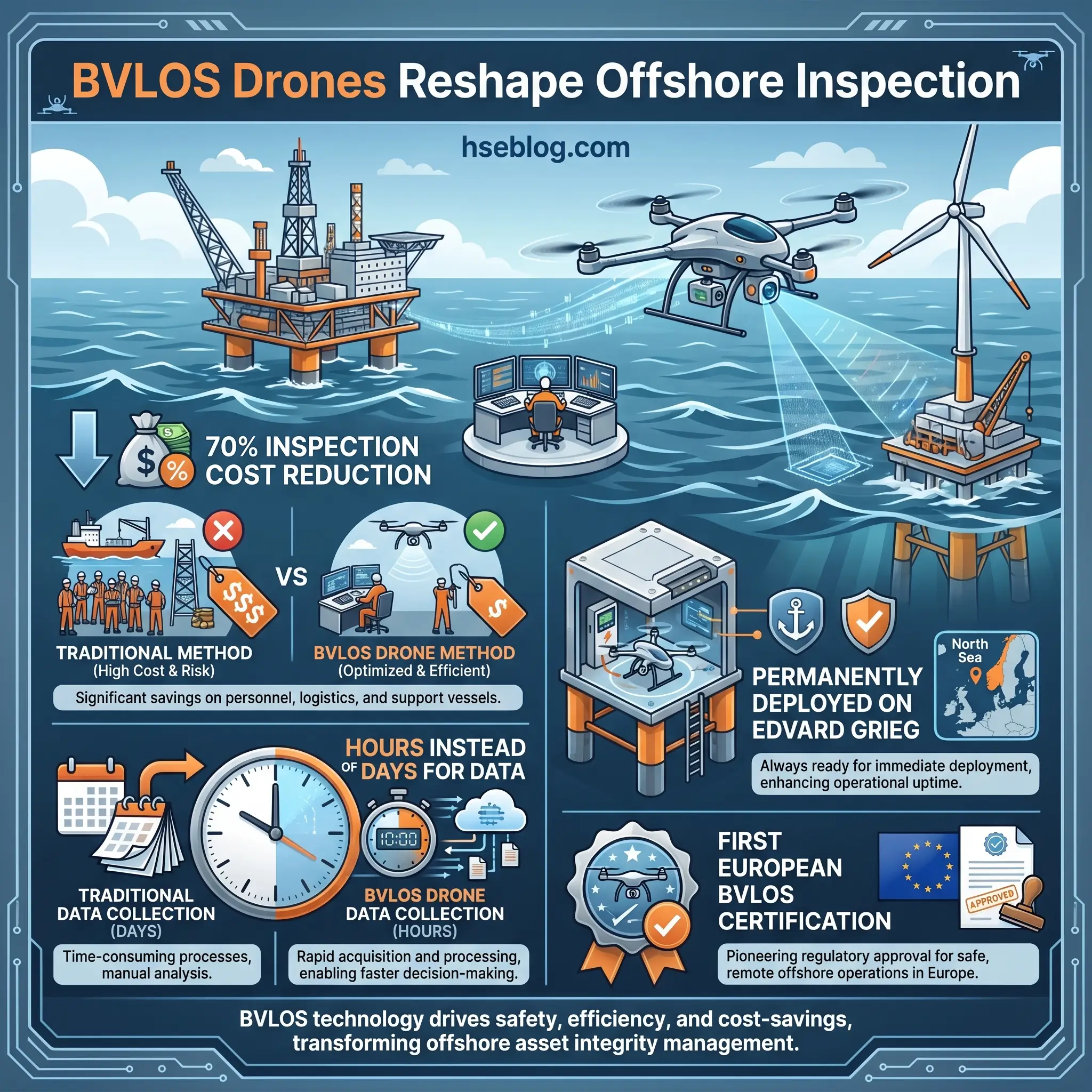
Autonomous drones now lead the curve. Aker Solutions became the first European company awarded full Beyond Visual Line of Sight (BVLOS) certification in 2025, enabling permanently deployed drones on the Edvard Grieg platform in the Norwegian North Sea. The company estimates inspection cost reductions of up to 70% and delivery of detailed structural inspection data within hours rather than days — with the larger safety benefit being the reduction of rope access and working-at-height exposure during routine inspection campaigns.
Digital twins are now standard on newer FPSO and platform projects. Equinor's Johan Sverdrup digital twin is the reference case study, used for operational simulation, permit-to-work visualisation, and remote intervention planning. The twin allows engineers onshore to walk through a modification before the work is executed offshore, catching interferences and access problems that would otherwise only emerge at the worksite.
Subsea robotics — remotely operated vehicles (ROVs) and autonomous underwater vehicles (AUVs) — have steadily replaced divers for routine inspection, pipeline survey, and light intervention work in most mature basins. AI-powered gas detection flags leak patterns in seconds by recognising signatures across sensor networks, and predictive maintenance models catch equipment degradation trends that used to only show up in failure.
On the worker-attached side, connected PPE is moving from pilot to production. Gas-detection headgear, smart harnesses with fall-detection and automatic alerting, and AR-equipped helmets for remote expert guidance are starting to appear on platforms and wind turbines. Duty holders should note that each of these technologies imports new cyber-physical risks and new human-factors considerations — and those have to be worked into the safety case rather than assumed away. IOGP's ongoing development of Process Safety in Design guidance is already folding these considerations into new-build expectations.
Building a Strong Offshore Safety Culture
Technology and procedures don't prevent incidents on their own. What connects them is culture — and on an installation it is visible within the first few hours if you know what to look for. Safety climate is perception; safety culture is embedded values. The two don't always match.
Leadership visibility offshore is the most reliable indicator. An OIM who walks the modules at different hours, talks to the night shift roustabouts, and sits in on toolbox talks generates a different operational reality than one who manages from the office. Psychological safety — the extent to which anyone on the platform can stop a job or raise a concern without career consequence — is the embedded version of Stop Work Authority, and it separates installations where near-misses get reported from installations where they don't. Both the Piper Alpha and Deepwater Horizon investigations returned to this point.
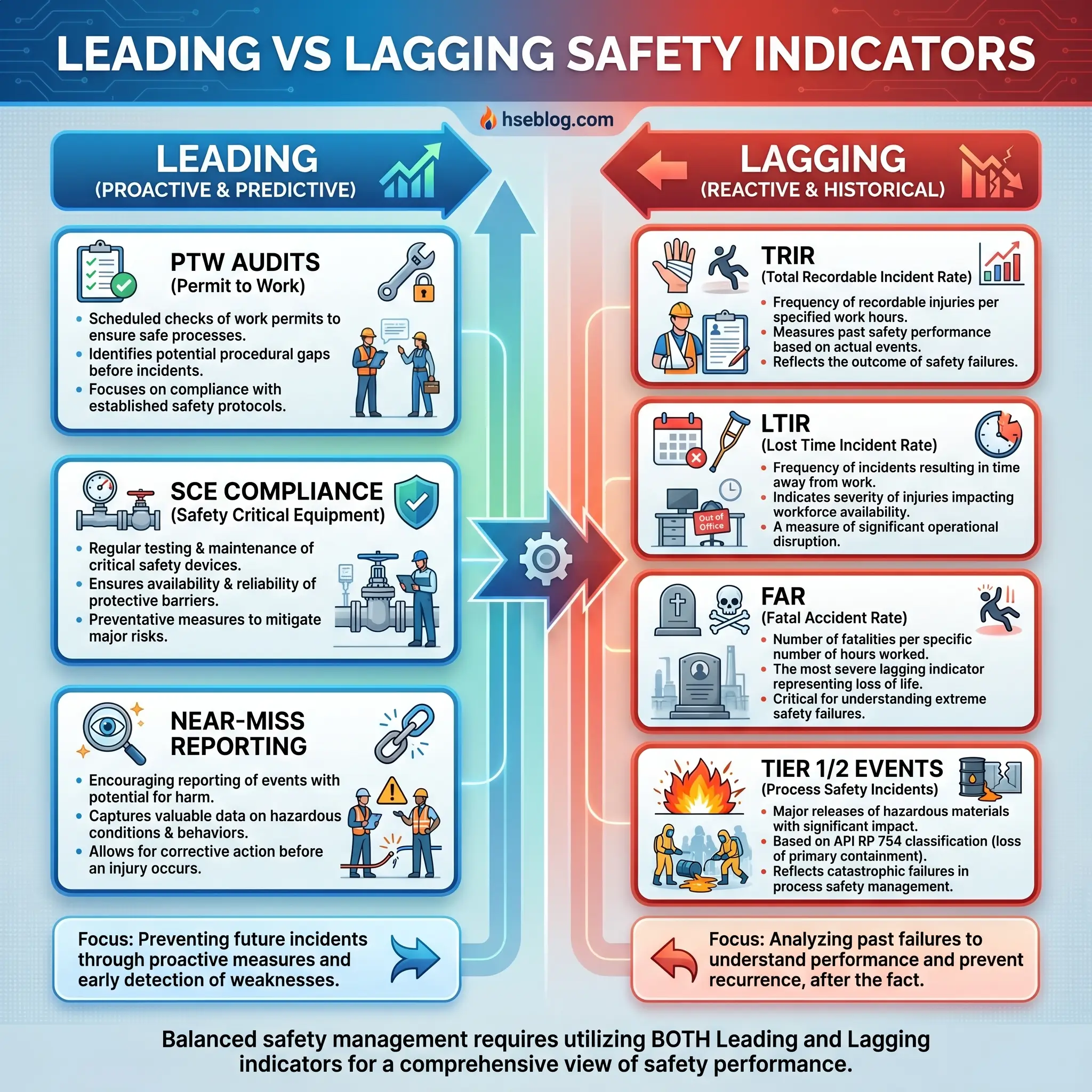
Just Culture frameworks distinguish between honest mistakes, at-risk behaviour, and reckless action — and apply proportionate responses to each. Without that framework, error reporting collapses and the organisation loses its most important leading indicator. Leading indicators offshore typically include permit-to-work audit scores, SCE performance standard compliance, safety observation program quality, and participation rates in near-miss reporting. Lagging indicators — Total Recordable Injury Rate (TRIR), Lost Time Injury Rate (LTIR), Fatal Accident Rate (FAR), and process safety event counts under the IOGP Tier 1 and Tier 2 definitions — tell the organisation what has already happened.
Fatigue management on 2-week-on/2-week-off rotations is the cultural dimension most frequently neglected. Twelve-hour shifts over two weeks produce cumulative sleep debt, and the fatigue curve is well documented in offshore human-factors research. Good operators run fatigue-risk management programs with documented work-rest limits, journey risk assessments for helicopter travel, and rotation design that acknowledges human biology rather than fighting it.
Frequently Asked Questions
What are the biggest risks of working offshore?
Explosion, fire, and burns remain the single largest fatality category — IOGP reported they accounted for 41% of oil and gas deaths in 2024. After that, the major risk areas are helicopter transport incidents, falls from height, dropped objects during lifting, H₂S exposure, and loss of well control events. The specific risk profile shifts depending on whether the installation is drilling, producing, or being decommissioned.
Who regulates offshore safety?
Regulation is jurisdictional rather than international. In the UK, the Offshore Major Accident Regulator — a partnership of HSE and OPRED — administers SCR 2015, PFEER, DCR, and MAR. In the US, BSEE regulates under 30 CFR Part 250, with the US Coast Guard covering vessel-side requirements. Australia uses NOPSEMA, Norway uses the Petroleum Safety Authority, and the EU coordinates Member State competent authorities under Directive 2013/30/EU. The IMO governs offshore units treated as ships globally.
What is an offshore safety case and when is it required?
An offshore safety case is a document in which the duty holder demonstrates that major accident hazards on the installation have been identified, risks have been reduced to ALARP, and emergency response is adequate. Under SCR 2015 in the UK, HSE must formally accept the safety case before hydrocarbons flow through the plant. Material changes, design notifications, and periodic reviews all trigger revision obligations — a safety case is a live document, not a one-off submission.
Is BOSIET mandatory to work offshore?
For personnel travelling to offshore oil and gas installations by helicopter in most jurisdictions, yes. OPITO's BOSIET standard is the industry baseline, with variants for CA-EBS, EBS rebreather, and Tropical conditions depending on the basin. A BOSIET certificate is valid for four years and is refreshed through FOET. STCW-certified seafarers can in some cases follow a conversion route rather than the full BOSIET. Offshore wind personnel follow the GWO Basic Safety Training pathway instead.
How dangerous is offshore work compared to other industries?
US Bureau of Labor Statistics data for 2022 recorded a fatal injury rate of 14.2 per 100,000 full-time equivalent workers in oil and gas extraction, against a private-industry average of 3.7 — nearly four times higher. Offshore specifically carries a higher consequence profile than onshore; IOGP's 2024 data recorded an offshore FAR of 1.31 compared with an onshore FAR of 0.56. The long-term picture is better: the industry's FAR has fallen more than 90% since 1985.
What's the difference between offshore oil and gas safety and offshore wind safety?
The hazard profiles diverge. Oil and gas safety centres on hydrocarbon process safety, major accident hazards, and blowout prevention. Offshore wind safety centres on working at height, electrical hazards in the nacelle, blade work, and marine transfer. Training regimes differ too — OPITO BOSIET for oil and gas, GWO BST for wind. Regulatory scope also differs: UK oil and gas sits under the SCR 2015 Safety Case regime, while UK offshore wind operates under the general Health and Safety at Work Act framework with sector guidance.
Conclusion
The next decade of offshore safety will be shaped less by new rulebooks and more by how existing goal-setting frameworks absorb new technologies and a rapidly growing offshore wind workforce. Safety cases will carry sections on autonomous inspection systems and digital twin integration that didn't exist five years ago. BVLOS drone operations will move from Aker Solutions' first-mover status to standard practice across basins, and IOGP's updated Process Safety in Design guidance will pull cyber-physical considerations into the front end of project engineering where they belong.
For duty holders, the direction is clear. Major accident hazard control will keep anchoring everything — the post-Piper Alpha and post-Deepwater Horizon regulatory architecture is not going to soften. But the edges are changing: offshore wind safety will continue to mature toward safety-case-style rigour even where regulation doesn't mandate it; IOGP Life-Saving Rules adherence will become table stakes rather than differentiator; and duty holders who can demonstrate leading-indicator performance will carry an advantage in licensing rounds and contractor selection.
Offshore safety has never been static, and the practitioners who keep installations safe are the ones who treat every rotation as a fresh engagement with a risk landscape that rewards attention and punishes complacency. The frameworks, the regulations, and the emerging technologies are all tools. The judgement about when to use them still sits with the person on the deck.