
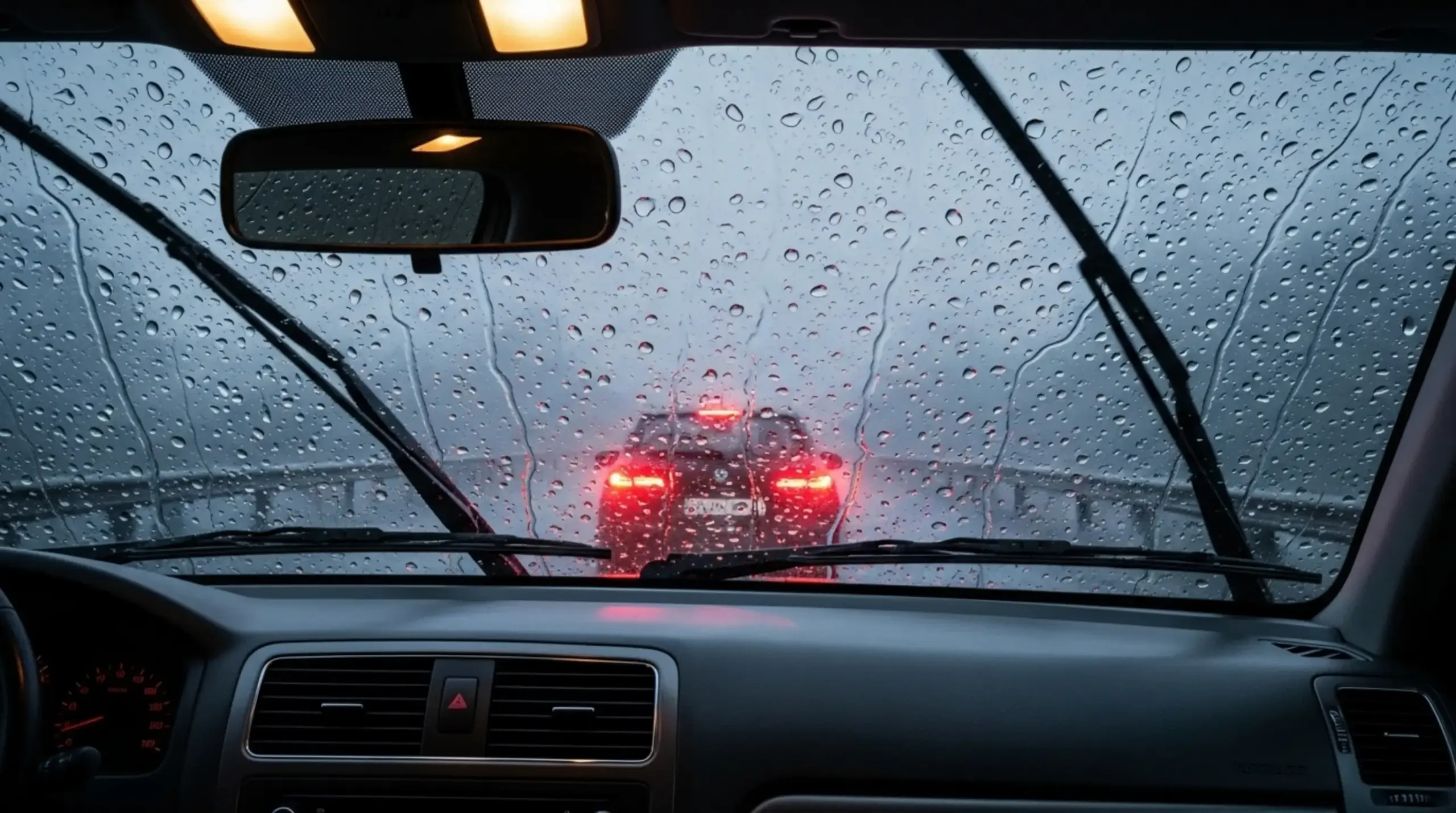
I was managing a logistics safety audit during a monsoon downpour when a heavy goods vehicle (HGV) skidded off the access road, narrowly missing a transformer bank. The driver was experienced, but he had fallen into the common trap of treating wet asphalt like dry concrete. Even with top-tier maintenance programs, the physics of a rain-slicked road don’t care about your schedule or your years behind the wheel; once the film of water separates rubber from the road, you are a passenger in a multi-ton kinetic object.
Driving in the rain is one of the most underestimated high-risk activities in any industrial or public setting. This article covers the mechanical realities of wet-weather traction, the psychological shifts required for safe operation, and the field-tested maneuvers that prevent “loss of control” incidents. We will focus on visibility, speed management, and the technical hazards of hydroplaning and flash flooding.
TL;DR
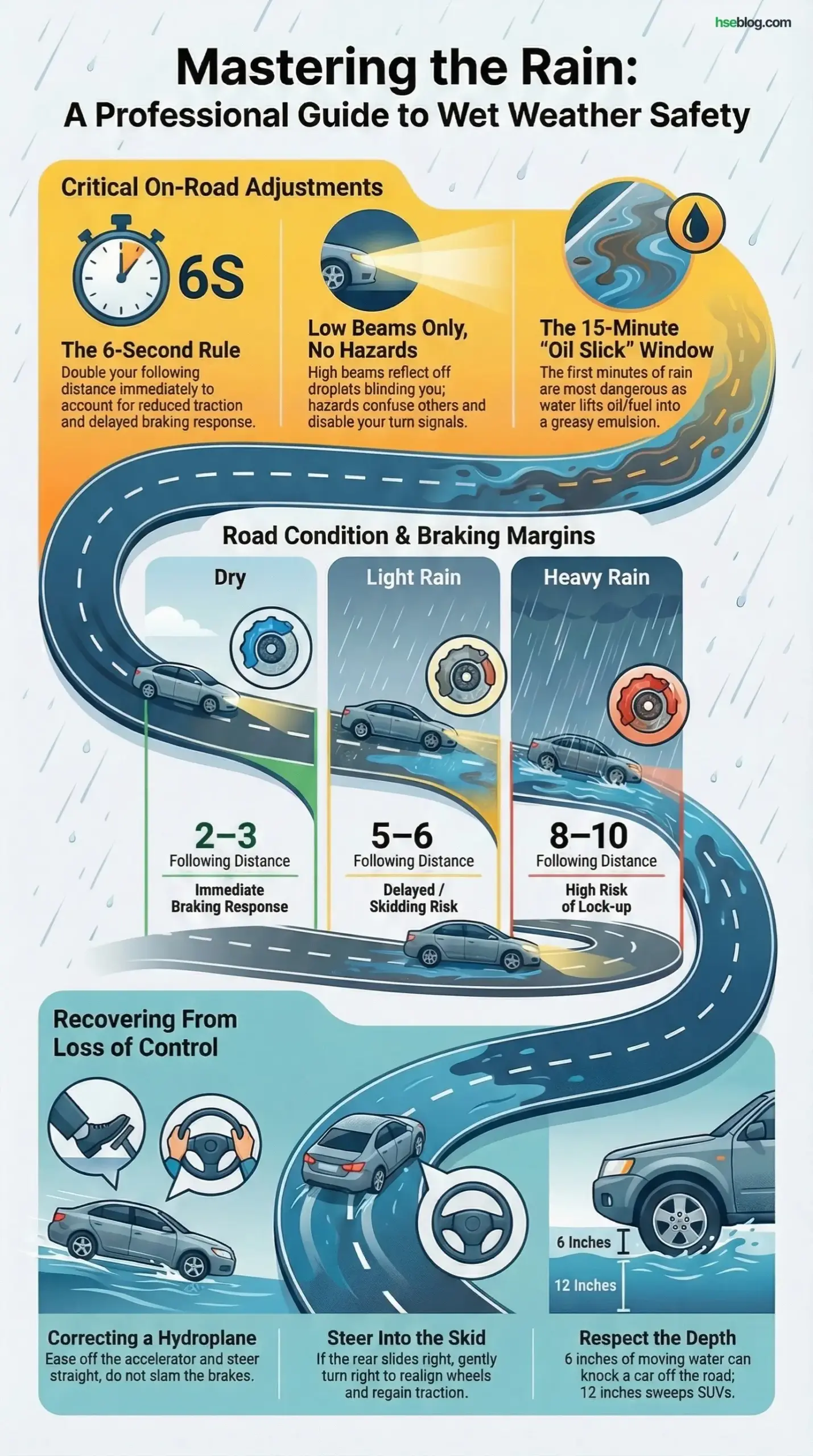
- Visibility is Life: If you can’t see the road or be seen, you shouldn’t be on it; clean your glass and use low beams, never hazards.
- The 6-Second Rule: Double your following distance immediately to account for increased braking distance and reduced tire traction.
- Avoid the “Float”: Steer straight and ease off the accelerator if you feel the steering go light (hydroplaning); never slam the brakes.
- Respect the Depth: Six inches of moving water can knock a car off the road; if you can’t see the pavement, don’t cross.
1. Maintaining Visibility and Communication
During vehicle inspections, I often find wipers that are cracked or “chattering,” which tells me the driver is unprepared for the first storm of the season. Visibility isn’t just about your eyes on the road; it’s about ensuring every other operator knows exactly where you are located.
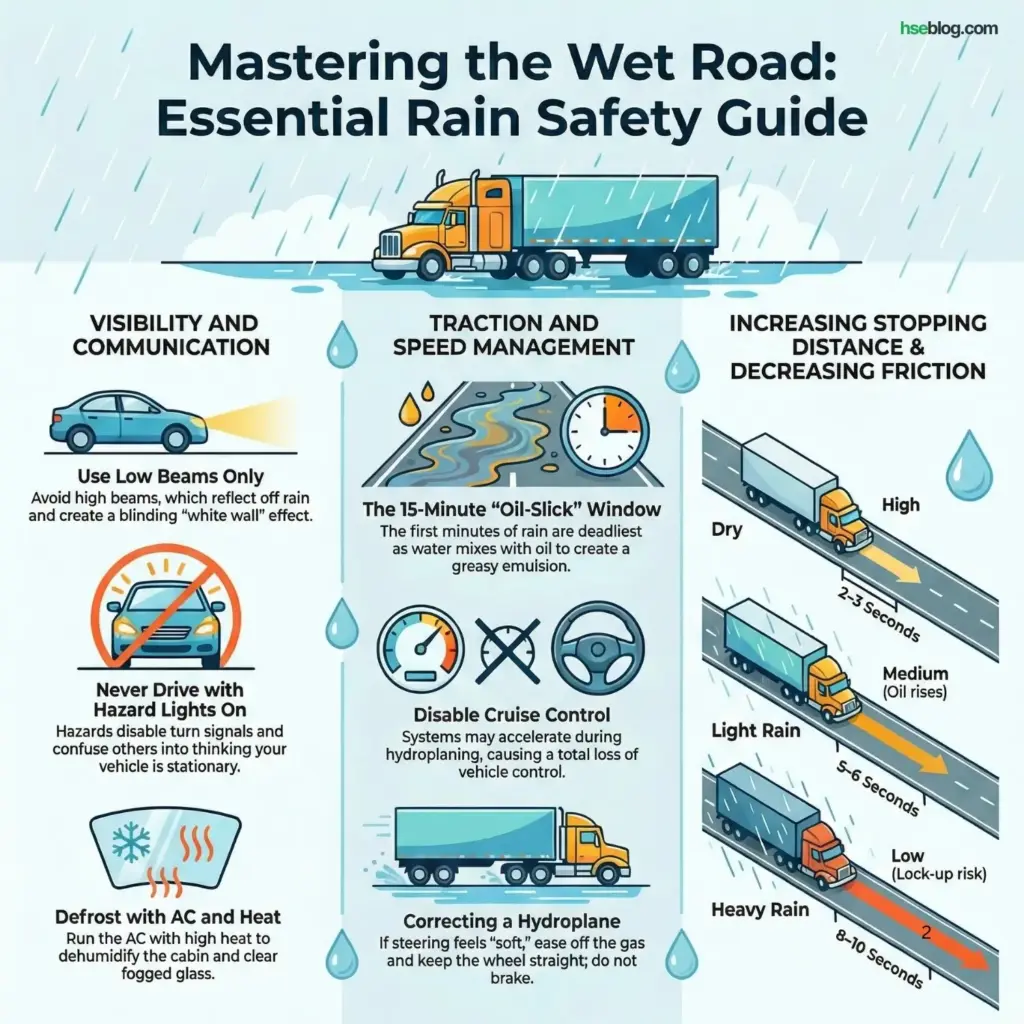
- Low Beams Only: Use your headlights, but avoid high beams. High beams reflect off the water droplets, creating a “white wall” effect that blinds you.
- Defrost Immediately: Rain causes rapid temperature drops on the windshield, leading to internal fogging. Run the AC with the heat turned up to dehumidify the cabin.
- The Hazard Light Mistake: Never drive with your hazard lights on in the rain. It confuses other drivers who may think you are a stationary object, and it disables your turn signals when you actually need to change lanes.
- Clean the Glass: Oil and road grime build up on the windshield. Use a dedicated glass cleaner; a simple water spray won’t cut the oily film that causes dangerous glare at night.
2. Managing Speed and Following Distance
In my investigations of rear-end collisions during rain events, the primary root cause is almost always “speed unsuitable for conditions.” Even if you are driving under the posted speed limit, you can still be cited for driving too fast if the road is wet.
Braking and Distance Metrics
The table below illustrates how rain fundamentally changes your vehicle’s capability to stop.
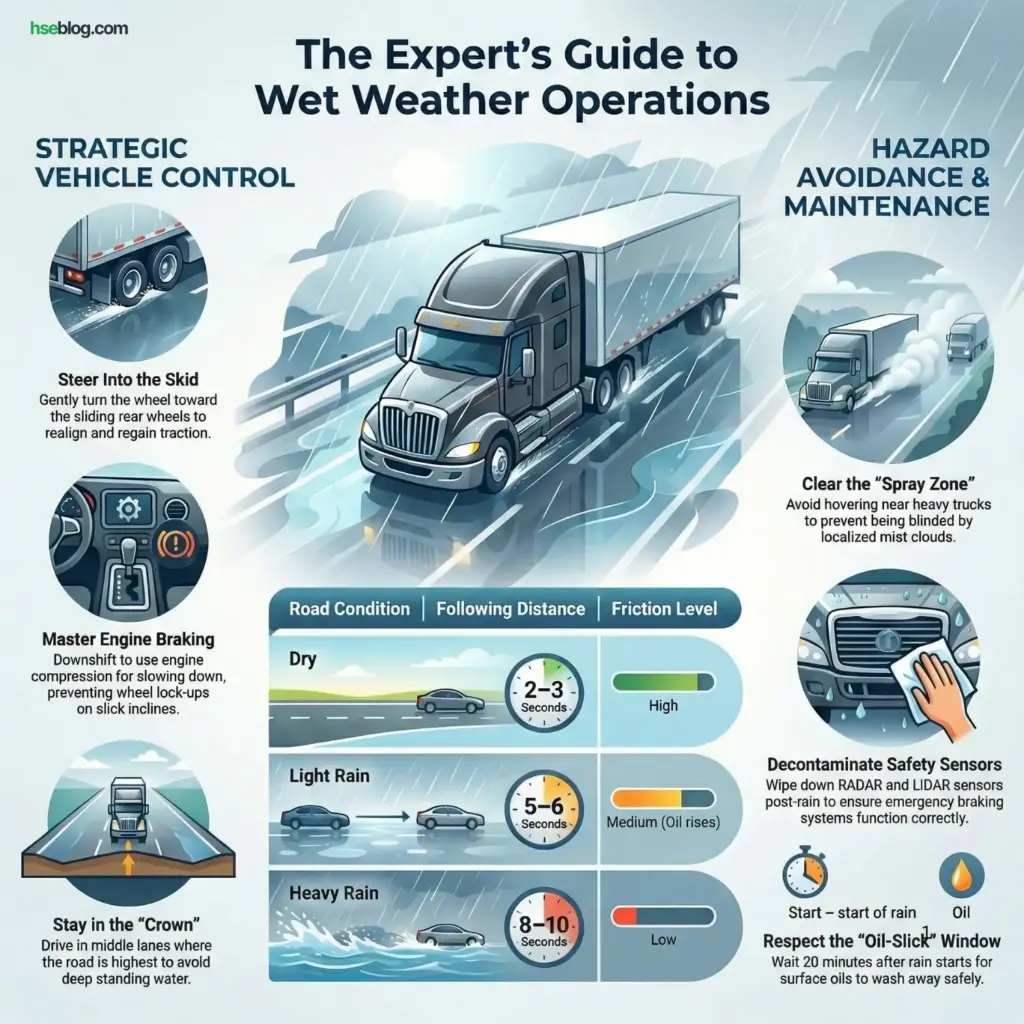
| Road Condition | Standard Following Distance | Braking Response | Friction Level |
| Dry | 2–3 Seconds | Immediate | High |
| Light Rain | 5–6 Seconds | Delayed / Skidding risk | Medium (Oil rises) |
| Heavy Rain | 8–10 Seconds | High risk of lock-up | Low |
- The “First Rain” Danger: The first 10 to 15 minutes of rain are the most dangerous. Rain mixes with leaked oil and fuel on the road surface, creating a greasy, slick emulsion.
- No Cruise Control: Never use cruise control on wet roads. If you begin to hydroplane, the system may attempt to maintain speed by accelerating, which can cause a total loss of control.
- Gentle Inputs: Treat the pedals as if there is an egg under them. Sudden braking or sharp steering inputs break what little friction you have left.
3. Understanding and Correcting Hydroplaning
I’ve stood on roadsides where vehicles have spun 180 degrees because the driver panicked when they felt the steering wheel go “soft.” Hydroplaning occurs when your tires encounter more water than they can displace, causing the vehicle to ride on a thin layer of liquid.
Pro Tip: If the steering feels light or “disconnected,” do not brake. Take your foot off the gas completely and keep the steering wheel pointed straight until you feel the tires “bite” the pavement again.
- Tire Health: We mandate a minimum of 3mm tread depth for wet-weather operations, even if the legal limit is lower. Shaved or worn tires cannot channel water out from under the contact patch.
- Follow the Tracks: Drive in the tire tracks of the vehicle ahead of you. Those tires have already displaced some of the standing water, giving you slightly better grip.
- Avoid the Edges: Water tends to pool in the outside lanes and near curbs. Stay toward the center of the road where the “crown” allows water to drain off.
4. Navigating Standing Water and Floods
One of the hardest “Stop Work” orders I ever had to give was at a remote site where a flash flood covered the main egress. Drivers wanted to “push through” in their 4x4s. I had to remind them that it only takes 12 inches of rushing water to carry away most small SUVs.
- Turn Around, Don’t Drown: If you cannot see the road markings or the bottom of the puddle, do not enter it. You have no way of knowing if the road underneath has washed away.
- Dry Your Brakes: If you must drive through a shallow puddle, tap your brake pedal lightly afterward. This creates friction and heat to dry out the pads and rotors.
- Engine Ingestion: If water is deep enough to reach your intake, your engine will “hydrolock,” leading to instant mechanical failure and leaving you stranded in the middle of the flood.
5. Managing the “Oil-Slick” Window
In my years auditing site access roads, I’ve seen the most accidents occur within the first ten minutes of a light drizzle. This is when the road is at its slickest.
- Wait Out the Initial Flush: If you are at a site or office and it starts to sprinkle after a long dry spell, wait 15–20 minutes before departing. This allows the rain to wash away the “sweated” oils, rubber dust, and fuel resins that have surfaced.
- Watch for Rainbow Sheen: If you see a multi-colored shimmer on the water surface, you are driving on a concentrated oil patch. Reduce speed immediately without touching the brakes.
6. Strategic Lane Selection
On multi-lane highways or industrial haul roads, your choice of lane can be the difference between a stable ride and a sudden skid.
- Avoid the “Gutter” Lanes: Water naturally drains to the edges of the road. The far-right and far-left lanes often have the deepest standing water (pooling).
- Stay in the “Crown”: Most well-engineered roads are higher in the center (the crown) to facilitate drainage. Position yourself in the middle lanes to minimize the risk of hitting a deep puddle that can yank your steering wheel.
7. Proper Response to a Skid
During defensive driving drills, I’ve noticed that most people’s “lizard brain” tells them to slam the brakes and turn away from the skid. This is a fatal error.
- Steer Into the Skid: If your rear wheels start to slide to the right, gently turn your steering wheel to the right. This helps realign the front wheels with the direction the back of the car is moving, helping you regain traction.
- Avoid Over-Correcting: Jerking the wheel in the opposite direction usually results in a “tank-slapper,” where the vehicle whips back and forth with increasing violence until it flips or leaves the road.
8. Heavy Vehicle Spray Management
If you are driving a light vehicle near HGVs (Heavy Goods Vehicles) or tankers, the “spray zone” is a massive hazard that can cause “whiteout” conditions for several seconds.
- The Overtaking Gap: Never hover alongside a large truck in the rain. Their massive tires kick up a localized cloud of mist that can completely blind you.
- Anticipate the Blast: If you must pass, ensure your wipers are on the highest speed before you enter the spray zone, and complete the maneuver as quickly and safely as possible to regain clear sightlines.
9. Post-Rain Vehicle Decontamination
Rain isn’t just water; it’s a cocktail of road salt, industrial chemicals, and grit that can compromise your vehicle’s safety components over time.
- Sensor Cleaning: Modern vehicles rely on RADAR and LiDAR sensors for emergency braking and blind-spot monitoring. After a heavy rain, wipe down these sensors; dried mud and road film can “blind” these systems, leading to false readings or failure when you need them most.
- Check the Lights (Again): Road grime can coat your tail lights, significantly reducing their lumen output. A quick wipe ensures the person behind you sees your brake lights in time.
10. Master the “Engine Braking” Technique
In my time overseeing transport operations in hilly terrain and mining sites, I’ve seen too many drivers overheat their brakes or lock their tires because they relied solely on the service brake to slow down on wet inclines.
- Downshift for Control: If you are approaching a descent or a sharp turn in the rain, shift to a lower gear (even in most modern automatics using ‘Manual’ or ‘L’ mode) before you reach the hazard. This uses the engine’s compression to slow the vehicle naturally.
- Avoid Kinetic Snap: By using the engine to manage your speed, you keep the tires rotating consistently. Tapping the brakes on a slick surface can cause a “micro-lockup” where the tire stops spinning for a fraction of a second—this is often all it takes to break the static friction and send you into a slide.
- Balanced Weight Distribution: Engine braking keeps the vehicle’s weight more evenly distributed across all four tires, whereas heavy foot-braking throws the weight forward, making the rear end light and prone to fishtailing.
Conclusion
Safe driving in the rain isn’t about skill; it’s about humility. It’s about accepting that your vehicle’s technology cannot override the laws of physics. Whether you are managing a fleet of heavy equipment or driving home from a shift, your goal is the same: arrive intact. No delivery or deadline is worth the risk of a high-speed hydroplane or a water-crossing gone wrong. Paperwork can be redone, and schedules can be shifted, but a life lost to a preventable road incident is a permanent failure of our safety culture.