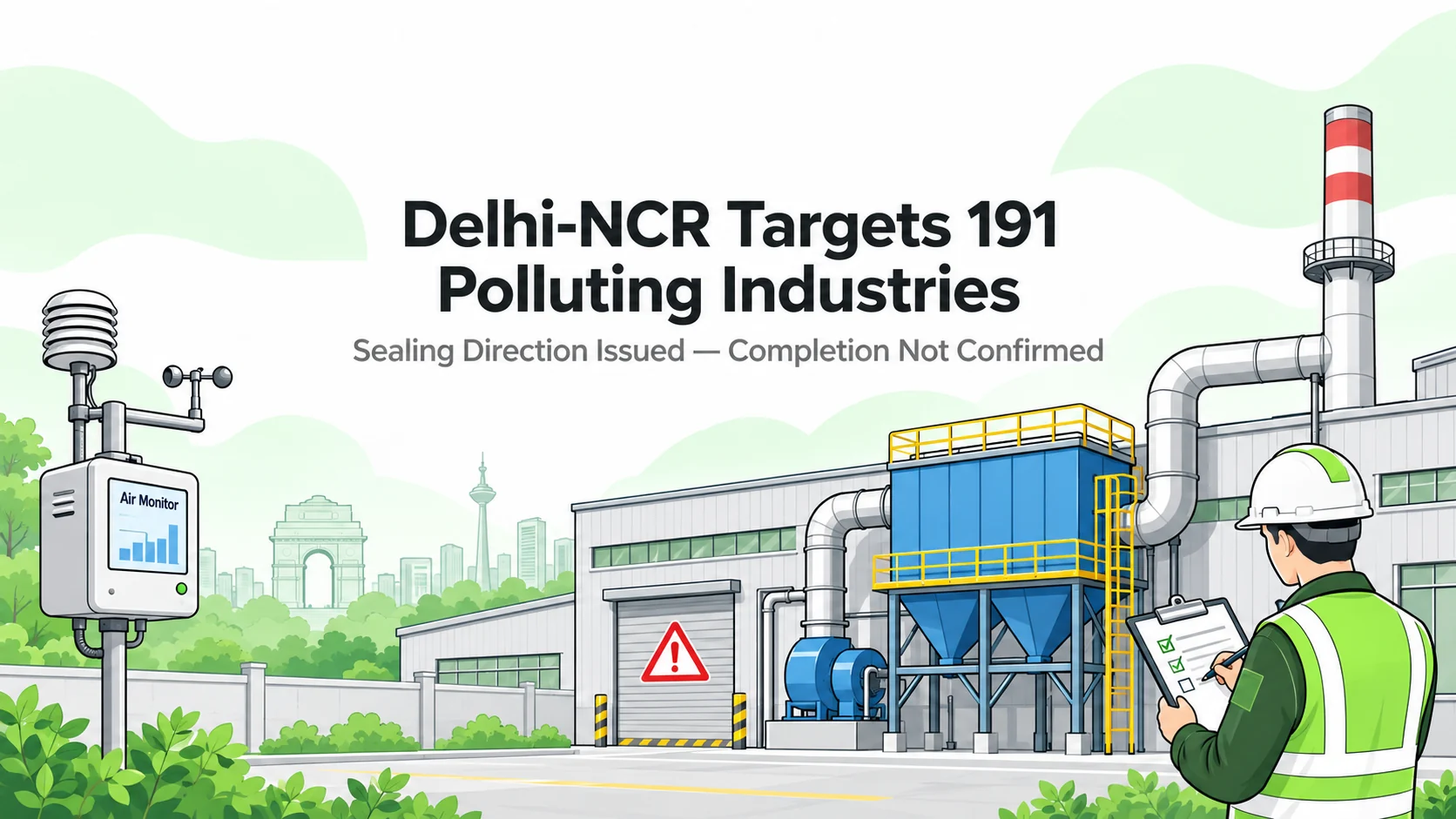
DELHI NATIONAL CAPITAL REGION, INDIA — India's environment minister has directed the Central Pollution Control Board to immediately seal 191 identified non-conforming polluting industries in Delhi-NCR. A ministry announcement published on November 14 says the units had not even placed orders for air-pollution-control devices despite repeated directions.
Direction targets industrial pollution-control compliance
The official release, posted at 13:52 IST, records Environment Minister Bhupender Yadav's review of regional pollution-control measures. It establishes that the sealing direction was issued, rather than demonstrating that enforcement teams had already sealed every targeted premises.
The ministry also called for strict enforcement of the industrial particulate-matter emission norm of 50 mg/Nm³. It described closure, electricity disconnection and sealing as possible enforcement measures for non-compliant industries. This article does not identify individual operators or infer the outcome of any particular site's case.
Monitoring totals describe a different compliance measure
The release separately reported that 2,298 of 2,345 targeted industries had been connected to online continuous emissions monitoring, with the remaining 47 closed or sealed. Those monitoring figures should not be treated as a completion tally for the new direction concerning 191 units.
HSE Blog Analysis
The practical distinction is between ordering equipment, installing it and demonstrating that it performs as required. An equipment purchase order cannot by itself show control of emissions. Environmental managers reviewing their own installations should connect legal obligations to commissioning records, operating arrangements and maintenance responsibilities.
Where an enforcement action could interrupt operations, planning also needs to address the safety of shutdown and subsequent restart. Those are general management considerations, not additional findings against the unnamed facilities. HSE Blog's article on keeping risk assessments useful in real work explains why documented controls need to remain connected to what happens on site.
Sources and limits
The ministry release is the primary evidence. Times of India, India Today, The New Indian Express and The CSR Journal were checked for corroborating coverage; these reports substantially follow the same government announcement, with some PTI input, rather than five independent investigations. No site-by-site closure verification or independently measured emissions improvement is claimed.
Featured image: an original conceptual illustration. It is not an actual industrial inspection photograph and does not show a specific affected business.
Source
Ministry of Environment, Forest and Climate Change via Press Information Bureaupib.gov.in