
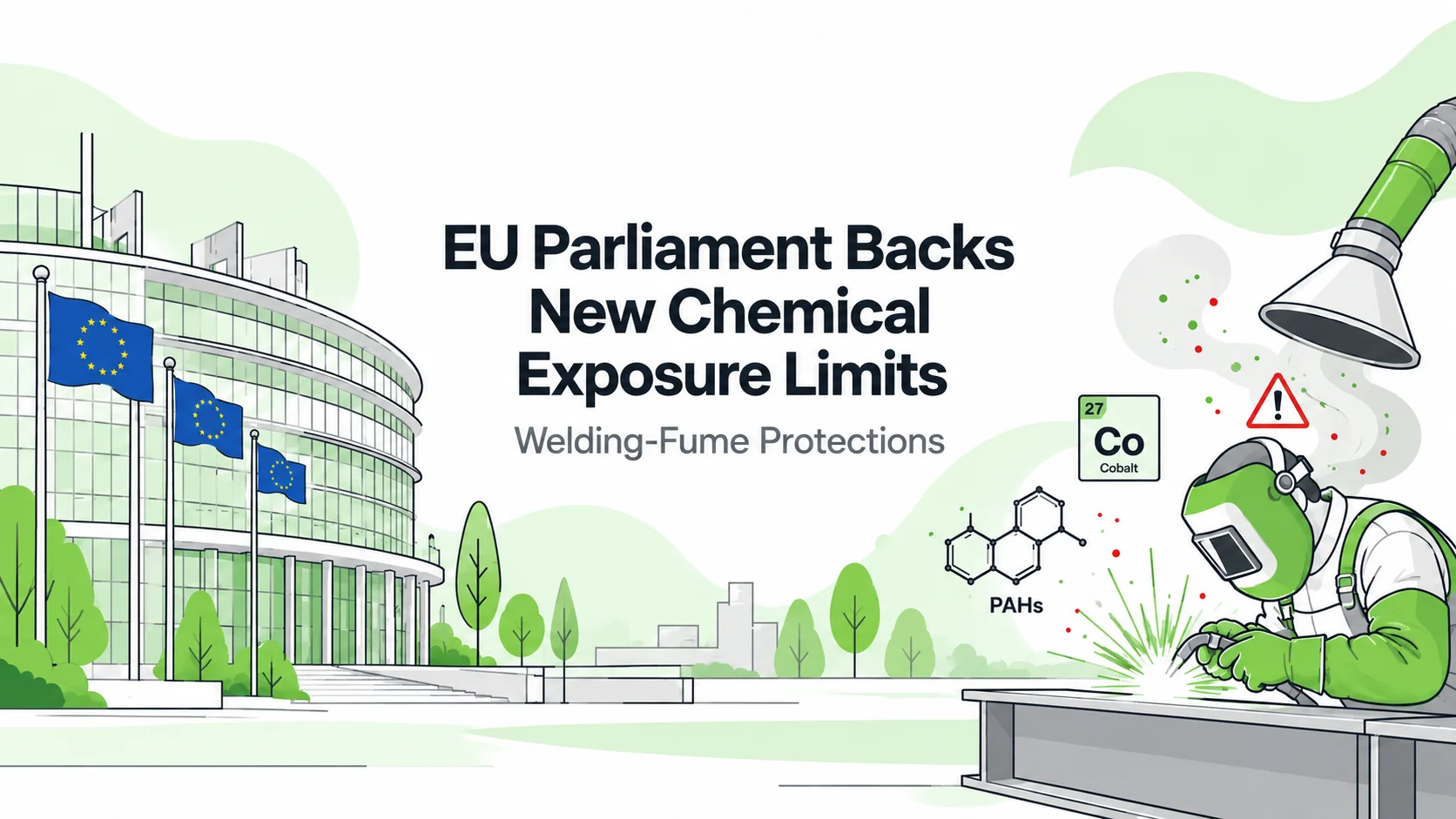
EUROPEAN UNION — The European Parliament voted on 6 October 2026 to approve revised protections against hazardous workplace exposures under the Carcinogens, Mutagens and Reprotoxic Substances Directive (CMRD).
The sixth revision addresses cobalt and its inorganic compounds, polycyclic aromatic hydrocarbons (PAHs), 1,4-dioxane and isoprene. It also expands coverage of hazardous welding fumes and strengthens provisions concerning personal protective equipment.
Parliamentary approval is a legislative milestone, rather than an immediate compliance deadline. Formal adoption and publication must precede entry into force.
What the revision covers
The Council’s account of the agreement identifies the following changes:
| Area | Change | Why it matters |
|---|---|---|
| Cobalt and inorganic compounds | Occupational exposure limits | Relevant to battery production and other cobalt-handling operations |
| PAHs | Exposure limit with a seven-year transition for specified sectors | Transition also covers carbon and graphite manufacturers |
| 1,4-dioxane | Airborne exposure limits and biological monitoring provisions | Long-term, short-term and biological limits serve different purposes |
| Isoprene | An occupational exposure limit added to the agreement | Extends the substances covered by the revision |
| Welding fumes | Covered work brought into Annex I | Requires attention to the substances released by welding processes |
This overview is not a numerical compliance schedule. Employers should use the adopted annexes and national implementing rules for exact values, measurement conventions and applicability dates.
Additional protections for welding and PPE use
Welding fumes: coverage rather than one universal limit
Work involving welding fumes containing covered carcinogenic, mutagenic or reprotoxic substances is brought within the directive’s scope. The revision does not establish one exposure limit for every welding-fume mixture.
Regular breaks for workers wearing protective equipment
The agreement introduces regular breaks for workers wearing PPE and clarifies its use within the existing legislative framework. The Council also stresses that meeting an exposure limit does not eliminate every health risk.
Implementation will follow national transposition
According to the European Parliamentary Research Service, Member States will have two years from entry into force to transpose the provisions. Certain exposure limits have longer transitional arrangements.
A short-term exposure limit must not be described as a transitional limit: one controls brief exposure peaks, while the other temporarily applies during implementation.
HSE Blog analysis: planning the exposure review
- Identify processes using or generating the substances covered.
- Review exposure monitoring and the suitability of engineering controls.
- For welding, assess the materials, process and contaminants generated.
- Review PPE selection, fit, maintenance and break arrangements.
- Track formal publication and national implementation before setting compliance deadlines.
Sources: European Parliament announcement; Council of the European Union; European Parliamentary Research Service.
Source
European Parliamenteuroparl.europa.eu