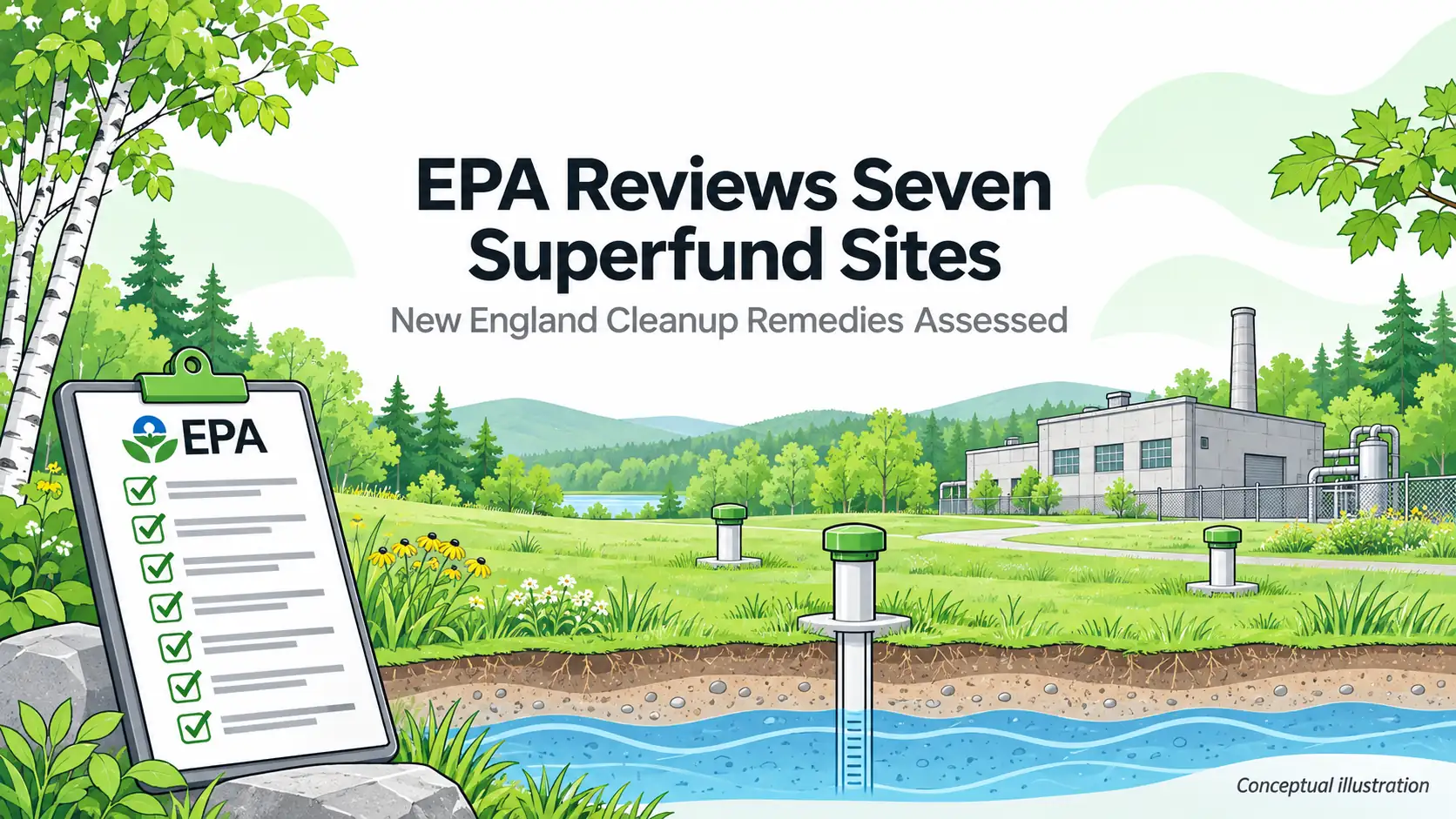
NEW ENGLAND, UNITED STATES — EPA announced on November 12 that it had completed five-year cleanup reviews for seven New England Superfund sites during fiscal year 2026. The agency said the assessed remedies remained protective of health and the environment, with follow-up recommendations where required.
Review announcement covers four states
The EPA release lists Callahan Mine and Eastern Surplus in Maine; Coakley Landfill and Savage Municipal Water Supply in New Hampshire; Durham Meadows in Connecticut; and Massachusetts’ Fort Devens Sudbury Training Annex and U.S. Army Materials Technology Laboratory.
This is a newly issued summary of completed reviews, not a claim that seven cleanups finished on November 12. Five-year reviews examine how remedies perform after implementation and whether further action is needed.
Protectiveness does not mean every restriction disappears
The announcement does not declare all seven properties suitable for unrestricted use or announce their removal from the National Priorities List. Readers making site-specific decisions should consult the relevant review and current controls rather than treating a regional summary as permission to disturb land or groundwater.
HSE Blog Analysis
For employers using or maintaining former industrial land, the important distinction is between a remedy that works under defined conditions and a site that needs no continuing management. Monitoring, access arrangements and responsibilities can remain important after visible remediation work ends.
A useful handover should explain who holds the current records, who checks continuing controls and what changes trigger reassessment. Excavation, new underground services or altered land use can introduce questions that an earlier project team did not need to answer. That is a practical application of risk assessments that reflect actual work rather than a reason to assume an existing remedy has failed.
Organisations can also use their health and safety management systems to keep land-condition information available to maintenance staff and contractors. These are general operational observations; no unreported contamination finding or control failure is alleged at the listed sites.
Source transparency: EPA’s November 12 release and its Callahan and Durham Meadows site profiles were checked. These remain one primary source organisation. A Publicnow republication was located but could not be fully retrieved and supplies no independent investigation. The regional announcement is the evidence for the new development; individual review reports were not independently audited by HSE Blog.
Featured image: original HSE Blog conceptual illustration, not an incident photograph or reconstruction. Depicted equipment and arrangements do not establish conditions at the actual location. Source reporting provides its own visual context; no third-party photograph has been reproduced.
Source
U.S. Environmental Protection Agencyepa.gov