CENTRAL CHINA — A study published in Frontiers in Psychology on 26 November 2026 explores whether machine learning can help identify nurses reporting workplace bullying. The authors caution that the model lacks external validation.
Study Uses Earlier Survey Data
Jia and colleagues collected self-reported data from nurses at three tertiary hospitals in central China during August and September 2025. The publication is new; the survey was not conducted this week.
The paper reports 286 nurses, or 27.98% of participants, experiencing bullying. Its selected XGBoost model achieved a validation-set area under the curve of 0.865. That measures discrimination within the study’s split sample, not the accuracy of a proven tool across other hospitals.
Association Does Not Establish Cause
The authors identify a cross-sectional design, self-reporting and a restricted geographic sample as limitations. They say the findings cannot establish causal relationships and require wider validation.
The model should not be used to blame affected nurses, replace an independent investigation or determine performance appraisal. Its proposed role concerns identifying possible support needs.
HSE Blog Analysis
Prediction research can invite a premature jump from an interesting result to a management decision. Before a tool is used in a different organisation, decision-makers need to understand what it was trained to identify and whose experience is represented in its data.
Privacy and trust matter particularly where the underlying issue involves harmful behaviour at work. People may be less willing to report concerns if they expect an assessment to become a judgement about their own suitability for a role.
For managers grounding risk assessments in real working conditions, a model output cannot replace discussion of workload, relationships and reporting arrangements. A high score is not proof of misconduct; a low score is not a reason to dismiss someone asking for help.
The publication is a research development, not evidence that an intervention has reduced bullying or improved health outcomes in practice.
Sources and Verification
Checked the original paper, DOI 10.3389/fpsyg.2026.2009114, including methods and limitations. Five independent reports or replications were not located. This account relies on one primary study and does not claim independent reanalysis of its data.
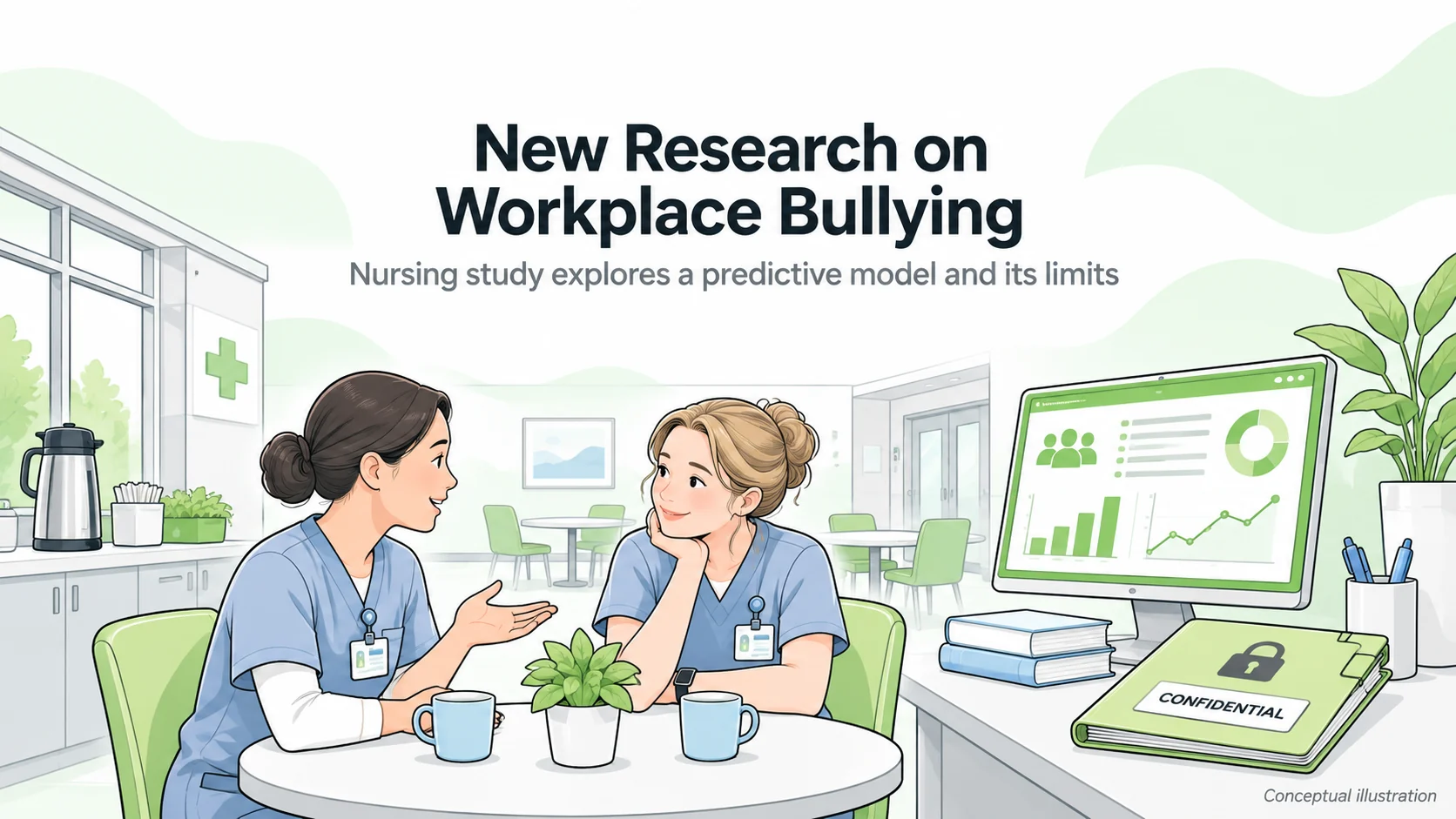
Featured image: original AI-generated conceptual illustration, not an event photograph, site plan, technical design or reconstruction.
Source
Frontiers in Psychology; Jia and colleaguesfrontiersin.org