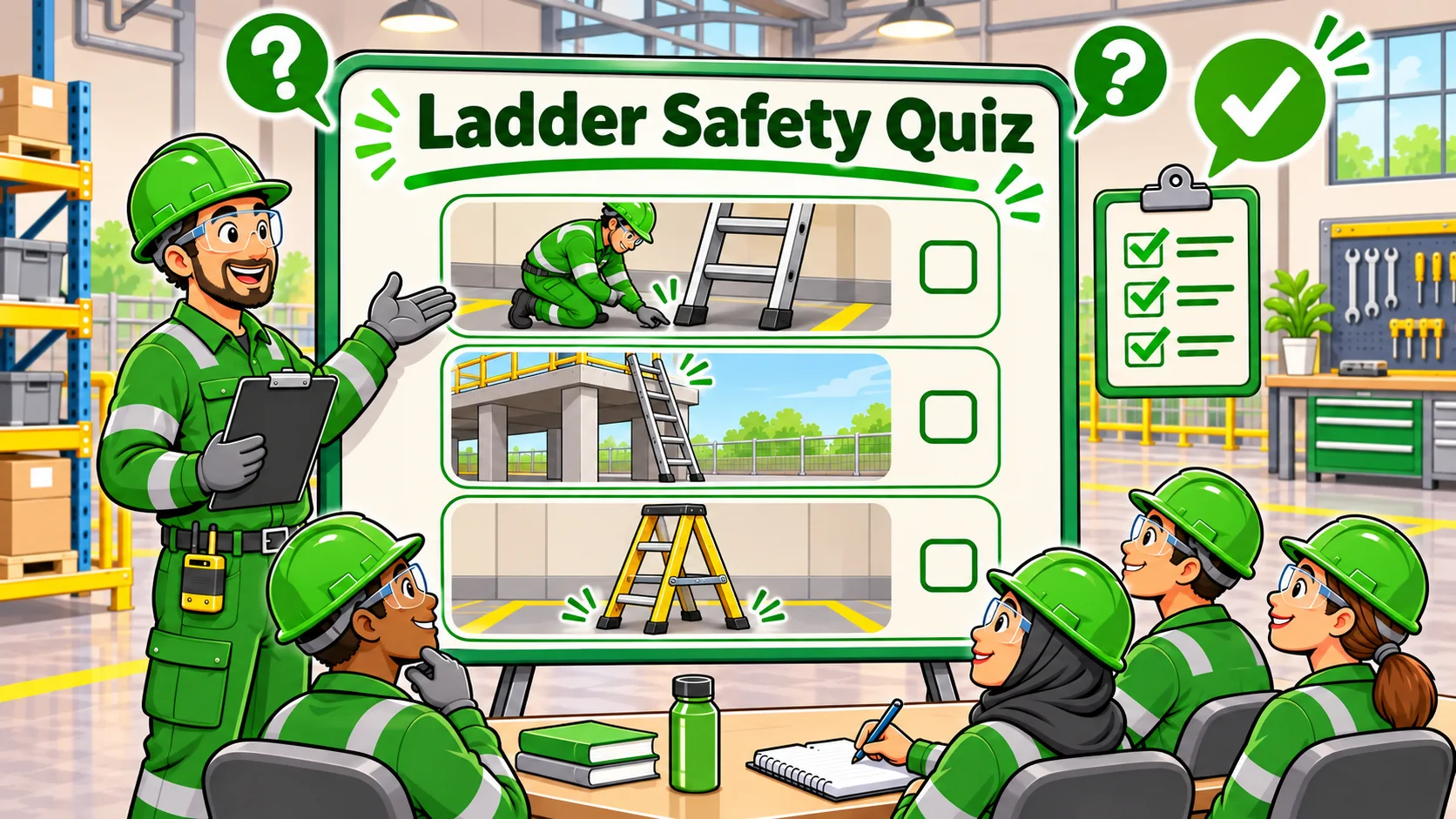
Ladder Safety Quiz: Inspection, Setup, and Safe Use
25 questions
About 13 min
Updated
0 of 25 answered
Score 0
Question 1 of 25
What should determine whether a ladder is suitable for a task?
Question 2 of 25
A task requires prolonged two-handed heavy work. What is the appropriate approach?
Question 3 of 25
Does HSE's roughly 30-minute guide mean every task under that duration is safe on a ladder?
Question 4 of 25
Who should carry out the user's pre-use ladder check?
Question 5 of 25
When should a ladder be checked again after the initial daily check?
Question 6 of 25
A stile is bent. What should the user do?
Question 7 of 25
Why inspect ladder feet?
Question 8 of 25
A ladder is moved from muddy ground onto a smooth floor. What is important?
Question 9 of 25
A rung is loose. What should happen?
Question 10 of 25
What surface is suitable for setting up a ladder?
Question 11 of 25
Under HSE's leaning-ladder guide, what does the 1-in-4 rule mean?
Question 12 of 25
What is a suitable upper resting point for a leaning ladder?
Question 13 of 25
How should a leaning ladder be protected against slipping?
Question 14 of 25
Why is footing a ladder not the preferred first securing method?
Question 15 of 25
When climbing or descending, how should the user face?
Question 16 of 25
What are three points of contact during ordinary climbing?
Question 17 of 25
How should tools be taken up a ladder?
Question 18 of 25
The user needs to reach farther sideways. What should they do?
Question 19 of 25
May a ladder be moved or extended while someone is on it?
Question 20 of 25
Under HSE guidance, should work be carried out from the top three rungs of a leaning ladder?
Question 21 of 25
What should be checked when opening a stepladder?
Question 22 of 25
Why can side-on drilling be unsuitable from a stepladder?
Question 23 of 25
For a telescopic ladder, what additional check is important?
Question 24 of 25
What must be considered near electrical conductors?
Question 25 of 25
What does a current inspection tag prove by itself?
About This Quiz
Test practical ladder awareness with 25 original questions on deciding whether a ladder suits a task, checking its condition, setting it up securely and using it without losing support. Scenarios include leaning ladders, stepladders and telescopic designs, with explanations for the choices that prevent common falls.
Scope and independent practice
This independent practice resource follows Great Britain HSE ladder guidance and is not an accredited training course or practical competence assessment. The stated 1-in-4 setup and duration guidance must be understood in that context. Other countries, equipment designs and tasks can have different requirements. Follow applicable law, the manufacturer's instructions and the site's risk assessment. Short duration or a current inspection tag alone never establishes that a task is safe.
Study before you start
Start with the task and work environment before selecting access equipment. Review the difference between a user's current pre-use check and a more detailed inspection system. Think about support at both ends, grip, securing, safe reach and the tools being carried. If the work requires force, prolonged exposure or an unsupported working position, consider a better access method rather than trying to adapt unsafe ladder use.
Practice format
Answer 25 original multiple-choice questions, selecting one answer per question. The learning pass mark is 70%, with no time limit. Answers are shuffled, explanations are shown after submission and retakes are allowed. Use the feedback to identify topics to review before another attempt. A knowledge score does not establish practical competence.
Related learning
Continue with our construction safety quiz. Compare the examples with the procedures and controls used in your workplace.
Primary references
Reference information checked on 8 November 2026. Consult current applicable law, equipment instructions and task-specific procedures.
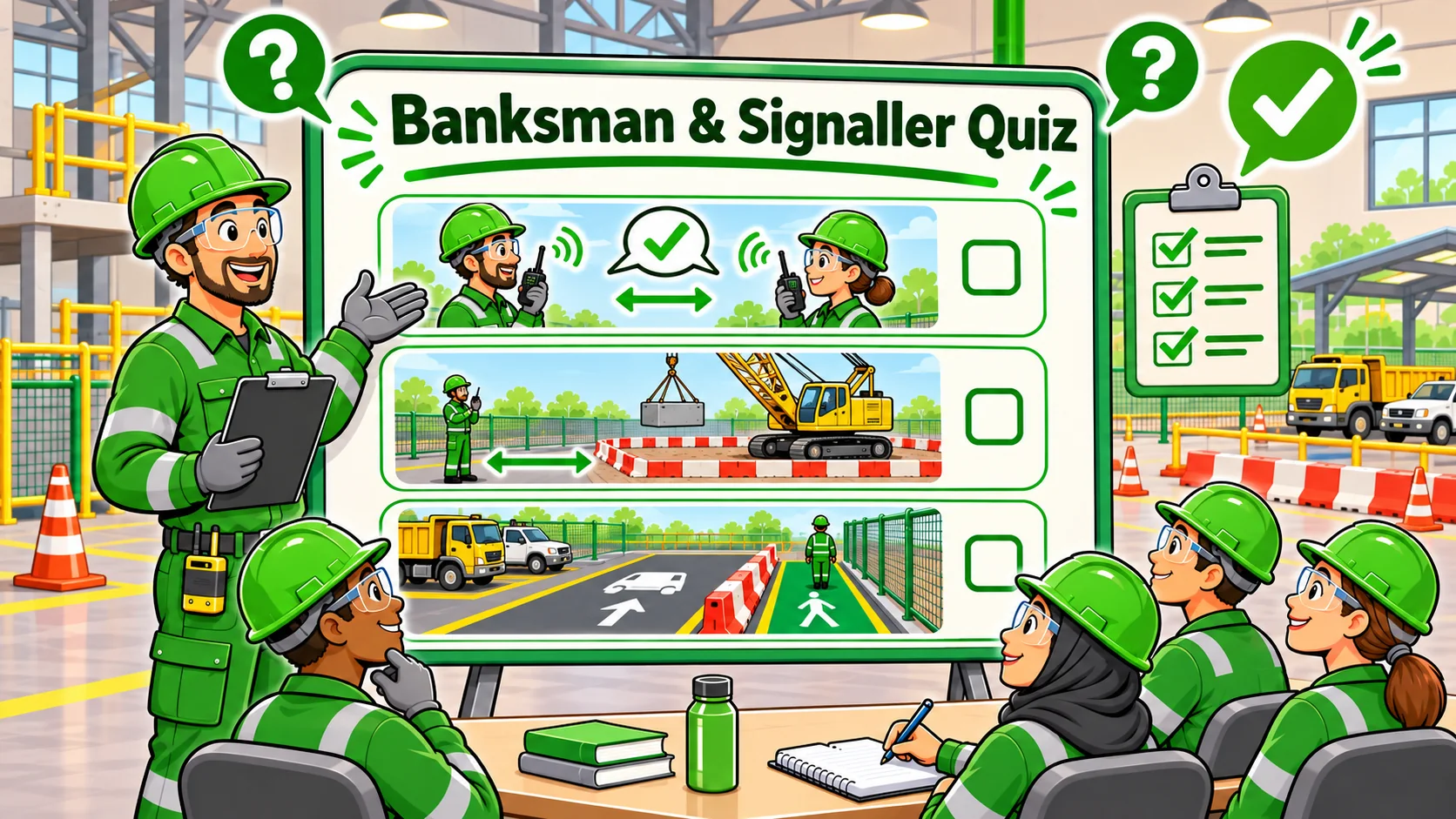
Check your understanding of the people and communication arrangements needed for safe vehicle and lifting movements. These 25 original questions cover vehicle banksman duties, crane signalling, slinging interfaces, protected positions, radio checks, lost communication and controlled handovers. The terms describe related activities, but each role needs the competence required for its actual work.
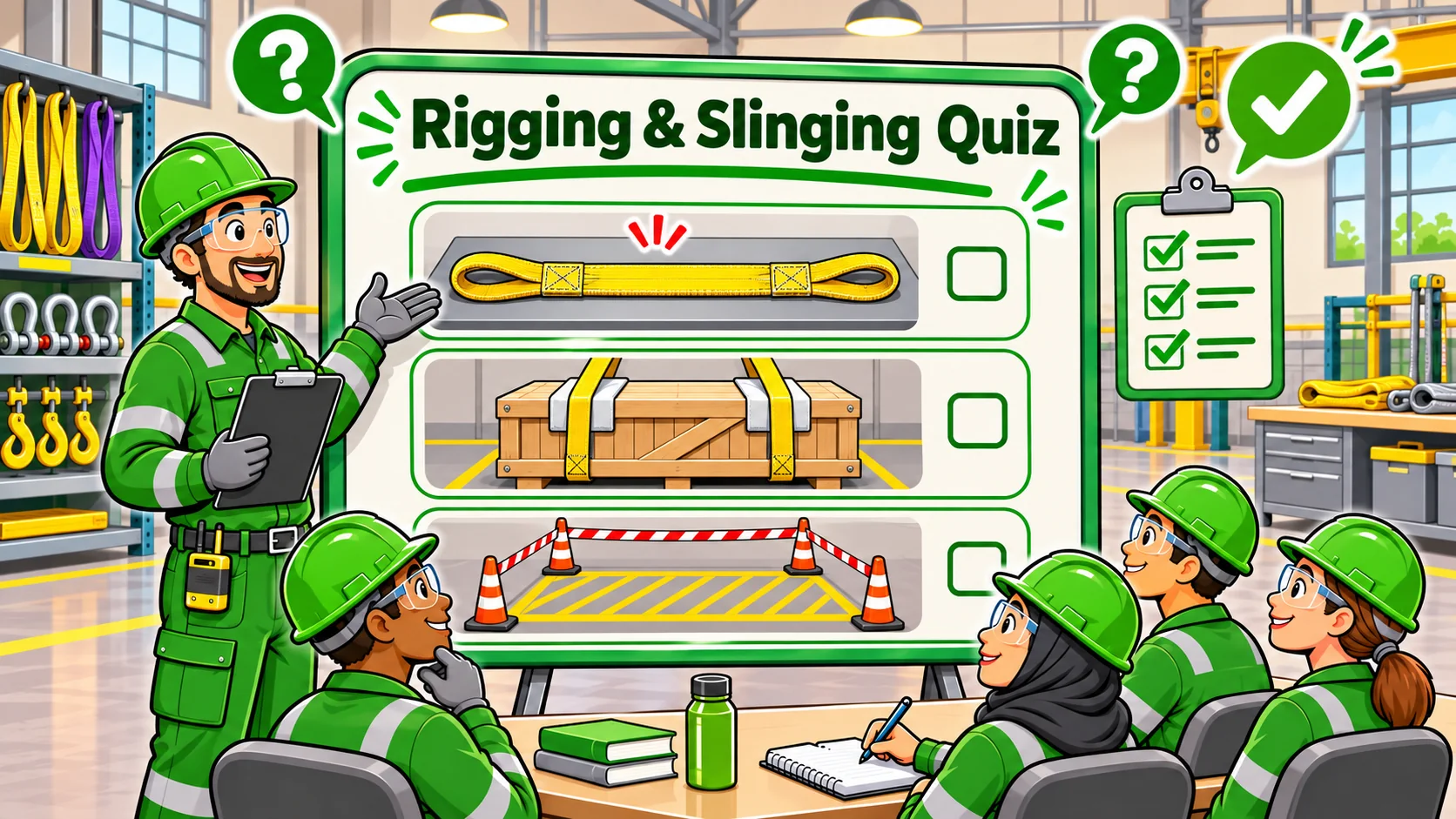
Review the decisions that help keep lifting operations controlled with 25 original multiple-choice questions. Topics include load information, sling configuration, capacity identification, equipment condition, edge protection, safe positions and landing arrangements. The focus is understanding why an arrangement is safe, rather than learning a shortcut for choosing equipment.