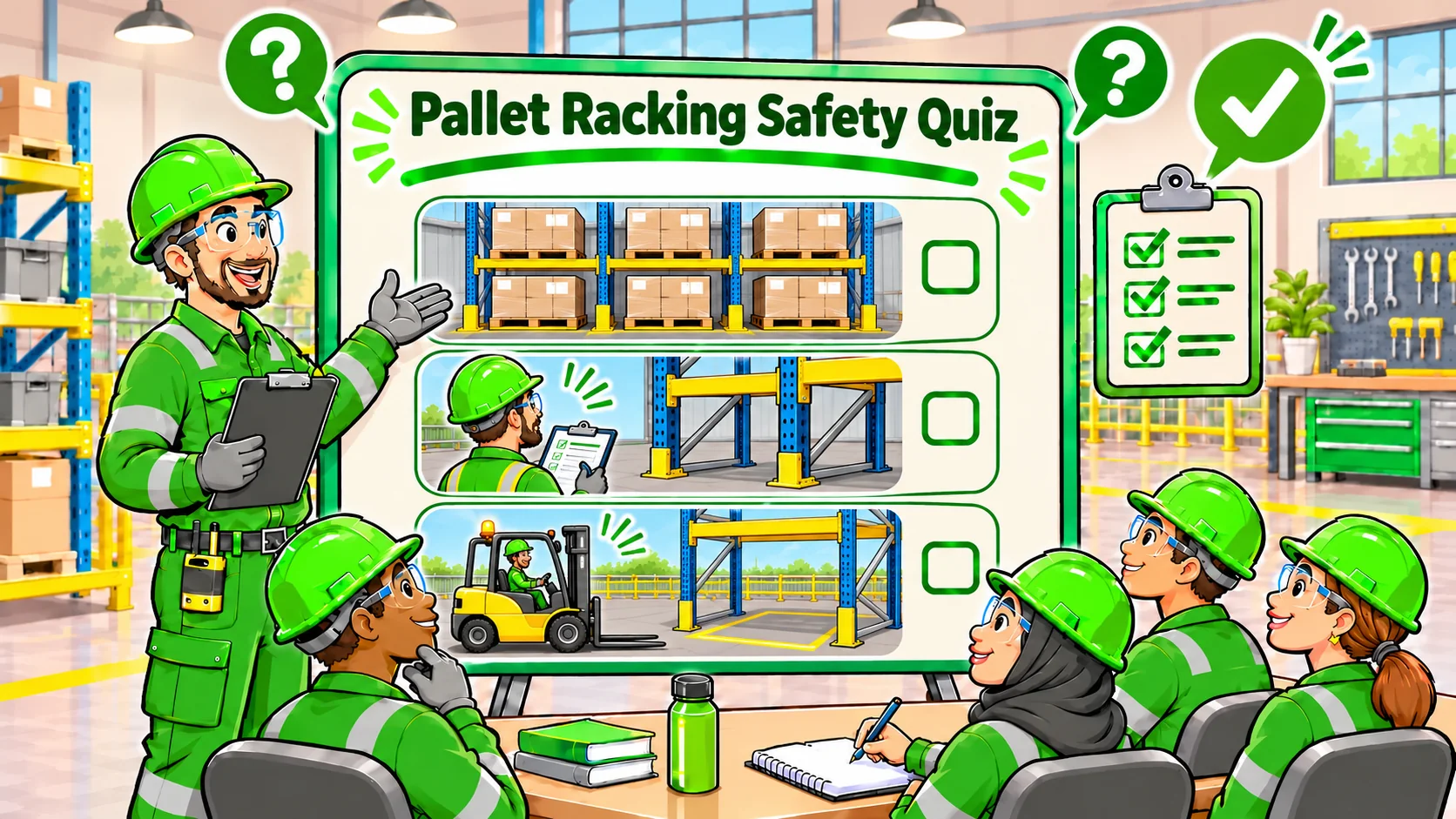
Pallet Racking Safety Quiz: Damage, Loading, and Inspections
25 questions
About 13 min
Updated
0 of 25 answered
Score 0
Question 1 of 25
What should a pallet-racking load notice communicate?
Question 2 of 25
A pallet's weight is unknown. What should happen before storing it?
Question 3 of 25
What is the safest response to an unreadable load notice?
Question 4 of 25
A bay limit is 3,000 kg and its beam-level limit is 1,000 kg. Can one level hold 1,200 kg if the bay total is only 2,500 kg?
Question 5 of 25
A level permits two evenly placed 800 kg pallets in its stated configuration. What is their combined load?
Question 6 of 25
Why must pallet type and dimensions suit the rack?
Question 7 of 25
A pallet has broken supporting boards. What should be done?
Question 8 of 25
What is a beam connector lock intended to prevent?
Question 9 of 25
An inspector finds a missing beam connector lock. What is appropriate?
Question 10 of 25
A forklift strikes an upright but the rack remains standing. What should the driver do?
Question 11 of 25
Who coordinates the rack-safety inspection system in HSG76?
Question 12 of 25
Do scheduled inspections replace employees' immediate damage reports?
Question 13 of 25
How does HSG76 describe routine visual inspection timing?
Question 14 of 25
What expert-inspection interval does HSG76 recommend for the standard rack inspection arrangement?
Question 15 of 25
Where are normal rack inspections generally carried out under HSG76?
Question 16 of 25
Who should classify uncertain rack damage?
Question 17 of 25
In HSG76's damage system, what does a green classification require?
Question 18 of 25
An amber-classified component has been unloaded. May it be reloaded before repair?
Question 19 of 25
What does HSG76 recommend if amber damage is not remedied within four weeks of designation?
Question 20 of 25
How should red-risk damage be managed?
Question 21 of 25
Can a bent upright simply be hammered straight by warehouse staff?
Question 22 of 25
What is needed before moving beam levels?
Question 23 of 25
Does upright impact protection eliminate the need for inspections?
Question 24 of 25
Is climbing pallet racking an acceptable way to retrieve a box?
Question 25 of 25
What should a useful rack-safety record retain?
About This Quiz
Practise recognising pallet-racking hazards with 25 questions on load notices, pallet condition, beam locks, impact damage, inspection responsibilities, safe repairs and changes to rack configuration. Two simple load exercises test how stated limits apply.
How to use the quiz
Choose one answer for each of 25 questions. The pass mark is 70%, there is no time limit and retakes are allowed. Answer choices are shuffled. Review the correct answers and explanations to identify what to study next.
Scope and standards
This is independent practice material, not an official HSE or SEMA examination, expert-inspector qualification or structural assessment. The quiz uses Great Britain HSE guidance, including HSG76, second edition 2007, still supplied by HSE at the review date. Its inspection intervals and green, amber and red classifications are labelled as HSG76 guidance rather than universal legal rules. Actual damage assessment, repairs and offloading need competent advice and the applicable manufacturer criteria; the arithmetic examples do not determine a real rack's capacity.
Primary sources
Sources reviewed on 19 November 2026. Consult the applicable requirements and equipment instructions before real work.
Test loading and unloading safety with 25 questions on vehicle movement, stable loads, loading bays and exclusion zones. Includes answers and explanations.
Practise recognising warehouse risks before they lead to injury. These 25 original multiple-choice questions cover racking and pallets, pedestrian separation, loading docks, handling tasks and safe coordination with visiting drivers.
Safe forklift operation depends on the truck, its load, the travel route, and the people nearby. This quiz brings these factors together through everyday operating decisions.
Test arc flash awareness with 25 questions on electrical hazards, isolation, boundaries, PPE and safe decisions. Includes correct answers and explanations.