WHMIS Practice Test: Canadian Workplace Safety Questions
25 questions
About 13 min
Updated
0 of 25 answered
Score 0
Question 1 of 25
What does WHMIS stand for?
Question 2 of 25
Which elements work together in WHMIS?
Question 3 of 25
Who is responsible for supplier hazard classification and compliant supplier information?
Question 4 of 25
What must an employer add to general WHMIS education?
Question 5 of 25
What should a worker do if a label is damaged and the product cannot be identified?
Question 6 of 25
A product is transferred to a container for use by several workers over several shifts. What is normally needed?
Question 7 of 25
What does a signal word indicate?
Question 8 of 25
If both could otherwise apply, which signal word takes precedence?
Question 9 of 25
What does a hazard statement communicate?
Question 10 of 25
What is a precautionary statement intended to describe?
Question 11 of 25
What does the flame-over-circle pictogram identify?
Question 12 of 25
Which pictogram is associated with more severe acute toxicity categories?
Question 13 of 25
What can the corrosion pictogram indicate?
Question 14 of 25
Does one pictogram describe every hazard of a product?
Question 15 of 25
What additional detail does an SDS provide compared with the label?
Question 16 of 25
How many numbered headings are in the standard WHMIS SDS format?
Question 17 of 25
Which SDS section provides first-aid measures?
Question 18 of 25
Which SDS section addresses accidental-release measures?
Question 19 of 25
Which SDS section addresses exposure controls and personal protection?
Question 20 of 25
How should an SDS be available to workers?
Question 21 of 25
A worker finds an SDS whose product identifier differs from the container label. What should happen?
Question 22 of 25
Is a WHMIS hazard category number a universal ranking across all hazard classes?
Question 23 of 25
What should happen after a process or hazardous product changes?
Question 24 of 25
By November 2026, has the transition period for the December 2022 HPR amendments ended?
Question 25 of 25
Does completing this independent WHMIS quiz replace workplace-specific training?
About This Quiz
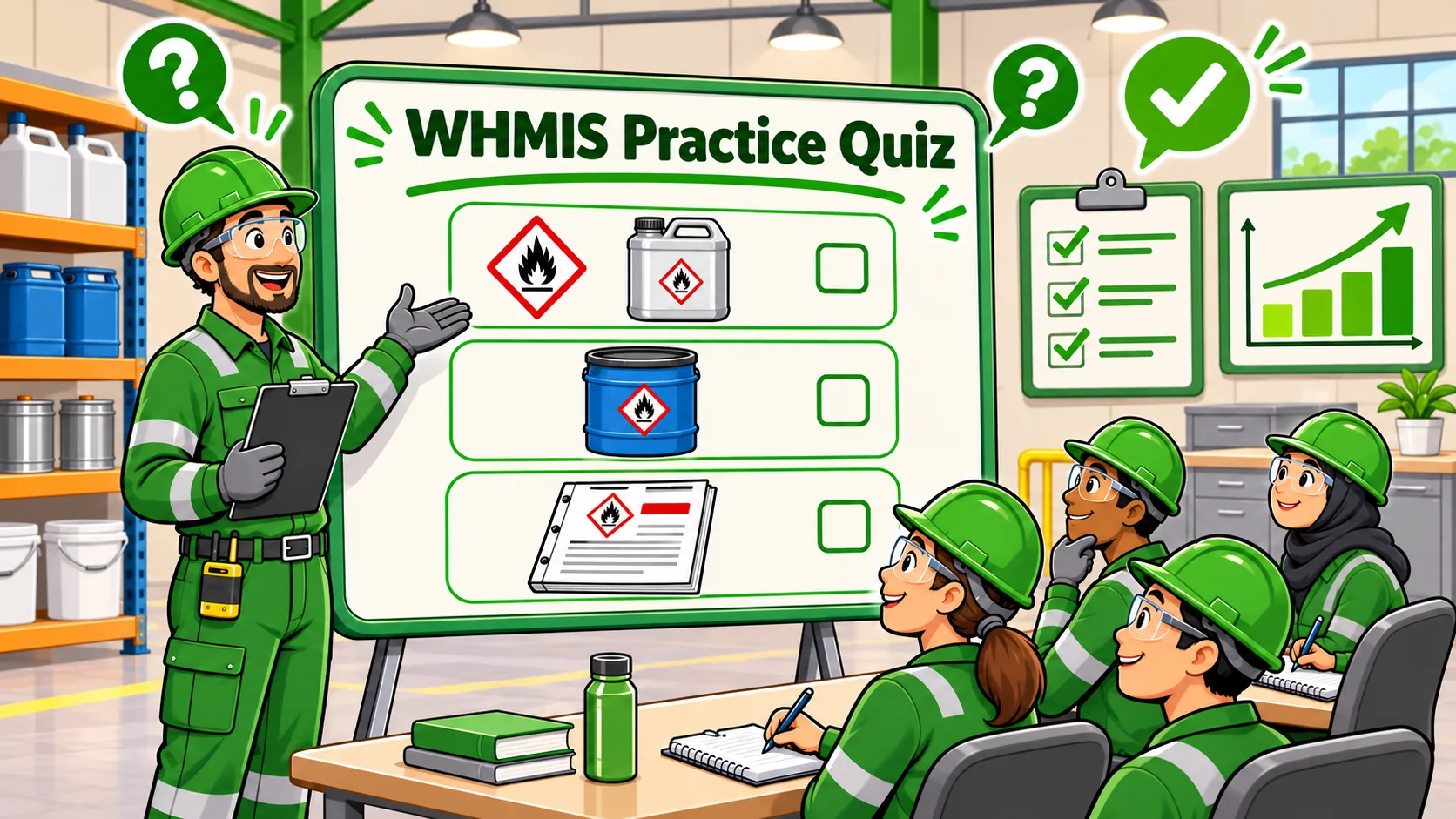
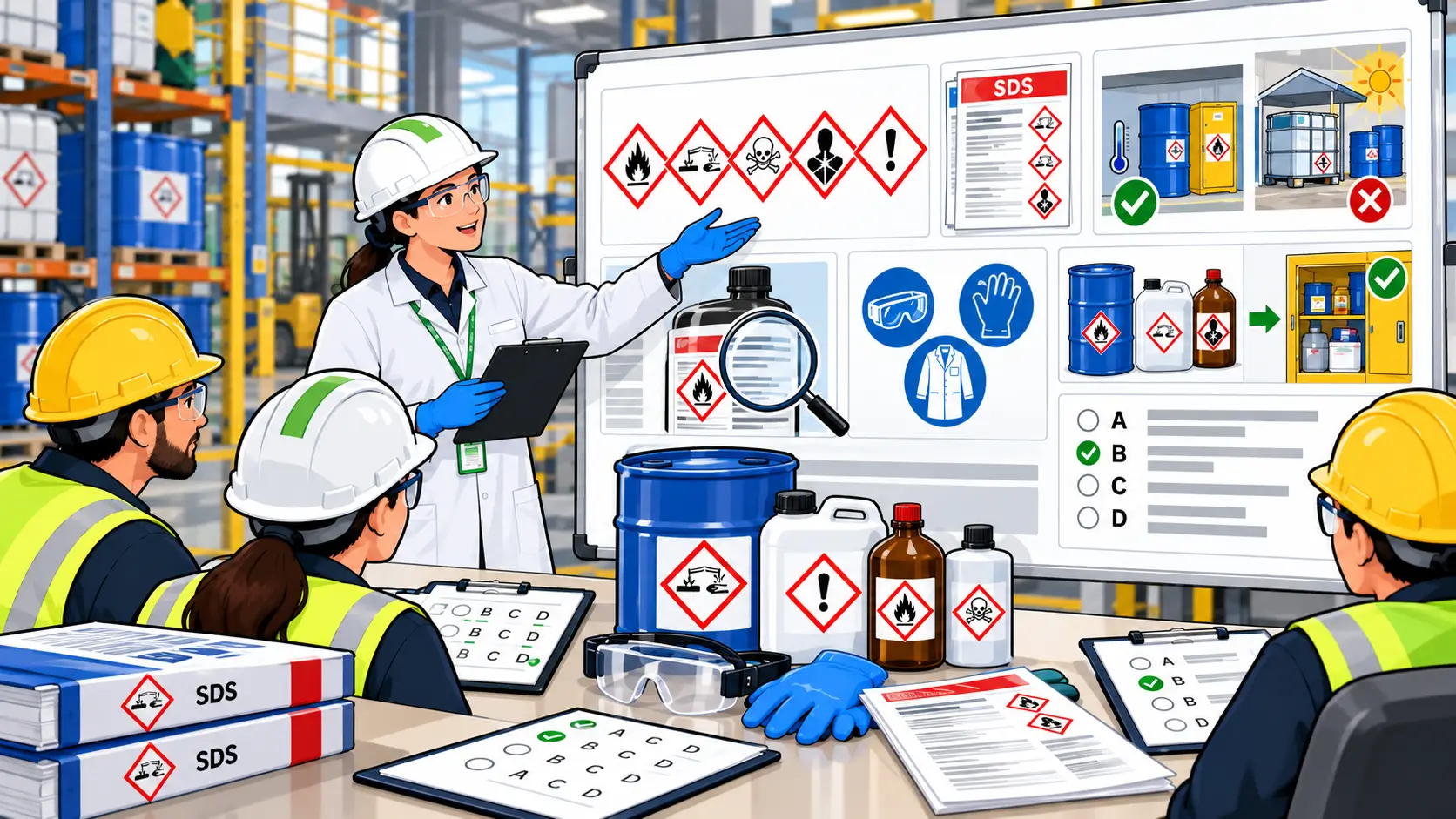
Check your understanding of Canada's Workplace Hazardous Materials Information System with 25 original questions on supplier information, workplace labels, pictograms, safety data sheets and worker training. Scenarios emphasise how to find accurate information and recognise when a task needs clarification before work begins.
Scope and independent practice
Independent awareness practice created by HSEBlog. It is not a Health Canada or CCOHS examination and does not issue a government certificate. Supplier obligations fall under the federal Hazardous Products Act and Regulations; workplace requirements depend on the province, territory or federal workplace jurisdiction. General education must be supplemented with workplace-specific training. The transition for the December 2022 HPR amendments ended on 14 December 2025. A compliance-promotion policy does not extend that legal transition.
Study before you start
Start with the product identifier and confirm the label matches the SDS. Read the hazard statements as well as the pictograms, then consider the task, exposure routes and controls. Practise locating first aid, accidental release and exposure control information in the 16-section format. If a label is missing or information conflicts, resolve it through the workplace procedure before use; do not identify a product by appearance or smell.
Practice format
Answer 25 original multiple-choice questions, choosing one answer per question. The learning pass mark is 70%, with no time limit. Answers are shuffled, explanations are shown after submission and retakes are allowed. Use feedback to identify learning gaps, then review the source material before trying again. This practice score is not a qualification or an assessment of practical competence.
Test your understanding of hazardous-substance assessment and practical exposure controls with 25 original questions. This learning resource is useful for workers, supervisors and safety learners handling chemicals or working with processes that generate harmful dust, fume, vapour or biological exposure.