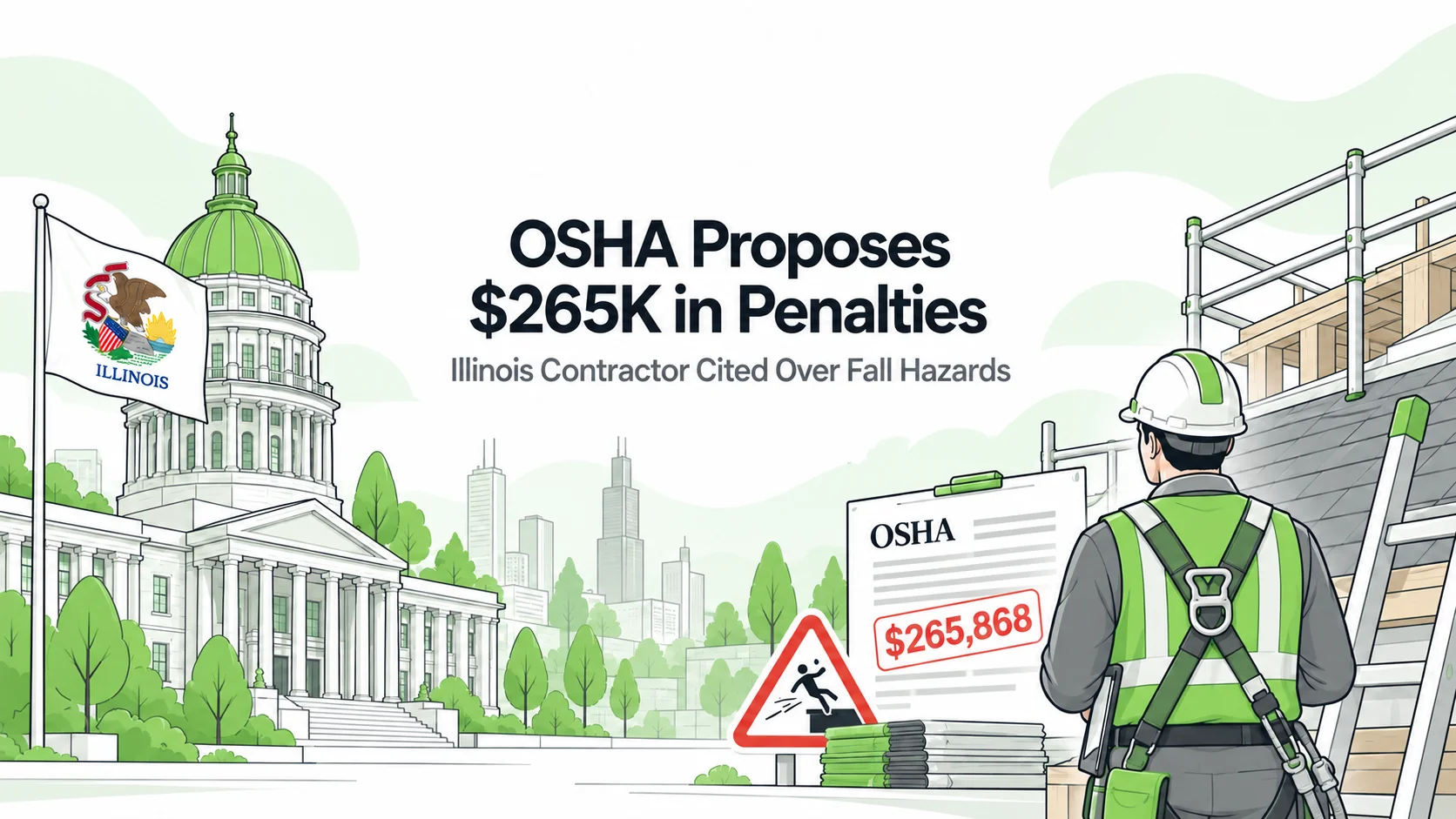
UNITED STATES — The U.S. Occupational Safety and Health Administration proposed $265,868 in penalties against an Illinois residential construction employer after investigators reported workers exposed to falls of up to 25 feet.
In its 15 September 2026 announcement, OSHA identified the employer as Martin Araujo, doing business as Araujo Construction Corp., based in Calumet City. The agency said workers were installing roof rafters and sheeting without fall protection at two worksites.
What OSHA cited
| Classification | Citations | Reported findings |
|---|---|---|
| Willful | 2 | Failure to provide fall protection |
| Repeat | 9 | Head and eye protection, stairway handrails and ladder access deficiencies |
| Serious | 1 | Unsafe platform access |
| Other-than-serious | 1 | Missing training certifications |
Proposed penalties are not a final case outcome
The release does not establish a final penalty or confirm payment. Employers normally have 15 business days from receipt to comply, seek an informal conference or contest citations. That period does not restart when a news article is published.
OSHA advises checking its establishment records for subsequent changes. No later case outcome is established by the cited release.
The 2026 penalty ceiling
OSHA’s May 2026 memorandum sets the maximum federal penalty for a willful or repeated violation at $165,514. There was no inflation-based increase for 2026; the 2025 maximum remained in effect. Actual proposed amounts depend on the circumstances and applicable adjustment policies.
HSE Blog analysis: check roof-work controls before access
The reported findings concern both protection from falls and the equipment used to reach and work on elevated areas. Contractors reviewing comparable work should consider:
- How suitable fall protection is planned before roofing starts.
- Whether ladders, stairways and platforms provide safe access.
- How required head and eye protection is selected and used.
- Whether workers understand the controls and required training records are maintained.
Previous findings should inform corrective action across comparable sites. Equipment provision alone is insufficient without installation checks, supervision and worker understanding.
Primary sources: U.S. Department of Labor / OSHA release, 15 September 2026; OSHA civil penalties memorandum, 21 May 2026.
Source
U.S. Department of Labor / OSHAosha.gov