What should be established before excavation begins near possible buried services?
Question 2 of 25
Why is looking at a trench from above not enough to establish collapse safety?
Question 3 of 25
What is the function of a trench shield or trench box?
Question 4 of 25
What is the main purpose of shoring?
Question 5 of 25
What does sloping an excavation involve?
Question 6 of 25
Under US OSHA rules, is every excavation less than 5 feet deep automatically exempt from cave-in protection?
Question 7 of 25
What is the US OSHA general rule for cave-in protection when neither stated exception applies?
Question 8 of 25
Why should spoil piles and materials be controlled near an excavation edge?
Question 9 of 25
Under US OSHA, what minimum setback applies to excavated material unless suitable retaining measures prevent falling or rolling hazards?
Question 10 of 25
Under US OSHA, trench excavations 4 feet or more deep need safe egress within what lateral travel distance?
Question 11 of 25
What should workers do if water begins accumulating unexpectedly?
Question 12 of 25
A crack develops near the top of a trench wall. What is the appropriate response?
Question 13 of 25
When does US OSHA require competent-person excavation inspections where employee exposure is anticipated?
Question 14 of 25
How can vehicles operating near an excavation increase risk?
Question 15 of 25
An excavator operator cannot clearly see the excavation edge. What control is required under OSHA?
Question 16 of 25
Is an open-top excavation necessarily free of hazardous atmospheres?
Question 17 of 25
What is an important reason to assess an excavation near a landfill or leaking fuel system?
Question 18 of 25
Workers need to cross a trench. What should be provided?
Question 19 of 25
An excavation may undermine a neighboring wall. What is needed?
Question 20 of 25
A worker needs to pass beneath a suspended pipe being lowered into a trench. What should happen?
Question 21 of 25
What should happen if part of a protective system appears damaged?
Question 22 of 25
Why must the trench-box manufacturer's limits be followed?
Question 23 of 25
Is it safe to work outside a trench box simply because the box is nearby?
Question 24 of 25
What is the correct approach after heavy rain affects an excavation?
Question 25 of 25
A trench collapses with a person inside. What should an untrained coworker do?
About This Quiz
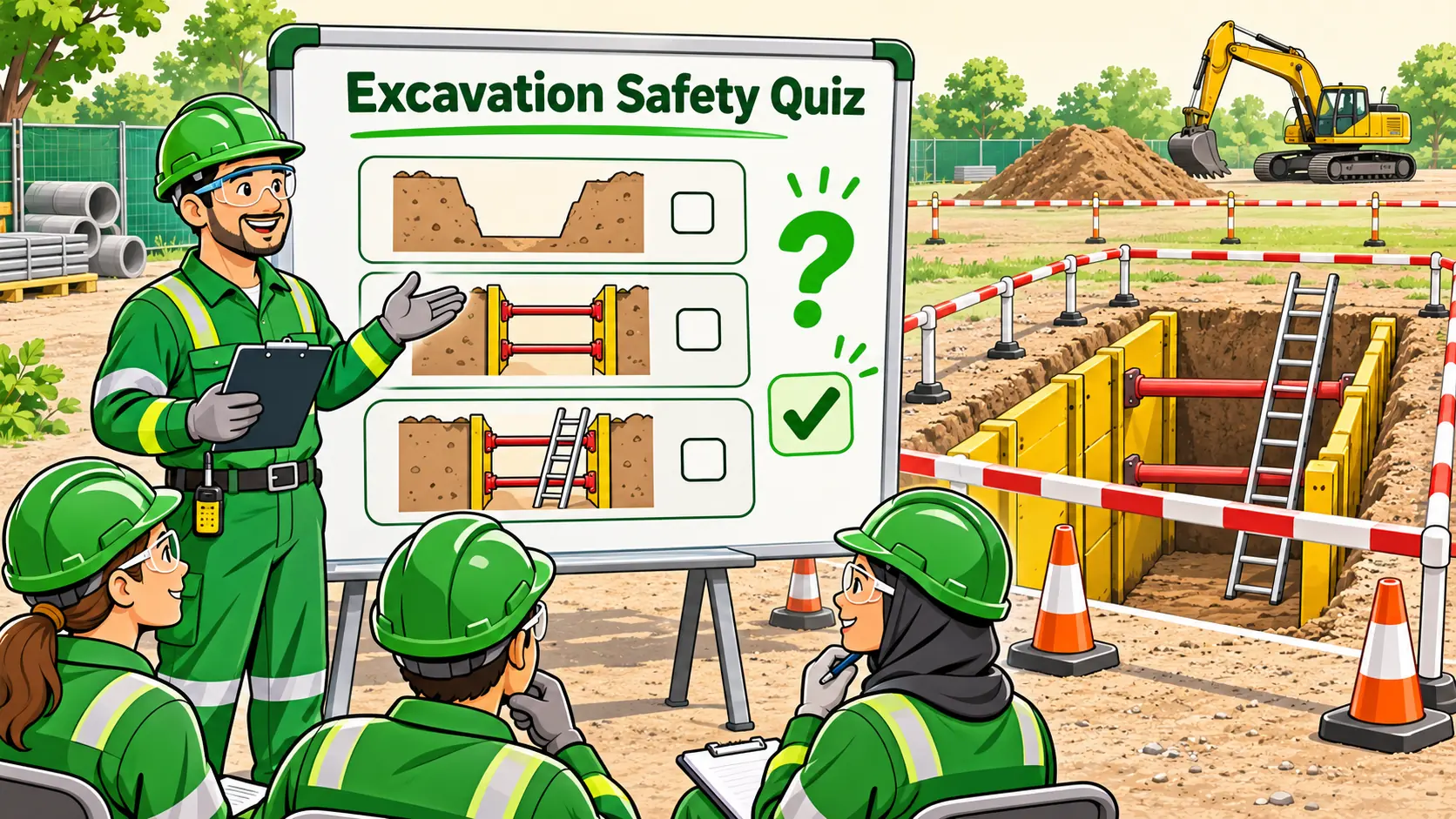
Excavation hazards extend beyond a trench collapse. This quiz covers planning, ground conditions, nearby services and loads, access, and the checks needed when conditions change. This practice resource is intended for excavation workers, supervisors, construction teams, and safety learners.
Topics covered
The focus is on practical understanding and decisions relevant to everyday work. Use these learning objectives to guide your preparation.
Recognize collapse hazards and the purpose of sloping, shoring, and shielding.
Understand checks for buried services, water, atmosphere, and nearby loads.
Identify safe access and conditions that require reassessment or withdrawal.
This quiz contains 25 multiple-choice questions. Select one answer for each question. It has a 70% pass mark, no time limit, and repeat attempts. Review the answer explanations after submitting to understand the reasoning behind each response. Use feedback to identify topics for further study; a knowledge score is only one part of learning and does not establish practical competence.
Standards and scope
US OSHA construction excavation requirements provide the reference framework. Protective-system selection depends on site conditions and competent assessment; generic depth rules must not be treated as a complete design.
References
Consult OSHA trenching and excavation for the primary reference material. Apply the requirements relevant to the industry, equipment, and country in which the work takes place.
Test your understanding of hazardous-substance assessment and practical exposure controls with 25 original questions. This learning resource is useful for workers, supervisors and safety learners handling chemicals or working with processes that generate harmful dust, fume, vapour or biological exposure.
Revise practical construction safety with 25 original multiple-choice questions covering site induction, occupational health, safe access, plant movements, excavation hazards and emergency response. The scenarios focus on the decisions an operative may face when conditions change or a control is missing.
Build confidence in everyday safety management with original scenarios about hazards, risk assessment, control selection, incident learning and performance monitoring. This quiz is designed for line managers, supervisors and safety learners who want to check their understanding before further study.
ISO 45001 connects occupational health and safety with the way an organization plans, operates, evaluates, and improves its work. This quiz focuses on understanding and applying management-system concepts.