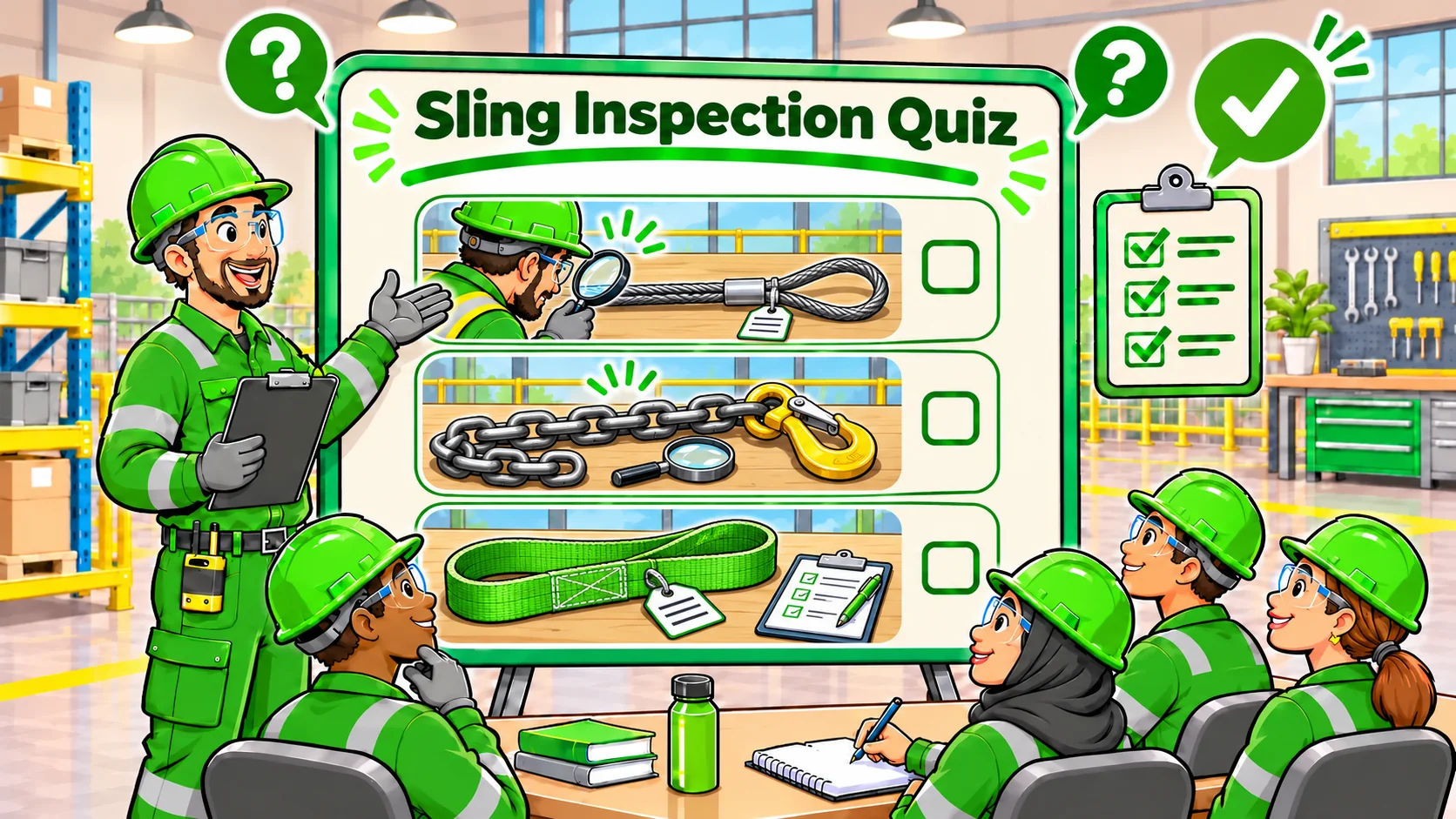
Lifting Sling Inspection Quiz: Wire Rope, Chain, and Web Slings
25 questions
About 13 min
Updated
0 of 25 answered
Score 0
Question 1 of 25
Under US OSHA construction rule 1926.251(a)(1), when must rigging equipment be inspected?
Question 2 of 25
A sling's last periodic inspection is current. What does this mean for today's pre-use inspection?
Question 3 of 25
A sling's required identification is missing and its capacity cannot be established. What should happen?
Question 4 of 25
What should a pre-use sling inspection cover?
Question 5 of 25
A wire-rope sling has a severe kink and crushed strands. What is the correct action?
Question 6 of 25
What does birdcaging in wire rope indicate?
Question 7 of 25
How should visible broken wires on a wire-rope sling be assessed?
Question 8 of 25
An inspector finds severe corrosion beneath a wire-rope sling's end fitting. What is the safest decision?
Question 9 of 25
A worker wants to shorten a sling using a knot. What should happen?
Question 10 of 25
What information belongs on the durable identification of an alloy steel chain sling under OSHA 1926.251(b)(1)?
Question 11 of 25
A chain sling has a visibly stretched link and a crack at another link. What should happen?
Question 12 of 25
How should chain-link wear be judged?
Question 13 of 25
A damaged lifting chain is repaired on site with a bolt joining two links. Is it ready for use?
Question 14 of 25
Under OSHA construction rule 1926.251(b)(6), how is the periodic inspection interval for alloy steel chain slings set?
Question 15 of 25
A synthetic web sling has a small cut along its edge. What is the correct action?
Question 16 of 25
A web sling has melted patches after contact with hot material. What should the inspector do?
Question 17 of 25
Why are broken or worn stitches in a web sling's load-bearing splice significant?
Question 18 of 25
A sling may have contacted an unidentified cleaning chemical. What should happen before reuse?
Question 19 of 25
Can webbing colour alone establish a sling's working load limit?
Question 20 of 25
A sling is marked with different capacities for vertical, choker and basket hitches. Which rating applies?
Question 21 of 25
For an ideal symmetric two-leg sling lifting a fixed load, what happens to leg tension as the legs become flatter to the horizontal?
Question 22 of 25
What should protect a sling where it contacts a sharp load edge?
Question 23 of 25
An inspector finds a hook that is bent and has a damaged latch. What should happen?
Question 24 of 25
A defective sling is removed from the lifting area. What helps prevent accidental reuse?
Question 25 of 25
What is a suitable way to store serviceable lifting slings?
About This Quiz
This lifting sling inspection quiz contains 25 questions on wire-rope, alloy steel chain and synthetic web slings. It focuses on pre-use checks, identification, defects, fittings, configuration ratings, removal from service and preventing accidental reuse of defective equipment.
What this quiz covers
Practise identifying damage that requires removal from use, checking the full sling and fittings, reading the rating for the actual hitch and angle, and keeping defective equipment out of circulation. Numerical broken-wire or wear limits must be looked up for the actual assembly; colour alone cannot establish capacity.
How to use the quiz
Choose one answer for each of 25 questions. The pass mark is 70%, there is no time limit and retakes are allowed. Answer choices are shuffled. Review the correct answers and explanations to identify what to study next.
Scope and standards
This is independent practice material, not an official OSHA examination, inspection qualification or evidence of competence to approve lifting equipment. Regulatory questions explicitly reference US OSHA construction rule 1926.251. OSHA's safe-sling publications provide additional guidance; they are not themselves a new regulation. Use the applicable local law, current manufacturer criteria and a competent inspection system for actual equipment. Do not transfer a discard limit from one sling construction or standard to another.
Sources and further study
The primary sources below were reviewed on 17 November 2026. Read the applicable requirements and equipment instructions before real work.
Test the choices that prevent collapse and exposure during concrete placement and formwork operations. These 25 original questions cover design loads, shoring inspections, pour monitoring, removal evidence, reshoring, equipment hazards and wet cement contact.
Practise the decisions involved in inspecting excavations and recognising changing ground hazards. These 25 original questions cover competent-person authority, soil analysis, protective systems, water, atmospheric risk, access and corrective action.
Check the choices that keep a mobile scaffold tower stable and its users protected. These 25 original questions cover competent assembly, compatible parts, base support, stabilisers, protected access, loading, movement and inspection.
Learn what to look for before relying on a safety harness and associated fall-arrest equipment. These 25 original questions explore webbing, stitching, hardware, identification, exposure history, inspection records and quarantine.