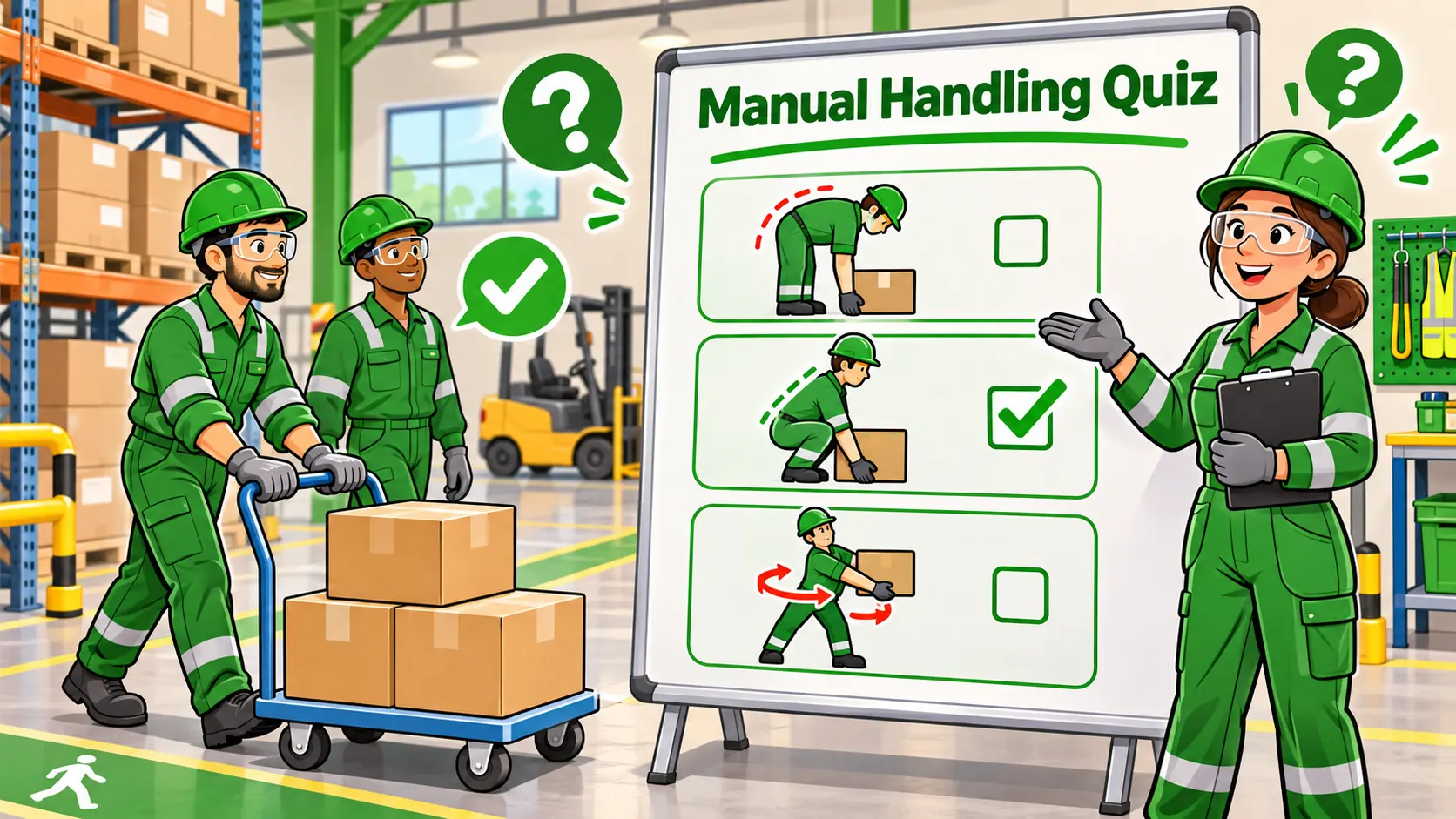
Manual Handling Quiz: Safe Lifting Questions and Answers
25 questions
About 13 min
Updated
0 of 25 answered
Score 0
Question 1 of 25
Under UK HSE guidance, what is the first priority for hazardous manual handling?
Question 2 of 25
Which task is manual handling?
Question 3 of 25
A light box is carried hundreds of times per shift. What should the assessment consider?
Question 4 of 25
Does UK manual-handling law set one maximum weight that is safe for everyone?
Question 5 of 25
Before lifting a load of unknown weight, what should a worker do?
Question 6 of 25
Why can holding a load far from the body increase strain?
Question 7 of 25
What is the safer way to change direction while carrying a manageable load?
Question 8 of 25
A route includes loose packaging and uneven flooring. What should happen before carrying a load?
Question 9 of 25
A large box blocks the carrier's view. What is the best response?
Question 10 of 25
What should a team lift include?
Question 11 of 25
A load shifts inside its container. Why is this important?
Question 12 of 25
When selecting a trolley, what should be checked?
Question 13 of 25
Which situation can make pushing a trolley more demanding?
Question 14 of 25
Why should high-frequency storage be placed at accessible heights where practicable?
Question 15 of 25
A worker feels new pain while handling loads. What should happen?
Question 16 of 25
What role does manual-handling training play?
Question 17 of 25
A load has sharp edges and is difficult to grip. What should be considered?
Question 18 of 25
Which change should prompt review of a handling assessment?
Question 19 of 25
Why should a load be set down on a stable surface before final adjustment?
Question 20 of 25
Which factor is relevant when assessing an individual worker's handling capability?
Question 21 of 25
A pallet can be moved by a suitable powered aid instead of repeated carrying. What is the best approach?
Question 22 of 25
Why are sudden jerking movements undesirable when moving a load?
Question 23 of 25
A heavy item must be retrieved from deep inside a container. Which improvement addresses the risk at source?
Question 24 of 25
Who should contribute practical information to a manual-handling assessment?
Question 25 of 25
What should happen before handling a person who needs assistance to move?
About This Quiz
Manual handling includes lifting, lowering, carrying, pushing, and pulling. This quiz examines how to assess a task and reduce physical demands before relying on lifting technique. This practice resource is intended for workers, supervisors, warehouse teams, and manual-handling learners.
Topics covered
The focus is on practical understanding and decisions relevant to everyday work. Use these learning objectives to guide your preparation.
Assess the task, load, individual capability, and working environment.
Recognize when to avoid handling or use suitable mechanical assistance.
Choose safer arrangements for carrying, pushing, pulling, and team tasks.
This quiz contains 25 multiple-choice questions. Select one answer for each question. It has a 70% pass mark, no time limit, and repeat attempts. Review the answer explanations after submitting to understand the reasoning behind each response. Use feedback to identify topics for further study; a knowledge score is only one part of learning and does not establish practical competence.
Standards and scope
UK HSE guidance provides the main reference framework. There is no single weight that is safe for every worker and task; assessment must consider the actual handling conditions.
References
Consult HSE manual handling at work for the primary reference material. Apply the requirements relevant to the industry, equipment, and country in which the work takes place.
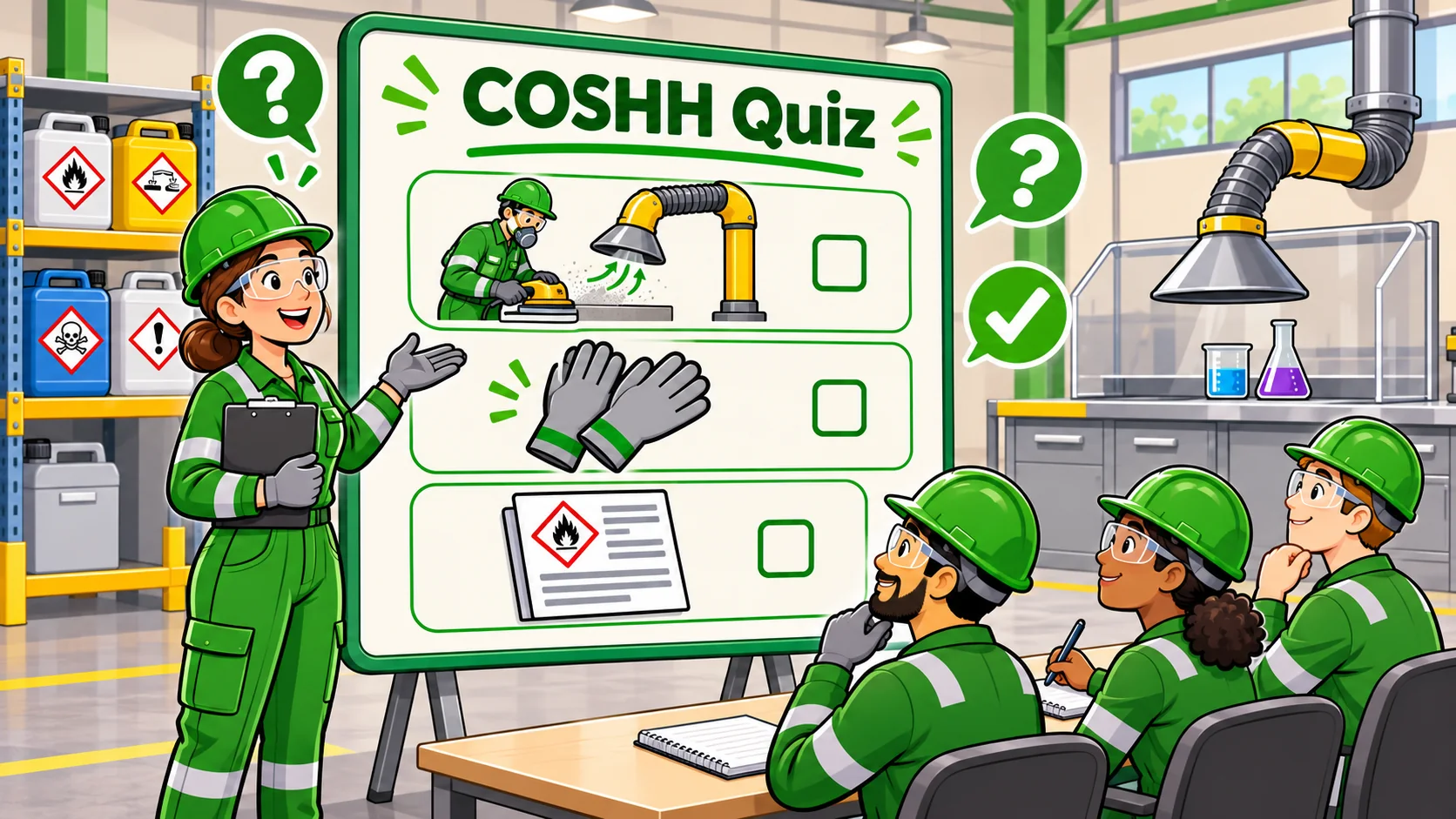
Test your understanding of hazardous-substance assessment and practical exposure controls with 25 original questions. This learning resource is useful for workers, supervisors and safety learners handling chemicals or working with processes that generate harmful dust, fume, vapour or biological exposure.
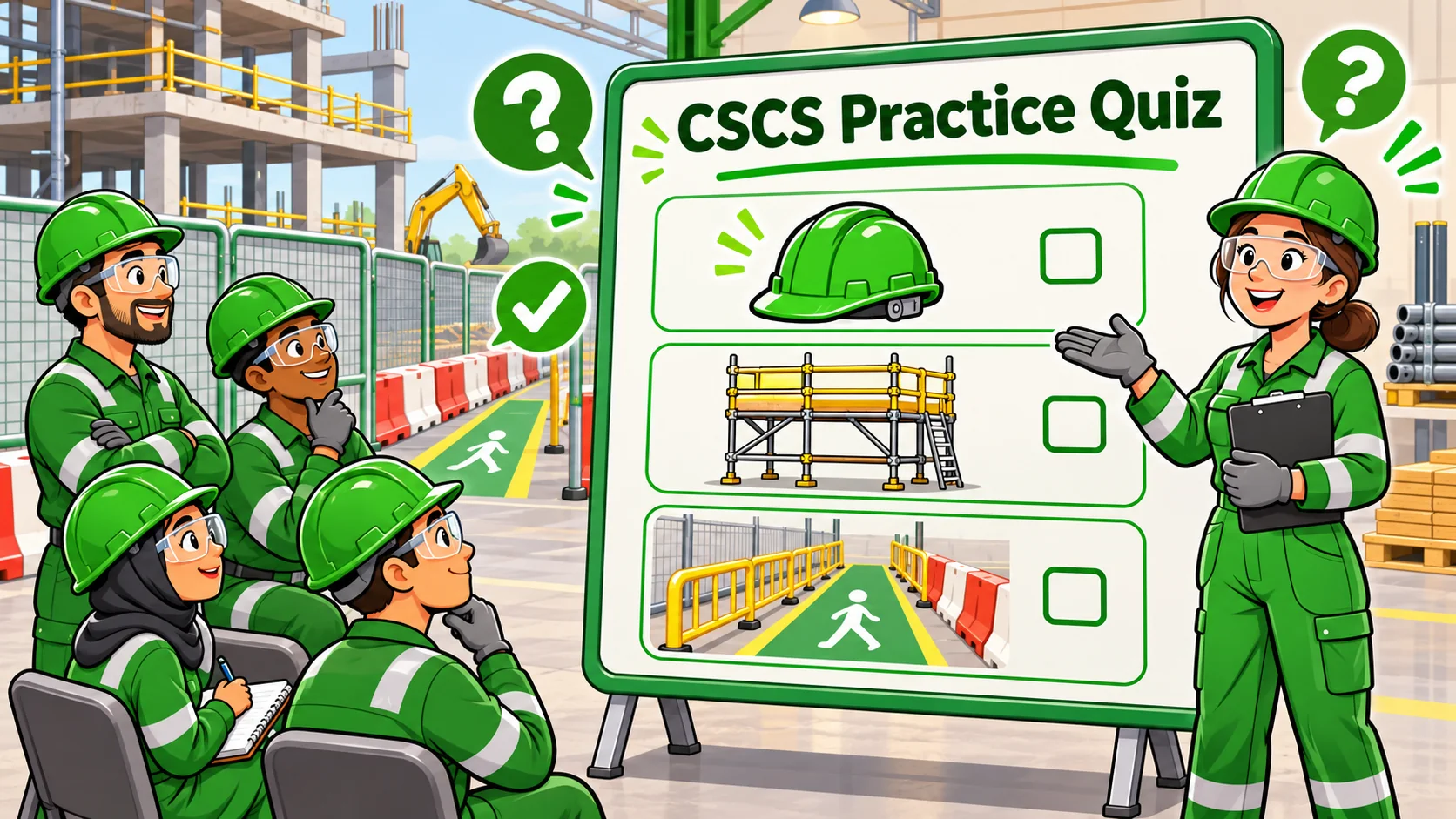
Revise practical construction safety with 25 original multiple-choice questions covering site induction, occupational health, safe access, plant movements, excavation hazards and emergency response. The scenarios focus on the decisions an operative may face when conditions change or a control is missing.
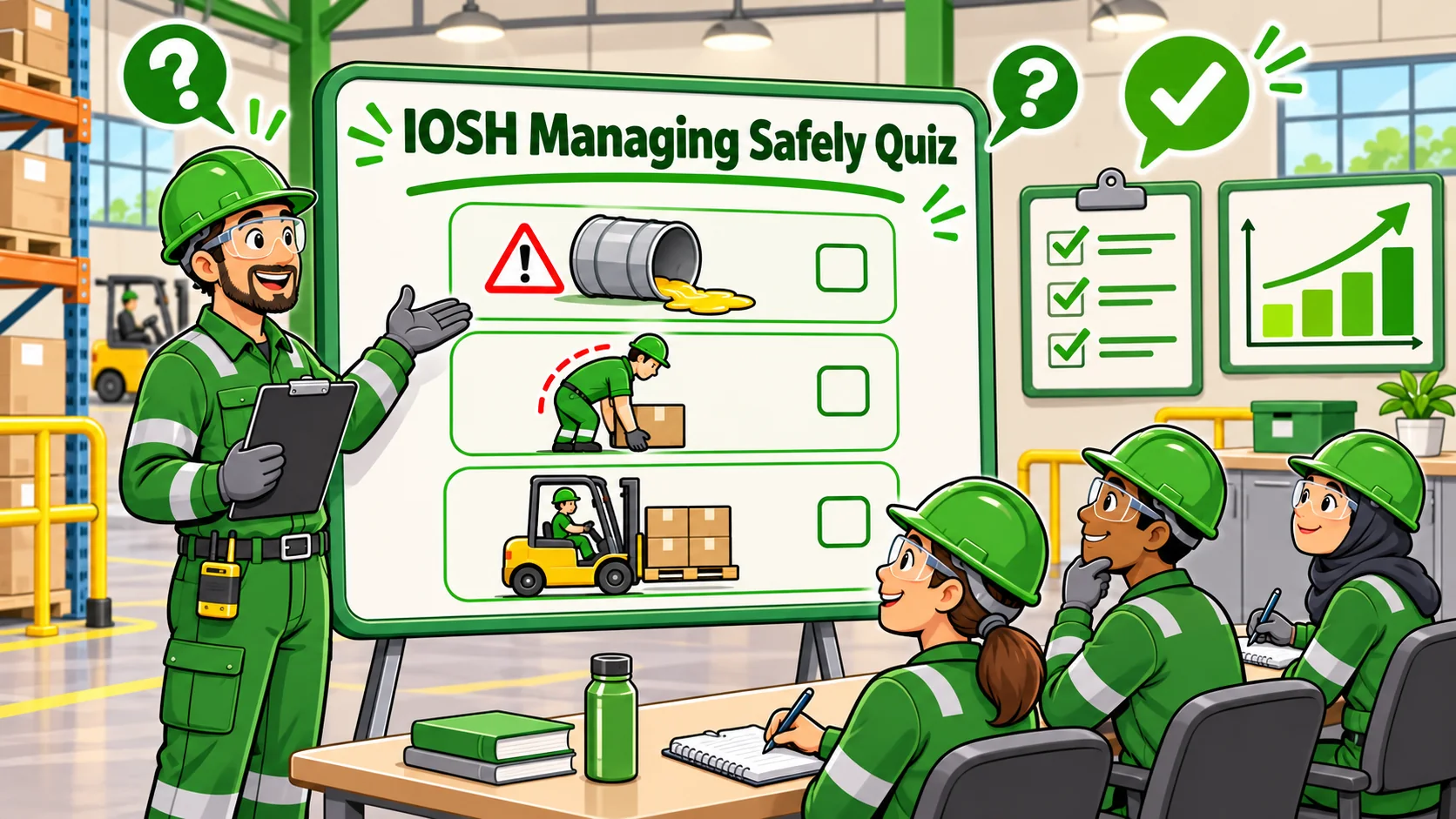
Build confidence in everyday safety management with original scenarios about hazards, risk assessment, control selection, incident learning and performance monitoring. This quiz is designed for line managers, supervisors and safety learners who want to check their understanding before further study.
ISO 45001 connects occupational health and safety with the way an organization plans, operates, evaluates, and improves its work. This quiz focuses on understanding and applying management-system concepts.