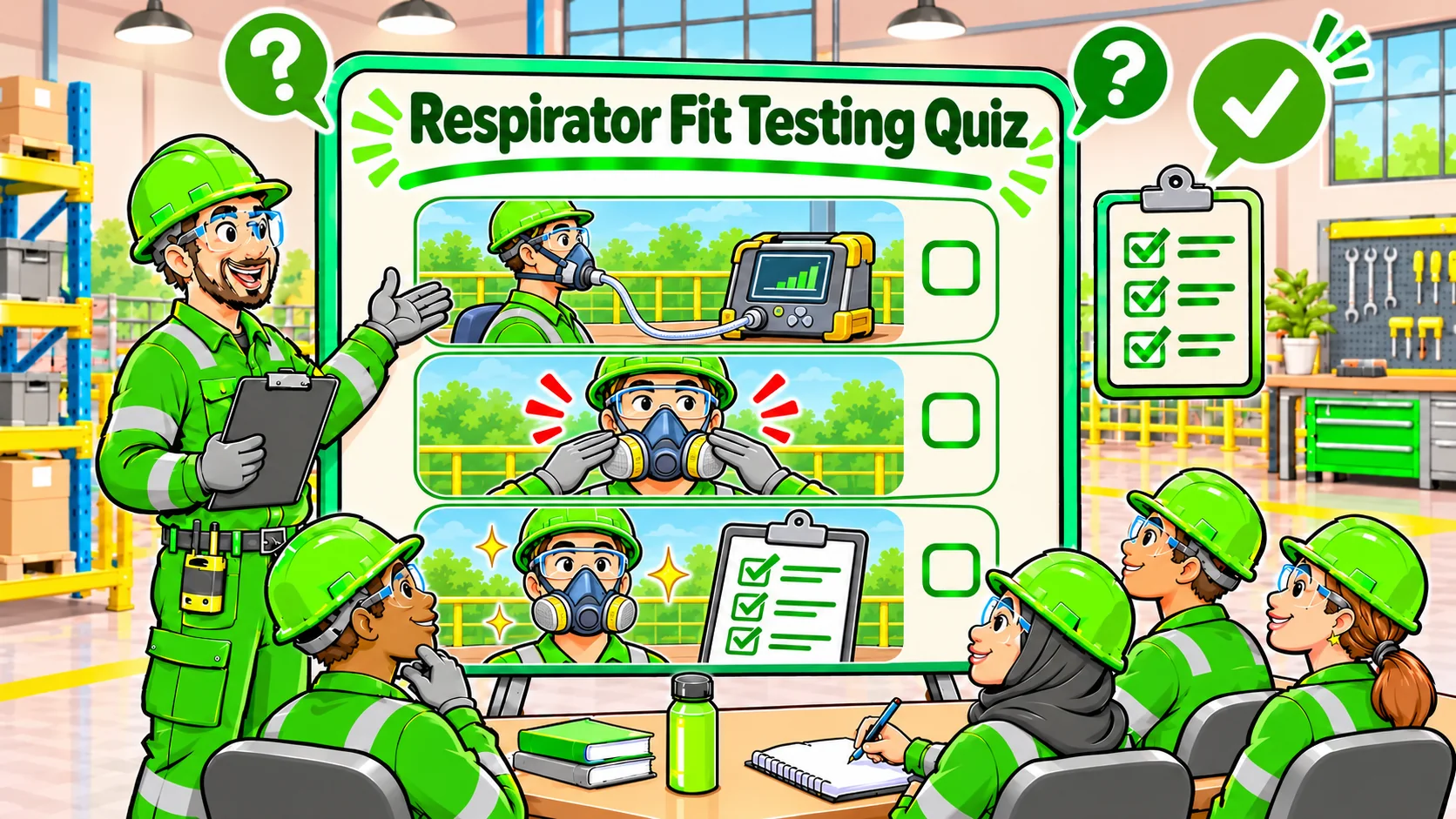
Respirator Fit Testing Quiz: Fit Tests, Seal Checks, and Facial Hair
25 questions
About 13 min
Updated
0 of 25 answered
Score 0
Question 1 of 25
What is the purpose of a respirator fit test?
Question 2 of 25
Which statement distinguishes a seal check from a fit test?
Question 3 of 25
Under US OSHA 1910.134, when is the initial fit test required?
Question 4 of 25
Under US OSHA 1910.134, what is the minimum routine fit-test frequency?
Question 5 of 25
A worker changes to another make of tight-fitting facepiece. What is required under US OSHA?
Question 6 of 25
Which change may trigger an additional fit test?
Question 7 of 25
How does a qualitative fit test assess fit?
Question 8 of 25
What distinguishes quantitative fit testing?
Question 9 of 25
Under US OSHA, qualitative fit testing of a negative-pressure air-purifying respirator is limited to which use?
Question 10 of 25
Under US OSHA, what minimum quantitative fit factor passes a tight-fitting half facepiece?
Question 11 of 25
Under US OSHA, what minimum quantitative fit factor passes a tight-fitting full facepiece?
Question 12 of 25
Which facial-hair condition prevents use of a tight-fitting respirator under US OSHA?
Question 13 of 25
A worker cannot achieve a seal because of facial hair. What should happen?
Question 14 of 25
Which respirator generally does not require a face-seal fit test?
Question 15 of 25
Why should normal work eyewear be considered during fit testing?
Question 16 of 25
Before required fit testing and respirator use, what does US OSHA require?
Question 17 of 25
A wearer fails a fit test. What should happen?
Question 18 of 25
Why do fit-test protocols include movement or speaking exercises?
Question 19 of 25
How tight should facepiece straps be?
Question 20 of 25
What should a wearer do after a failed user seal check?
Question 21 of 25
Does passing a fit test prove a particulate filter protects against toxic gases?
Question 22 of 25
Can a tight-fitting powered air-purifying respirator avoid fit testing simply because it has a blower?
Question 23 of 25
Why must fit-test modifications be removed before workplace use?
Question 24 of 25
Which detail belongs in a US OSHA fit-test record?
Question 25 of 25
What should a wearer do if leakage develops during hazardous work?
About This Quiz
A filter cannot provide its intended protection when contaminated air leaks around a tight-fitting facepiece. This respirator fit testing quiz explains how formal testing differs from a user seal check, why fit is specific to the wearer and facepiece, and how facial changes, eyewear and facial hair affect protection.
What this quiz covers
Check respirator fit-testing knowledge with 25 questions on qualitative and quantitative methods, seal checks, facial hair, medical evaluation and retesting.
How to use the quiz
Answer 25 multiple-choice questions with one correct answer each. The practice pass mark is 70%, requiring at least 18 correct answers. There is no time limit. Answer options are shuffled, explanations are available and retakes are allowed. Use the explanations to identify topics for further study.
Scope and limits
Independent practice material, not an official OSHA examination, fit-test certificate or demonstration of tester competence. Questions about frequency, fit factors, medical evaluation and records refer specifically to US OSHA 29 CFR 1910.134 and its appendices; other jurisdictions may differ. A quiz cannot replace a medical evaluation, accepted fit-test protocol, practical training or a complete respiratory-protection programme. A fit factor is not an assigned protection factor.
Sources and further reading
Guidance checked on 26 November 2026. Apply current requirements and the instructions for the actual equipment and task.
Test arc flash awareness with 25 questions on electrical hazards, isolation, boundaries, PPE and safe decisions. Includes correct answers and explanations.
Learn what to look for before relying on a safety harness and associated fall-arrest equipment. These 25 original questions explore webbing, stitching, hardware, identification, exposure history, inspection records and quarantine.
Check the decisions that prevent wheel breakage and loss of control during grinding and cutting. These 25 original questions cover accessory compatibility, inspection, mounting, guards, safe operation, dust and protective equipment.