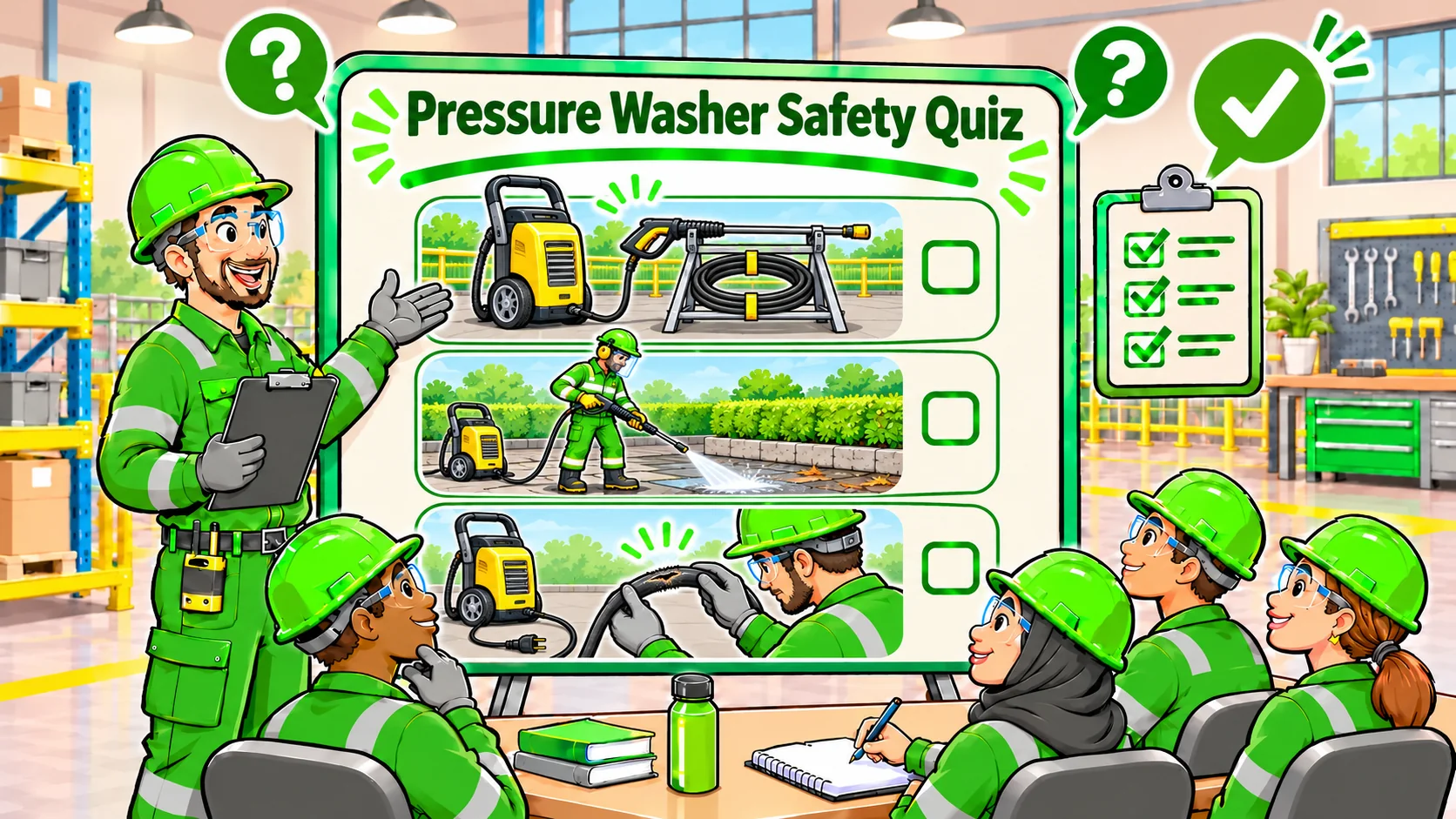
Pressure Washer Safety Quiz: Injection Injuries and Safe Operation
25 questions
About 13 min
Updated
0 of 25 answered
Score 0
Question 1 of 25
Why can a pressure-washer wound require urgent attention even when it looks small?
Question 2 of 25
What should happen after suspected high-pressure injection into the skin?
Question 3 of 25
Where should the lance be pointed?
Question 4 of 25
Is ordinary protective clothing proof against a pressure-washer jet?
Question 5 of 25
Why keep other people away from the cleaning area?
Question 6 of 25
What should guide nozzle selection and operating pressure?
Question 7 of 25
What should be done with a hose showing cuts, bulges or leaking fittings?
Question 8 of 25
Before changing a nozzle, what safe condition is needed?
Question 9 of 25
May the trigger be tied or locked in the spraying position?
Question 10 of 25
Why use stable footing and control the lance firmly?
Question 11 of 25
What is appropriate when a cleaning task cannot be safely reached from the ground?
Question 12 of 25
Can spray be used to push loose objects out of the work area?
Question 13 of 25
What should happen to children around pressure washing?
Question 14 of 25
What is a major additional hazard from a gasoline-powered pressure washer?
Question 15 of 25
May a gasoline washer run inside a garage with the door open?
Question 16 of 25
What clearance does CDC's pressure-washer guidance give from windows, doors and vents for a gasoline-powered washer?
Question 17 of 25
People develop headache and dizziness near a running gasoline washer. What is appropriate?
Question 18 of 25
What electrical protection should be checked before use according to CDC guidance?
Question 19 of 25
How should electrical cord connections be managed?
Question 20 of 25
What should happen if a circuit breaker trips during use?
Question 21 of 25
What should be done if a plug's grounding prong prevents it fitting a socket?
Question 22 of 25
What information is needed before using a cleaning chemical?
Question 23 of 25
Why inspect the surface and surroundings before cleaning?
Question 24 of 25
What should an operator do if the lance or trigger control malfunctions?
Question 25 of 25
What does this quiz replace in a workplace?
About This Quiz
A pressure washer can injure people through its water jet, flying debris, electricity and engine exhaust. This pressure washer safety quiz helps operators recognise the controls needed before starting work and the warning signs that call for an immediate stop.
What this quiz covers
Test pressure-washer safety knowledge with 25 questions on injection injuries, equipment checks, jet control, electrical hazards and engine exhaust.
How to use the quiz
Answer 25 multiple-choice questions with one correct answer each. The practice pass mark is 70%, requiring at least 18 correct answers. There is no time limit. Answer options are shuffled, explanations are available and retakes are allowed. Review the explanations and official guidance for any missed topics.
Scope and limits
Independent awareness practice using CDC pressure-washer guidance and relevant Great Britain HSE equipment and injection-injury guidance. It is not a licence, qualification or replacement for training and the instructions for the actual machine. The question specifying 20 feet identifies CDC guidance for gasoline-engine clearance from openings; it is not a universal legal distance. Suspected high-pressure injection needs urgent professional medical care even if the wound looks minor. Keep gasoline engines outdoors and prevent exhaust entering occupied areas.
Sources and further reading
Guidance checked on 22 November 2026. Use current official requirements and the instructions for the equipment actually being used.
Test portable electrical safety with 25 questions on plugs, cables, inspections, testing and defect reporting. Includes correct answers and explanations.
Test the decisions that keep tools, fittings and materials from injuring people below. These 25 original questions cover source control, secure transport and storage, containment, tool tethers, exclusion zones and coordination between work levels.
Check the decisions that prevent wheel breakage and loss of control during grinding and cutting. These 25 original questions cover accessory compatibility, inspection, mounting, guards, safe operation, dust and protective equipment.