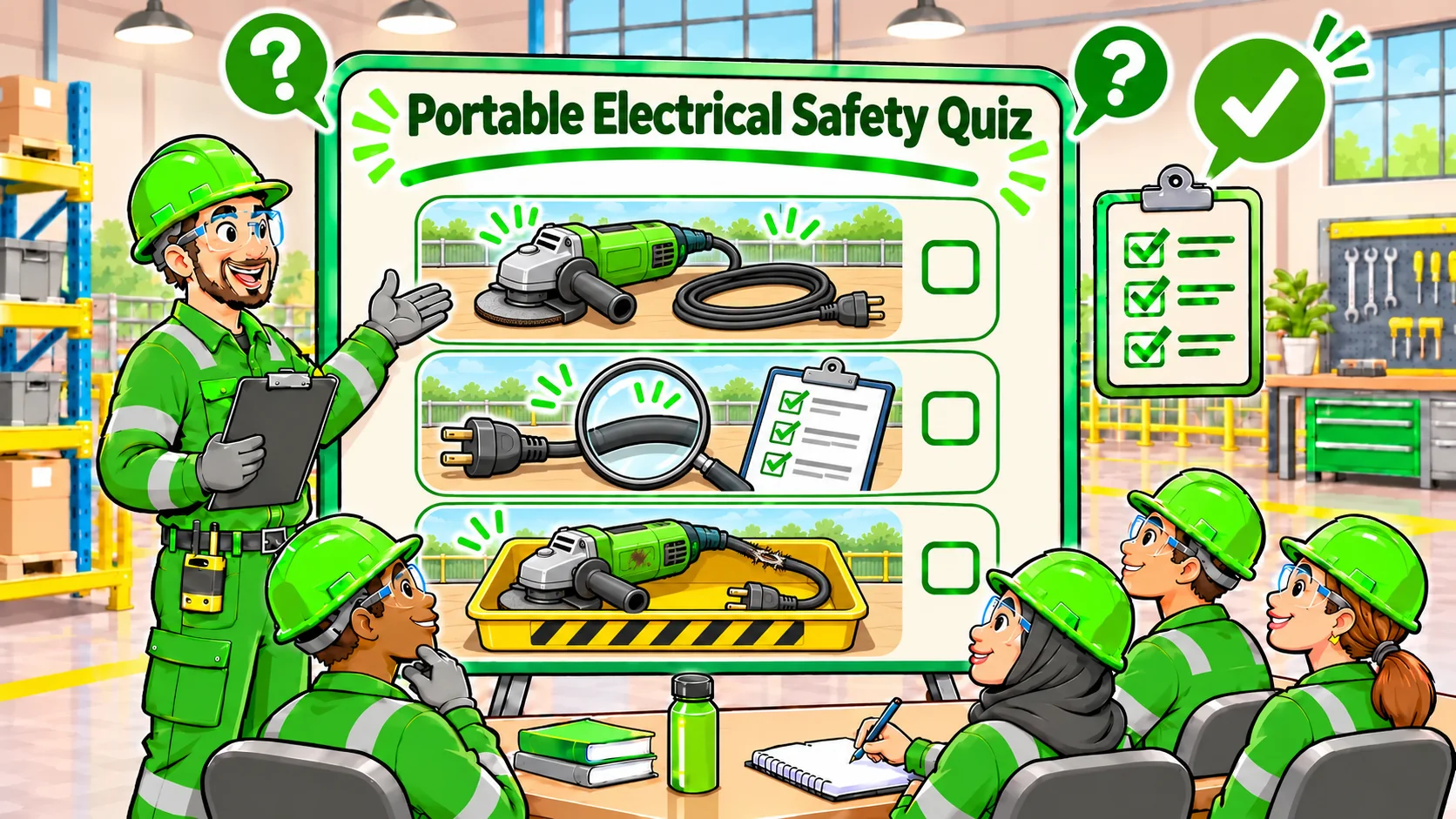
Portable Electrical Equipment Safety Quiz: Inspection and Defect Reporting
25 questions
About 13 min
Updated
0 of 25 answered
Score 0
Question 1 of 25
What should an ordinary user do before a simple visual check of mains-powered equipment?
Question 2 of 25
A flexible cable has exposed inner wires. What is appropriate?
Question 3 of 25
The equipment works normally despite a cracked plug body. What should the user do?
Question 4 of 25
Burn marks are visible around a plug or socket. What should happen?
Question 5 of 25
Why should a cable's outer sheath be properly secured at the plug?
Question 6 of 25
Can ordinary insulating tape be treated as a permanent repair for a damaged power cable?
Question 7 of 25
What should an ordinary user avoid during an external check?
Question 8 of 25
Does an in-date PAT label guarantee that an appliance is safe now?
Question 9 of 25
Under HSE's Great Britain PAT guidance, is annual testing legally required for every appliance?
Question 10 of 25
What should influence inspection and testing frequency?
Question 11 of 25
Can electrical testing replace visual inspection entirely?
Question 12 of 25
Can an external user check reveal every possible electrical defect?
Question 13 of 25
What competence does combined inspection and testing require?
Question 14 of 25
What is a suitable check on newly supplied equipment?
Question 15 of 25
What should be confirmed before connecting equipment to a supply?
Question 16 of 25
A tool is not designed for a wet environment. What should happen?
Question 17 of 25
What is the main distinction between Class I and Class II equipment?
Question 18 of 25
Can a missing protective earth on equipment requiring it be accepted because the appliance still works?
Question 19 of 25
What should determine a replacement fuse's rating?
Question 20 of 25
An RCD trips when an appliance is used. What should happen?
Question 21 of 25
What does a successful RCD test-button check prove?
Question 22 of 25
How should trailing leads be routed?
Question 23 of 25
What makes defect reporting effective?
Question 24 of 25
Who should decide when defective equipment can return to use?
Question 25 of 25
What is the value of keeping maintenance and test records where appropriate?
About This Quiz
Test portable electrical equipment safety with 25 practical questions on external checks, damaged plugs and cables, suitability, inspection and testing, RCD limitations, earthing, defect reporting and safe return to use. The quiz helps users recognise when to stop and refer equipment for competent assessment.
How to use the quiz
Choose one answer for each of 25 questions. The pass mark is 70%, there is no time limit and retakes are allowed. Answer choices are shuffled. Review the correct answers and explanations to identify what to study next.
Scope and standards
This is independent awareness practice, not an official HSE test, PAT qualification or permission to repair or test appliances. Questions use Great Britain HSE guidance, including HSG107 for Class I and Class II portable equipment. HSE's risk-based maintenance approach does not impose one annual testing interval on every appliance. Other countries, sectors and specialist equipment may have different requirements. Ordinary user checks must stay within the user's training; do not open equipment or carry out electrical repairs without appropriate competence and authorisation.
Primary sources
Sources reviewed on 20 November 2026. HSG85 and HSG107 are the third editions, published 2013 and still supplied by HSE at review. Consult current applicable requirements and equipment instructions before actual work.
Practise site electrical safety with 25 questions on temporary power, RCDs, cable protection and inspections. Includes correct answers and explanations.
Practise safe isolation with 25 questions on identifying supplies, lock-off, proving dead and preventing reconnection. Includes answers and explanations.
Test arc flash awareness with 25 questions on electrical hazards, isolation, boundaries, PPE and safe decisions. Includes correct answers and explanations.
Test your understanding of avoiding cable and pipe strikes before and during excavation. These 25 original questions cover service records, locator limitations, repeated checks, trial holes, safe exposure, authorisation, damage reporting and service protection.