Electrical Safe Isolation Quiz: Proving Dead and Preventing Reconnection
25 questions
About 13 min
Updated
0 of 25 answered
Score 0
Question 1 of 25
What must be established before starting electrical work intended to be done dead?
Question 2 of 25
Why identify the exact circuit and point of work before isolation?
Question 3 of 25
A panel label conflicts with the available drawing. What should the worker do?
Question 4 of 25
A machine's emergency-stop button is pressed. Does this alone establish safe electrical isolation?
Question 5 of 25
Why check for more than one electrical supply?
Question 6 of 25
What is the purpose of securing an isolation?
Question 7 of 25
Who should retain control of a personal isolation-lock key in the normal planned arrangement?
Question 8 of 25
Is a warning notice alone a dependable substitute for secure isolation?
Question 9 of 25
Several people work on equipment under lock-off. What arrangement is appropriate?
Question 10 of 25
What does proving dead establish?
Question 11 of 25
When does HSG85 require the voltage-detection instrument to be checked?
Question 12 of 25
What is the role of a suitable proving unit?
Question 13 of 25
For ordinary low-voltage proving-dead work within HSG85's scope, which device is not recommended as the sole means?
Question 14 of 25
Why does HSG85 caution against using general multimeters to prove low-voltage systems dead?
Question 15 of 25
A voltage indicator fails its after-use proving check. What should happen?
Question 16 of 25
Why must all relevant supply conductors be verified on a three-phase or multi-supply system?
Question 17 of 25
The intended circuit is isolated but exposed live parts are nearby. What is still needed?
Question 18 of 25
Does an electrical permit-to-work itself make equipment safe?
Question 19 of 25
Stored electrical energy is suspected after disconnection. What should happen?
Question 20 of 25
A generator could energise the circuit from another location. What must the plan address?
Question 21 of 25
What should happen if a protected isolation arrangement is disturbed during the job?
Question 22 of 25
What should a worker do if asked to remove another person's isolation lock without the authorised procedure?
Question 23 of 25
Before planned re-energisation, what must the responsible team establish?
Question 24 of 25
Who should carry out specialist electrical isolation and voltage-verification tasks?
Question 25 of 25
What does a high quiz score establish?
About This Quiz
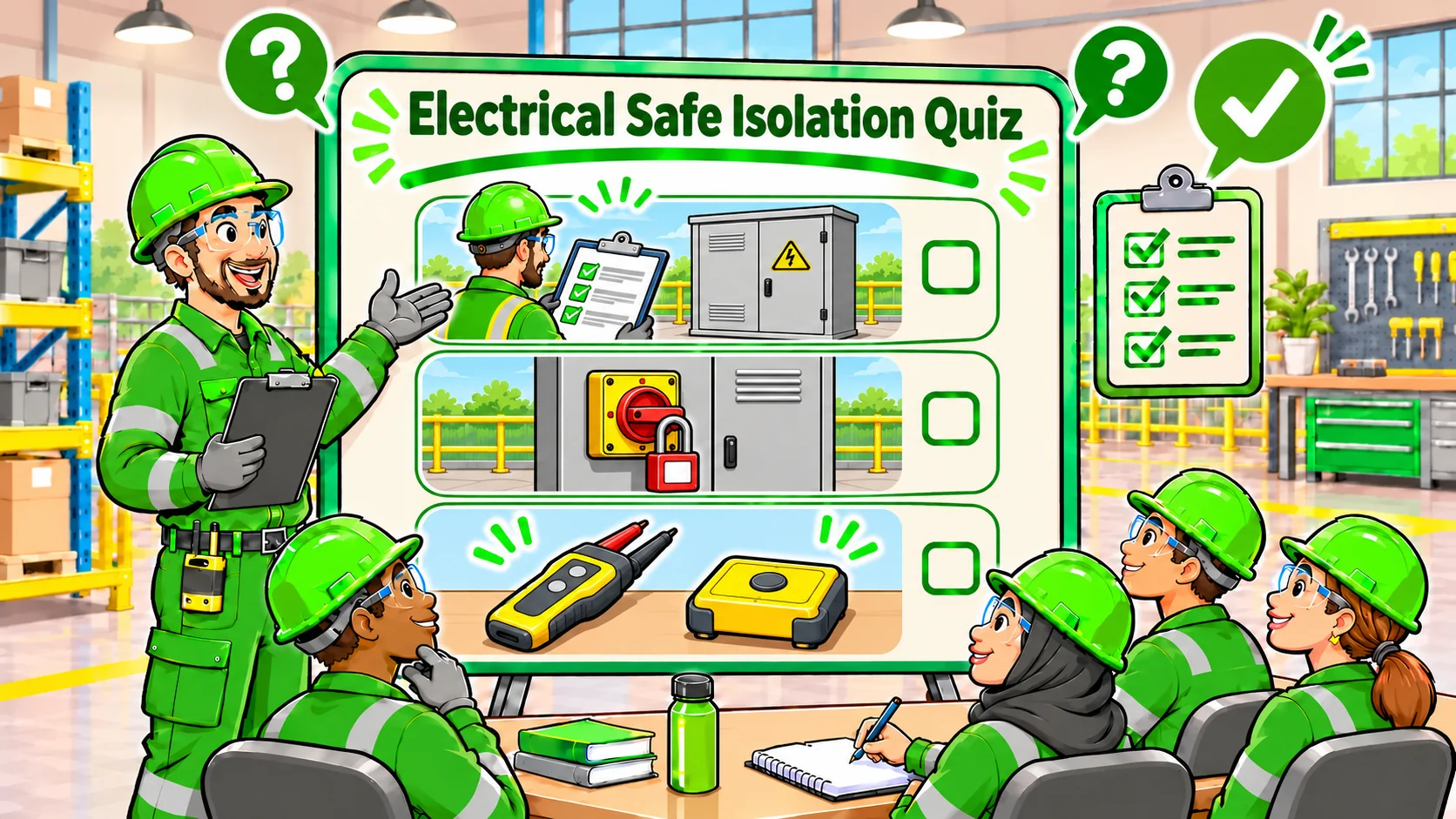
This electrical safe isolation quiz contains 25 questions on identifying circuits and supplies, disconnecting and securing them, proving dead, checking the voltage indicator, controlling group work and preventing unintended reconnection. It supports recognition of safe decisions and the limits of assumptions.
How to use the quiz
Choose one answer for each of 25 questions. The pass mark is 70%, there is no time limit and retakes are allowed. Answer choices are shuffled. Review the correct answers and explanations to identify what to study next.
Scope and standards
This is independent knowledge-practice material, not an official HSE examination, electrical qualification or authorisation to isolate, test or work on equipment. The reference scope is general workplace electrical safety in Great Britain, using HSG85 and HSE guidance; specialist systems may require additional rules. The quiz is not a complete practical isolation procedure. Trained, competent and authorised people must select the actual method, instruments, protective measures and handback arrangements for the system and task.
Primary sources
Sources reviewed on 20 November 2026. HSG85 and HSG107 are the third editions, published 2013 and still supplied by HSE at review. Consult current applicable requirements and equipment instructions before actual work.
Practise site electrical safety with 25 questions on temporary power, RCDs, cable protection and inspections. Includes correct answers and explanations.
Test portable electrical safety with 25 questions on plugs, cables, inspections, testing and defect reporting. Includes correct answers and explanations.
Test arc flash awareness with 25 questions on electrical hazards, isolation, boundaries, PPE and safe decisions. Includes correct answers and explanations.
Test your understanding of avoiding cable and pipe strikes before and during excavation. These 25 original questions cover service records, locator limitations, repeated checks, trial holes, safe exposure, authorisation, damage reporting and service protection.