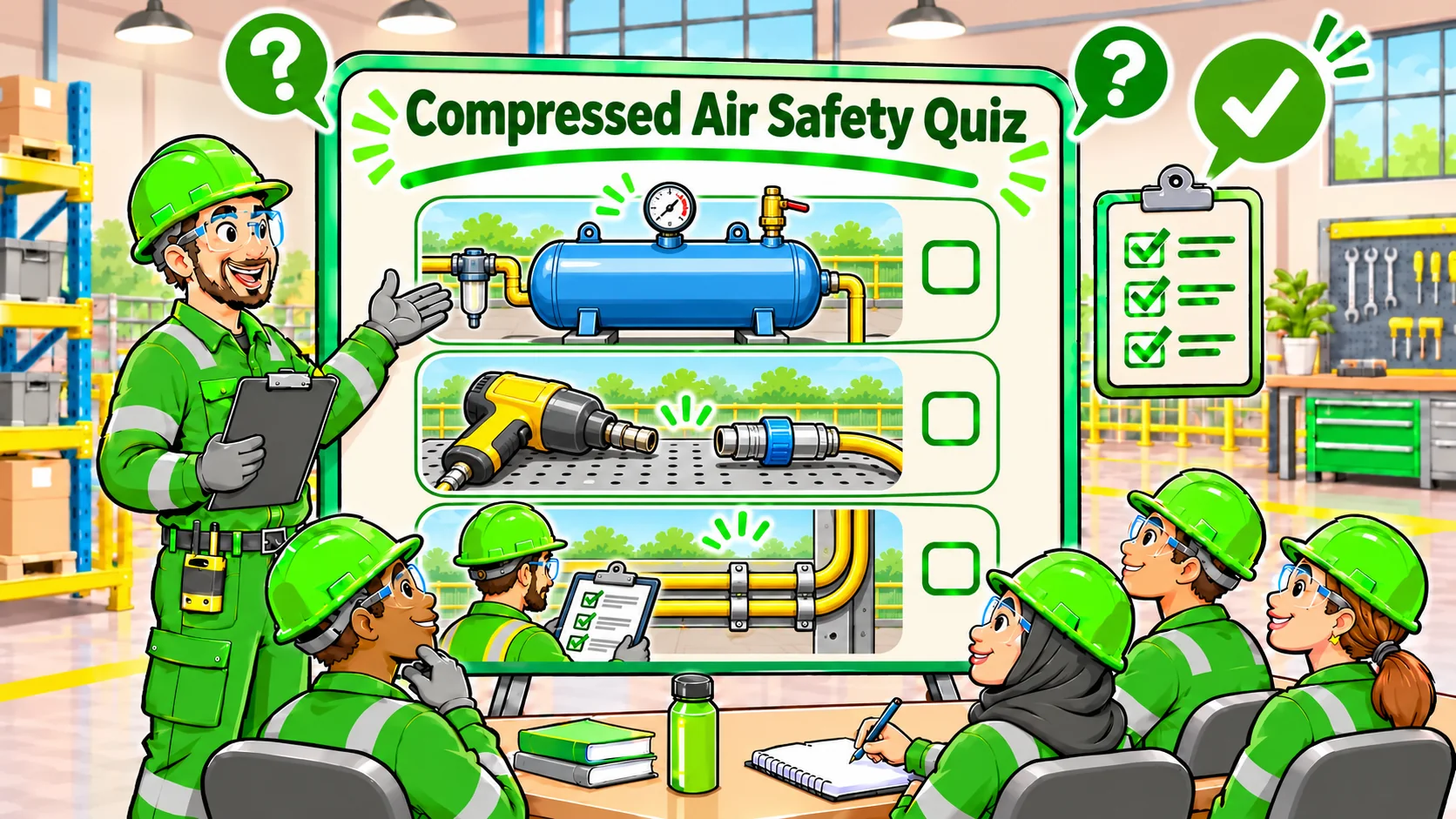
Compressed Air Safety Quiz: Tools, Hoses, and Stored Energy
25 questions
About 13 min
Updated
0 of 25 answered
Score 0
Question 1 of 25
What makes compressed air hazardous even when no electrical cable is attached to a tool?
Question 2 of 25
What should determine a pneumatic tool's operating pressure?
Question 3 of 25
Which hose is appropriate for a pneumatic tool?
Question 4 of 25
A hose has a bulge and surface damage. What should happen?
Question 5 of 25
How should a pneumatic tool be connected under US OSHA 1926.302(b)(1)?
Question 6 of 25
What is the purpose of a suitable hose safety cable or whip restraint?
Question 7 of 25
Before changing a pneumatic tool or accessory, what is needed?
Question 8 of 25
What is preferable when selecting quick-disconnect couplings?
Question 9 of 25
May a pneumatic tool be carried by its hose?
Question 10 of 25
Under US OSHA 1926.302, may an air hose hoist or lower a tool?
Question 11 of 25
What is required on pneumatic percussion tools under US OSHA 1926.302(b)(2)?
Question 12 of 25
What does US OSHA 1926.302(b)(7) require for air hoses exceeding one-half inch inside diameter?
Question 13 of 25
What pressure condition does US OSHA 1910.242(b) specify for permitted compressed-air cleaning?
Question 14 of 25
Does the US cleaning-pressure provision make blowing dust from clothing a good practice?
Question 15 of 25
Why must compressed air never be directed at another person?
Question 16 of 25
What should be considered for nearby people during pneumatic-tool work?
Question 17 of 25
What eye and face protection principle applies to pneumatic work producing fragments?
Question 18 of 25
Why assess noise from pneumatic tools and escaping air?
Question 19 of 25
What is a useful way to address vibration exposure?
Question 20 of 25
How should hoses be routed through a workplace?
Question 21 of 25
Under US OSHA 1910.169, what must an air receiver have?
Question 22 of 25
May a shutoff valve be placed between an air receiver and its safety valve under US OSHA 1910.169?
Question 23 of 25
Why remove accumulated liquid from an air receiver using its proper drain arrangement?
Question 24 of 25
A receiver safety valve is leaking. What is appropriate?
Question 25 of 25
Can ordinary workshop compressed air automatically be used as breathing air?
About This Quiz
Compressed air can power useful tools while creating stored-energy, hose-whip, noise and flying-particle hazards. This compressed air safety quiz tests the checks needed for pneumatic tools, supply hoses, receivers, protective devices and safe cleaning decisions.
What this quiz covers
Practise compressed-air safety with 25 questions covering pneumatic tools, secure connections, hose whip, pressure limits, receivers and cleaning hazards.
How to use the quiz
Answer 25 multiple-choice questions with one correct answer each. The practice pass mark is 70%, requiring at least 18 correct answers. There is no time limit. Answer options are shuffled, explanations are available and retakes are allowed. Review the explanations and official guidance for any missed topics.
Scope and limits
Independent knowledge practice drawing on CCOHS guidance and expressly identified US OSHA rules. OSHA 1926.302 questions concern construction; 1910.242 and 1910.169 address their stated general-industry subjects. The less-than-30-psi cleaning provision is not a universal safe pressure and does not justify blowing clothing or the body. Construction cleaning has particular exceptions that must not be transferred to general-industry rules. Follow applicable local law, equipment instructions and workplace procedures. Ordinary tool air must not be improvised into breathing air. Passing this quiz does not establish practical competence.
Sources and further reading
Guidance checked on 22 November 2026. Use current official requirements and the instructions for the equipment actually being used.
Practise pressure-testing safety with 25 questions about hydrostatic and pneumatic tests, stored energy, safe fittings, isolation and protecting people.
Practise compressed gas cylinder safety with 25 multiple-choice questions on identification, storage, transport within the workplace, regulators and emergency awareness.
Practise welding-fume safety with 25 questions covering health risks, source capture, respiratory protection, maintenance and protection of nearby workers.