Compressed Gas Cylinder Safety Quiz: Storage, Handling, and Regulators
25 questions
About 13 min
Updated
0 of 25 answered
Score 0
Question 1 of 25
What should establish a cylinder's contents before use?
Question 2 of 25
A cylinder label is illegible. What should happen?
Question 3 of 25
Why secure a cylinder against falling?
Question 4 of 25
Under US OSHA 1926.350, how should cylinders transported by powered vehicles be secured?
Question 5 of 25
Under US OSHA 1926.350(a)(6), what normally happens before moving a cylinder unless secured on a special carrier intended for that purpose?
Question 6 of 25
May a valve protection cap be used as a lifting point?
Question 7 of 25
Which arrangement is appropriate for hoisting cylinders under OSHA 1926.350(a)(2)?
Question 8 of 25
A cylinder is severely damaged. What should be done?
Question 9 of 25
What is a suitable routine way to move a cylinder across a workshop?
Question 10 of 25
What should govern regulator selection?
Question 11 of 25
A regulator connection will not fit normally. What should happen?
Question 12 of 25
Why keep oxygen fittings free of oil and grease?
Question 13 of 25
Where should stored cylinders be protected from damage?
Question 14 of 25
Does a nonflammable gas necessarily present no serious hazard?
Question 15 of 25
What should guide segregation of stored gases?
Question 16 of 25
For oxygen cylinders in storage under US OSHA 1926.350(a)(10), what is an accepted separation from fuel-gas cylinders?
Question 17 of 25
Should a cylinder marked empty be handled as if no hazard remains?
Question 18 of 25
May cylinders be used as rollers or supports?
Question 19 of 25
What should happen to the cylinder valve when work is finished under OSHA 1926.350?
Question 20 of 25
How should a suspected gas leak be approached?
Question 21 of 25
Which leak-checking method is suitable for oxy-fuel equipment when a trained person can safely check it?
Question 22 of 25
May an ordinary user modify a cylinder pressure-relief device?
Question 23 of 25
Who may refill a cylinder under US OSHA 1926.350(c)(2)?
Question 24 of 25
A cylinder has been heated by fire. What is appropriate?
Question 25 of 25
What does passing this cylinder quiz establish?
About This Quiz
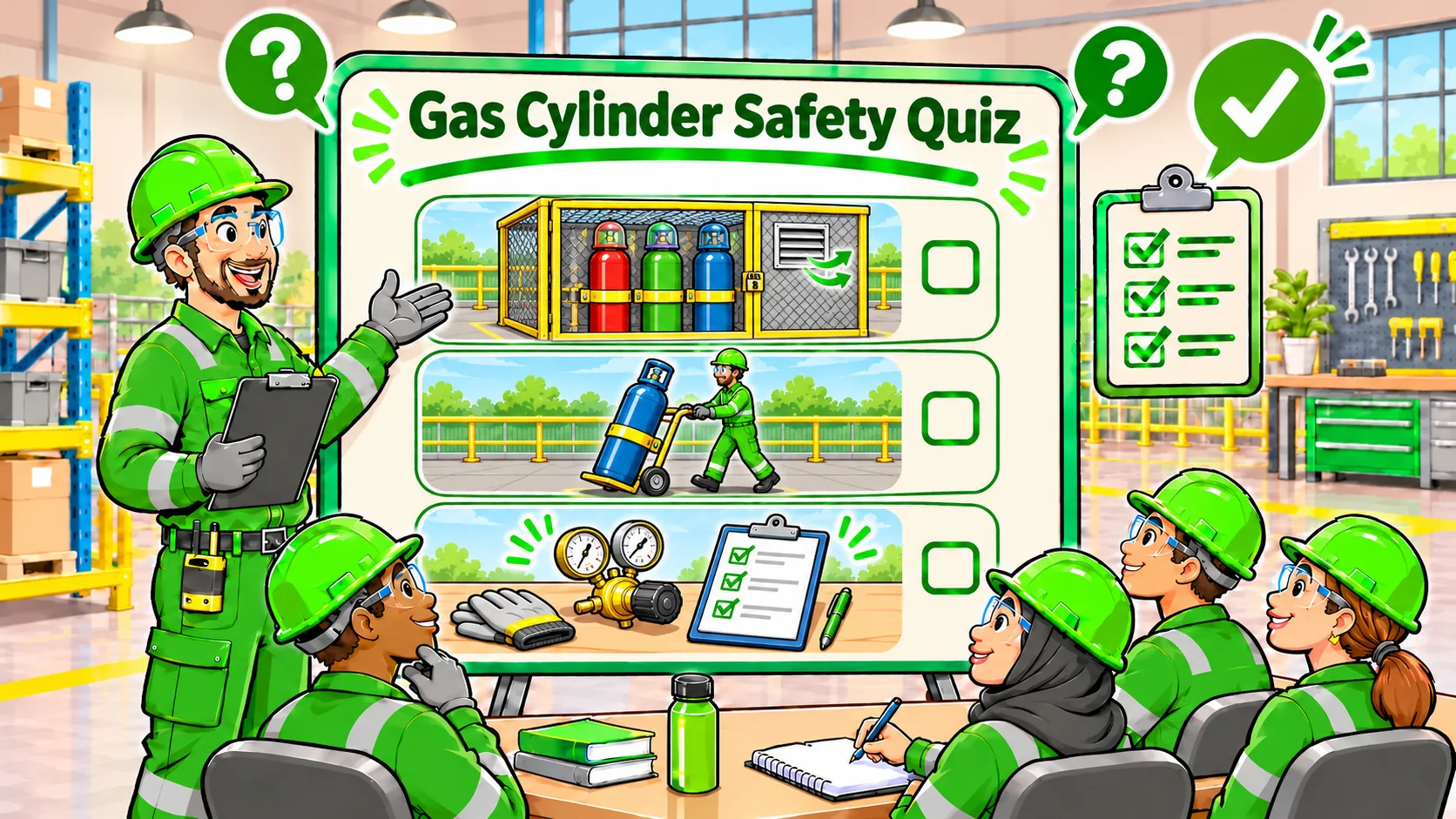
A gas cylinder can hold both hazardous contents and considerable stored energy. This compressed gas cylinder safety quiz tests how to identify cylinders, prevent valve damage, select compatible regulators, segregate gases and recognise situations that need supplier or emergency help.
What this quiz covers
Practise compressed gas cylinder safety with 25 multiple-choice questions on identification, storage, transport within the workplace, regulators and emergency awareness.
How to use the quiz
Answer 25 multiple-choice questions with one correct answer each. The practice pass mark is 70%, so at least 18 correct answers are needed. There is no time limit. Answer options are shuffled, explanations are available and retakes are allowed. Read each explanation and review the source guidance for any missed topic.
Scope and limits
This is independent knowledge practice for workers and supervisors, not a qualification or proof of practical competence. General precautions draw on CCOHS and HSE guidance. Questions explicitly naming OSHA 1926.350 apply to United States construction welding and cutting; their distances and exceptions are not universal storage or transport rules. Follow the applicable jurisdiction, gas safety data sheet, supplier instructions and workplace procedures. The quiz does not authorise gas transfer, repairs or emergency intervention.
Sources and further reading
Guidance checked on 21 November 2026. Use the current official guidance and applicable local requirements for real work.
Practise welding-fume safety with 25 questions covering health risks, source capture, respiratory protection, maintenance and protection of nearby workers.
Practise site electrical safety with 25 questions on temporary power, RCDs, cable protection and inspections. Includes correct answers and explanations.
Test portable electrical safety with 25 questions on plugs, cables, inspections, testing and defect reporting. Includes correct answers and explanations.