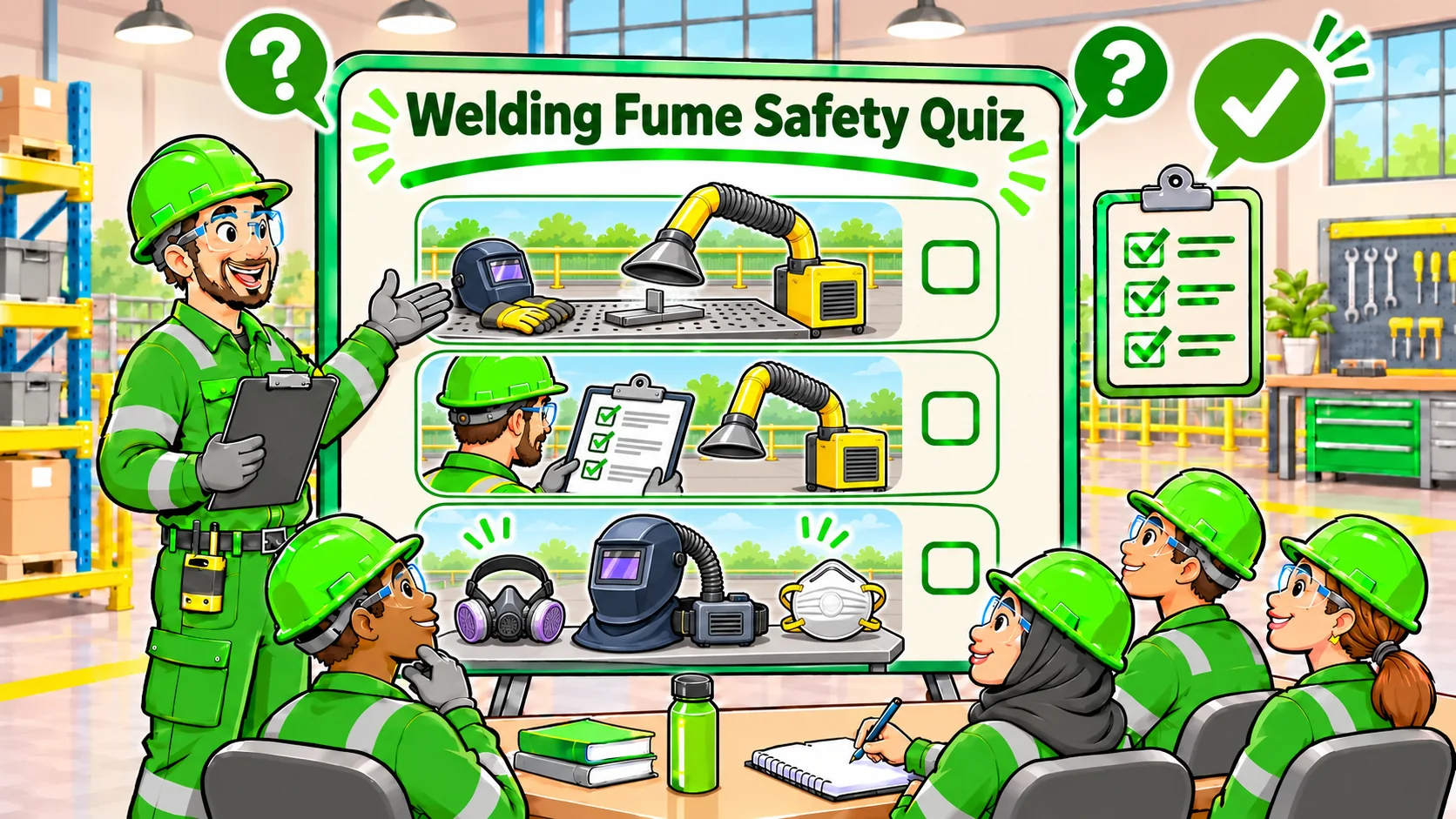
Welding Fume Safety Quiz: Exposure Controls and Ventilation
25 questions
About 13 min
Updated
0 of 25 answered
Score 0
Question 1 of 25
Why does mild-steel welding fume require effective exposure controls?
Question 2 of 25
Which approach should be considered first when planning a joining task?
Question 3 of 25
What is the main purpose of local exhaust ventilation (LEV) during indoor welding?
Question 4 of 25
Which factor matters most when positioning a movable extraction hood?
Question 5 of 25
An extraction hood is moved away to improve access, and fume escapes. What should happen?
Question 6 of 25
Why is an open workshop door generally insufficient as the only control for indoor welding fume?
Question 7 of 25
What is the appropriate response when LEV does not adequately control remaining welding-fume exposure?
Question 8 of 25
How does outdoor welding affect the need for respiratory protection under HSE guidance?
Question 9 of 25
What must be checked when selecting a tight-fitting respirator for an individual welder?
Question 10 of 25
Why can beard stubble in the sealing area make a tight-fitting respirator unsuitable?
Question 11 of 25
What check should a trained wearer perform whenever putting on a tight-fitting respirator?
Question 12 of 25
Which statement about a particulate respirator and welding gases is correct?
Question 13 of 25
Why must an oxygen-deficient space never be treated as safe merely by wearing a filtering respirator?
Question 14 of 25
Which nearby person can also need protection from welding fume?
Question 15 of 25
What should be considered before welding a coated or contaminated component?
Question 16 of 25
Why may changing to a lower-fume welding process still require a new control assessment?
Question 17 of 25
What is a useful daily check before operating an LEV system?
Question 18 of 25
What should happen if a welding-fume extraction hose is split?
Question 19 of 25
In Great Britain, what is the usual maximum interval for a competent thorough examination and test of welding-fume LEV under COSHH?
Question 20 of 25
For how long does HSE say LEV thorough-examination and test records should be retained?
Question 21 of 25
Which change is a reason to review a welding-fume risk assessment?
Question 22 of 25
Does an absence of immediately noticeable symptoms establish that welding-fume exposure is safe?
Question 23 of 25
How should a welding helmet's role be understood when assessing inhalation hazards?
Question 24 of 25
What can a welder's body position do to help reduce exposure alongside effective controls?
Question 25 of 25
Which training outcome best supports effective welding-fume control?
About This Quiz
All welding fume, including mild-steel fume, can cause lung cancer. This welding fume safety quiz focuses on avoiding or reducing exposure, capturing fume at source, selecting suitable respiratory protection and checking that controls keep working for welders and other people nearby.
What this quiz covers
Practise welding-fume safety with 25 questions covering health risks, source capture, respiratory protection, maintenance and protection of nearby workers.
How to use the quiz
Answer 25 multiple-choice questions with one correct answer each. The practice pass mark is 70%, so at least 18 correct answers are needed. There is no time limit. Answer options are shuffled, explanations are available and retakes are allowed. Read each explanation and review the source guidance for any missed topic.
Scope and limits
Independent knowledge practice using Great Britain HSE and COSHH guidance, not an official regulator examination or a qualification. Legal intervals in the questions are explicitly scoped to Great Britain. A particle filter does not automatically protect against welding gases and filtering respirators do not supply oxygen. Confined-space work needs its own assessment, safe system and emergency arrangements. Use the actual process, materials, contaminants, duration and wearer needs when selecting controls; a quiz score cannot establish practical competence.
Sources and further reading
Guidance checked on 21 November 2026. Use the current official guidance and applicable local requirements for real work.
Practise compressed gas cylinder safety with 25 multiple-choice questions on identification, storage, transport within the workplace, regulators and emergency awareness.
Welding, cutting, grinding, and related work can ignite materials beyond the immediate work point. This quiz looks at preparation, authorization, monitoring, and safe completion of hot work.
Practise site electrical safety with 25 questions on temporary power, RCDs, cable protection and inspections. Includes correct answers and explanations.