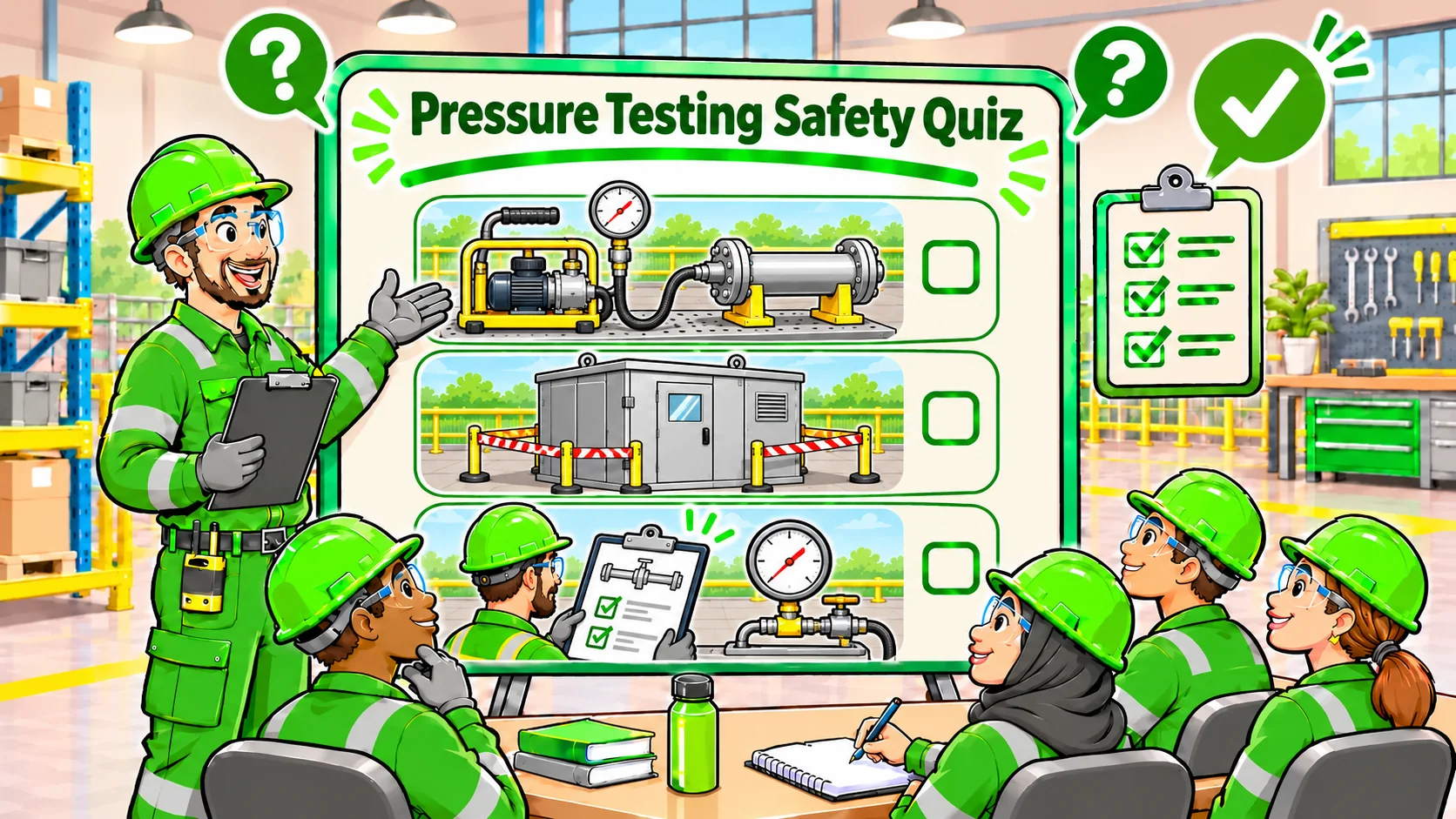
Pressure Testing Safety Quiz: Hydrostatic and Pneumatic Test Hazards
25 questions
About 13 min
Updated
0 of 25 answered
Score 0
Question 1 of 25
Why is pressure testing a high-risk activity?
Question 2 of 25
For otherwise comparable tests, why prefer a suitable liquid over gas where practicable?
Question 3 of 25
What should determine the test pressure?
Question 4 of 25
What information is essential when assessing stored-energy risk?
Question 5 of 25
What should be prepared before a pressure test?
Question 6 of 25
A test connector's threads are visibly deformed. What should happen?
Question 7 of 25
What verifies a hose or connector is suitable for a test?
Question 8 of 25
Can components from different hose-fitting manufacturers automatically be mixed?
Question 9 of 25
Where should pressure controls and monitoring devices be positioned where practicable?
Question 10 of 25
What must a protective test enclosure be capable of doing?
Question 11 of 25
Does a hose whip restraint replace a required protective enclosure?
Question 12 of 25
What should determine the exclusion zone for a pressure test?
Question 13 of 25
Why should unnecessary pressurised test volume be reduced where safely practicable?
Question 14 of 25
What must be considered when selecting a hose route?
Question 15 of 25
How should a suspected leak be checked during a pressure test?
Question 16 of 25
What is appropriate if a connection needs adjustment during testing?
Question 17 of 25
Does a hydrostatic test eliminate injection-injury risk?
Question 18 of 25
A tiny puncture may have been caused by a high-pressure fluid jet. What is needed?
Question 19 of 25
What overpressure protection should the test plan address?
Question 20 of 25
Why can a zero reading on one gauge be insufficient before dismantling?
Question 21 of 25
What should happen before people enter the danger zone after a test?
Question 22 of 25
Why review a repaired assembly even if it passed an earlier test?
Question 23 of 25
Why must a liquid-test assembly be properly vented before pressurisation?
Question 24 of 25
What is the role of supervision during pressure testing?
Question 25 of 25
How does GS4 describe starting and increasing test pressure?
About This Quiz
Pressure testing can verify integrity while exposing people to stored energy, flying components, hose whip and injection hazards. This pressure testing safety quiz focuses on the precautions that make hydrostatic and pneumatic tests controlled activities rather than improvised checks.
What this quiz covers
Practise pressure-testing safety with 25 questions about hydrostatic and pneumatic tests, stored energy, safe fittings, isolation and protecting people.
How to use the quiz
Answer 25 multiple-choice questions with one correct answer each. The practice pass mark is 70%, requiring at least 18 correct answers. There is no time limit. Answer options are shuffled, explanations are available and retakes are allowed. Review the explanations and official guidance for any missed topics.
Scope and limits
Independent knowledge practice based principally on Great Britain HSE GS4, fourth edition, and pressure-system guidance. It is not an official HSE examination, a practical qualification or a test procedure. No universal test pressure, pressure multiplier, enclosure design or exclusion distance is supplied: these require competent assessment of the actual equipment and applicable design requirements. Hydrostatic testing can reduce stored energy compared with gas testing but does not remove all hazards.
Sources and further reading
Guidance checked on 22 November 2026. Use current official requirements and the instructions for the equipment actually being used.
Practise compressed gas cylinder safety with 25 multiple-choice questions on identification, storage, transport within the workplace, regulators and emergency awareness.
Practise welding-fume safety with 25 questions covering health risks, source capture, respiratory protection, maintenance and protection of nearby workers.