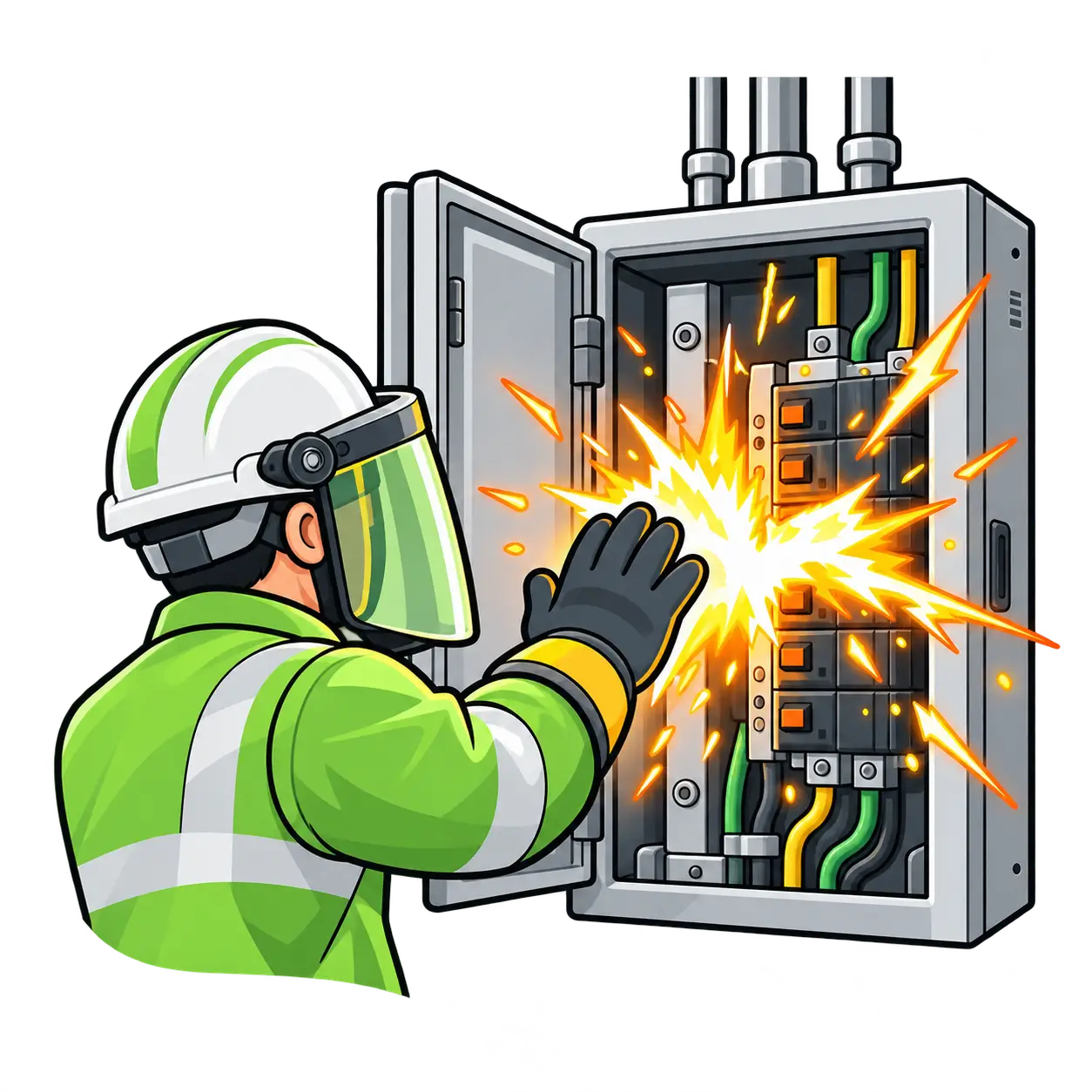
What is arc flash incident energy?
Incident energy is the heat energy (usually in cal/cm²) that reaches a worker’s body at a stated working distance if an arc flash occurs. PPE is chosen so the clothing’s arc rating (ATPV or EBT) meets or exceeds that energy.
This free tool has two modes: look up an NFPA 70E-style PPE category from a known incident energy, or run a rough open-air Lee-style estimate from fault current, system voltage, clearing time, and working distance. It is a planning and training aid — not a substitute for an IEEE 1584 study or a qualified engineer’s arc-flash analysis.
Arc Flash Calculator
Arc flash · Incident energy & PPE
Map incident energy to an NFPA 70E-style PPE category, or run a rough open-air estimate. Not a substitute for IEEE 1584 engineering analysis.
Formula: PPE from IE bands · Rough IE ≈ (793 × F × V × t) ÷ D² (Lee-style open air)
- Estimate mode is open-air Lee-style only — enclosures change results a lot.
- Working distance and clearing time dominate energy — use study values.
- Follow your electrical safety programme and the applicable NFPA 70E edition.
PPE category bands (indicative)
| Incident energy | Typical category | Min clothing arc rating (common) |
|---|---|---|
| ≤ 1.2 cal/cm² | Below Cat 1 / everyday workwear context | Verify site rules |
| ≤ 4 cal/cm² | Category 1 | ≥ 4 cal/cm² |
| ≤ 8 cal/cm² | Category 2 | ≥ 8 cal/cm² |
| ≤ 25 cal/cm² | Category 3 | ≥ 25 cal/cm² |
| ≤ 40 cal/cm² | Category 4 | ≥ 40 cal/cm² |
| > 40 cal/cm² | Beyond Cat 4 | Specialty / engineer controls |
Rough open-air estimate
One classic open-air approximation (Ralph Lee style) is:
IE ≈ (793 × F × V × t) ÷ D²
where F is bolted fault current (kA), V is line voltage (kV), t is arcing duration (s), and D is working distance (inches). Enclosure geometry, electrode configuration, and IEEE 1584 models can change results substantially.
How to use the result
- Prefer a site-specific incident-energy study for labelling and PPE selection.
- Working distance, clearing time, and available fault current drive most of the number — small changes matter.
- Hierarchy of controls still wins: de-energise, remote racking, maintenance modes, and shorter clearing times beat thicker clothing alone.
Frequently asked questions
Is this an IEEE 1584 calculator?
No. IEEE 1584 needs detailed equipment data and engineering judgment. This page maps known IE to PPE bands and offers only a rough open-air estimate for training.
Which NFPA 70E edition do the categories follow?
Bands here follow common Category 1–4 clothing arc-rating thresholds used in many training programmes. Always apply the edition and tables your site procedure cites.
What working distance should I use?
Use the distance in your arc-flash study or task analysis (often 18 in for many low-voltage tasks — confirm locally). Do not invent a distance to lower the energy.
Can I put these numbers on equipment labels?
No. Labels and PPE categories for live work must come from a qualified analysis under your electrical safety programme.