
Risk Priority Number (RPN) Calculator
RPN · FMEA Risk Priority Number
Rank a failure mode with Severity × Occurrence × Detection (each 1–10). Use consistent rating tables from your FMEA procedure. RPN is a prioritisation aid — modern AIAG–VDA FMEA also uses Action Priority.
Formula: RPN = Severity × Occurrence × Detection
- Use one written rating table for S, O, and D across the whole FMEA team.
- High severity can still require action even when RPN looks “low.”
- Re-calculate RPN after controls; track actions, not the score alone.
What is Risk Priority Number (RPN)?
The Risk Priority Number (RPN) is a classic metric in Failure Mode and Effects Analysis (FMEA). It ranks potential failure modes so teams can decide where to act first.
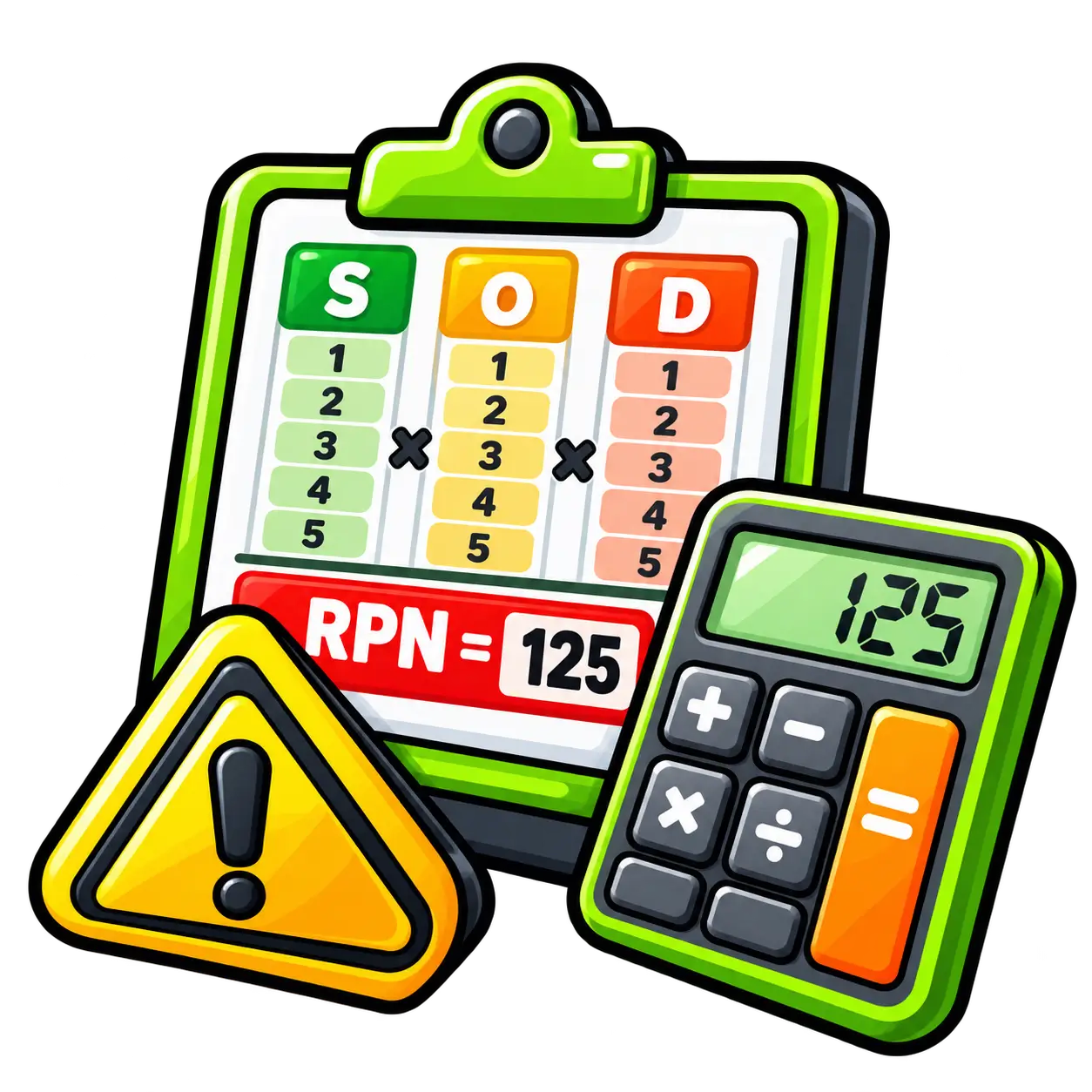
RPN = Severity (S) × Occurrence (O) × Detection (D), with each factor scored from 1 to 10 using your organisation’s rating table. Maximum RPN = 1,000.
The three factors
- Severity (S) — how bad the effect is if the failure occurs (safety, regulatory, customer impact)
- Occurrence (O) — how likely the cause is to happen
- Detection (D) — how unlikely current controls are to detect the cause/failure before escape (higher D = harder to detect)
Worked examples
- 2 × 2 × 2 = RPN 8 (low band)
- 5 × 5 × 5 = RPN 125 (moderate band)
- 8 × 7 × 6 = RPN 336 (high band)
Indicative RPN bands
| RPN | Risk level | Typical action |
|---|---|---|
| 1–100 | Low | Monitor and document |
| 101–200 | Moderate | Investigate and improve |
| 201–1,000 | High | Corrective action with owners and due dates |
Thresholds vary by company. Always use your FMEA procedure’s cut-offs.
Important caveats
- High severity still matters — a low RPN with S = 9–10 often still needs action
- Different S×O×D combinations can share one RPN — interpret the factors, not only the product
- AIAG–VDA FMEA emphasises Action Priority (AP) over fixed RPN gates for many automotive / advanced programmes
How to reduce RPN
- Redesign to lower severity where feasible (eliminate the hazardous effect)
- Add prevention controls to cut occurrence
- Improve inspection, poka-yoke, or process monitoring to improve detection (lower D score)
- Re-score after actions and keep the FMEA living as the process changes
FAQ
Is a lower Detection score better?
Yes. In standard FMEA tables, D = 1 means detection is almost certain; D = 10 means you almost cannot detect the failure before it escapes.
Should every RPN above 100 get a project?
Not automatically. Use your procedure’s threshold, severity rules, and resource capacity. Many teams act on high S even when RPN is modest.
Is RPN the same as Action Priority?
No. AP (AIAG–VDA) uses S/O/D logic tables rather than a single product. This calculator computes traditional RPN.
Related tools: Ergonomic Risk (Lifting Index), LTIFR Calculator, NMFR Calculator.