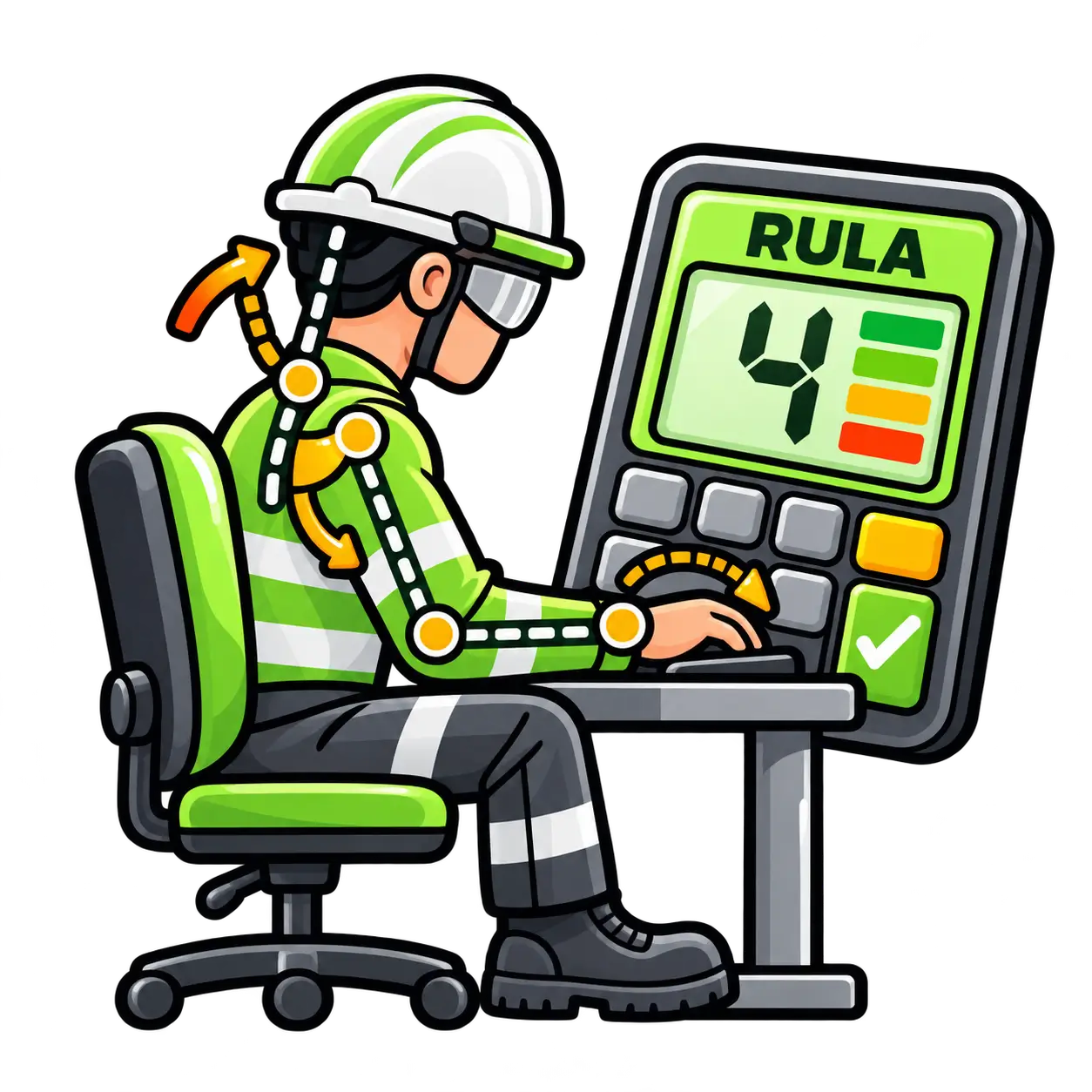

What is RULA?
RULA (Rapid Upper Limb Assessment) screens posture-related MSD risk for the neck, trunk, and upper limbs — ideal for seated or standing tasks with repetitive arm work. Final scores run from 1 to 7 with action levels.
Use REBA when the whole body (including legs) matters more, and the NIOSH lifting calculator for repetitive lifts.
RULA Ergonomic Calculator
RULA · Rapid Upper Limb Assessment
Screen upper-limb and neck/trunk MSD risk for a posture snapshot. Simplified digital walkthrough — confirm against published RULA tables for formal records.
Formula: RULA score from Tables A + B + C (1–7)
- Score the worse arm, or both sides if your procedure requires it.
- For whole-body postures including legs under load, also use REBA.
- High scores call for redesign — not PPE alone.
Indicative RULA action levels
- 1–2 — Acceptable if not maintained for long periods
- 3–4 — Investigate further; change may be needed
- 5–6 — Investigate and change soon
- 7 — Investigate and change immediately
Frequently asked questions
RULA vs REBA?
RULA focuses on upper limbs and neck/trunk. REBA covers the entire body including legs. Pick the tool that matches the task.
Left and right arms?
Score the worse side, or score both and take the higher action level per your procedure.
Is this a medical diagnosis?
No. It is a screening score for redesign priority — not a clinical assessment.
Can I average a shift?
RULA is usually a posture snapshot. Score the most demanding regular posture or follow a time-weighted method your programme specifies.