MANGOLPURI INDUSTRIAL AREA, DELHI, INDIA — Officials investigating a fatal fire at a shoe factory in Delhi’s Mangolpuri Industrial Area have identified alleged fire-safety and evacuation failures, including obstructed exits, blocked stairways, sealed windows and inadequate ventilation. Four workers died and two were injured.
The fire began at about 9:30 p.m. on 30 October 2026 in the basement of the multi-storey manufacturing unit. The most detailed safety findings emerged in reports published on 1 November, placing the development within today’s news window.
What happened at the factory
Delhi Police and Delhi Fire Services said crews responded to a fire in the basement of the shoe-manufacturing building. Thirty-one fire appliances were reportedly deployed, and the fire was brought under control at about 6 a.m. Six workers were rescued and taken to Sanjay Gandhi Memorial Hospital; four were declared dead and two remained under treatment.
Authorities have opened a criminal investigation and detained or arrested two men connected with the premises, according to multiple reports. These legal steps are part of an ongoing investigation and do not constitute final findings of responsibility.
Reported evacuation and fire-safety deficiencies
Officials quoted by the Indian Express, Hindustan Times and Times of India described several conditions that may have restricted escape and allowed smoke to spread:
- main and alternative exits were reportedly locked or obstructed;
- materials were allegedly stored on or near stairways;
- windows and ventilation openings had reportedly been sealed;
- the factory was reported to lack a fire no-objection certificate;
- officials said there was no smoke-detection system; and
- smoke reportedly travelled upward through a goods-lift shaft.
These are preliminary observations attributed to officials and witnesses. The fire’s ignition source has not been finally established. Some early reports mentioned a possible electrical fault, but investigators have not issued a final cause determination.
Inspection and regulatory questions
Reporting indicates that the factory held a business licence and pollution clearance, while responsibility for building approval, factory licensing and fire clearance was divided among several public bodies. Authorities are examining how the unit operated without the reported fire clearance and whether applicable inspection arrangements were adequate.
The case highlights a basic control principle: production licensing and environmental permissions do not replace fire-risk assessment, emergency-route maintenance, detection systems or evacuation planning.
HSE lessons for industrial workplaces
Emergency routes must remain continuously available, clearly marked and free of stored materials. HSE Blog’s guide to emergency exit-route design and maintenance explains the underlying requirements. Employers should also build practical evacuation drills into workplace fire-safety training and use scenario-based exercises described in our guide to effective fire-safety training.
For multi-storey factories, an effective review should cover exit capacity, door security, travel distance, smoke movement, stairway protection, alarm coverage, emergency lighting and accountability for workers on every shift. Storage and production changes should trigger reassessment because they can alter both fuel load and escape conditions.
Source verification and image rights
HSE Blog reviewed five distinct reporting streams: Indian Express, Hindustan Times, Times of India, The Tribune, and Press Trust of India reporting carried by multiple outlets. PTI copies were counted as one reporting stream, not several independent confirmations.
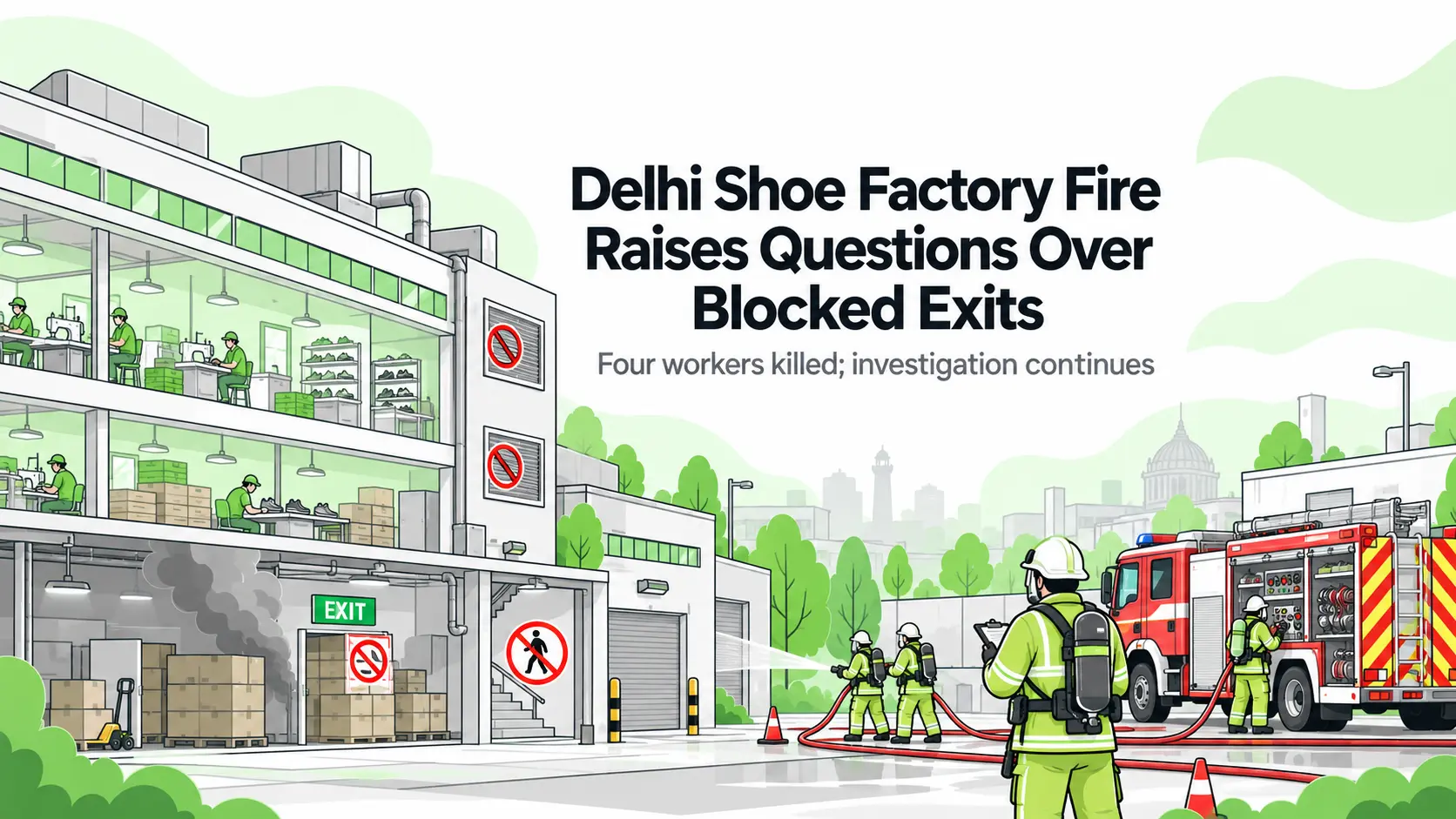
No event photograph was embedded because the available photographs carried publisher or agency copyright and no explicit reuse permission or authorised embed for HSE Blog was identified. The featured image is a purpose-made illustration and is not documentary photography.
HSE Blog analysis
The reported conditions point to a combined failure mode rather than a single missing control: smoke generation in a congested basement, vertical smoke spread, restricted ventilation and escape routes that workers allegedly could not use. Investigators must still determine the precise sequence and legal responsibility, but workplaces do not need to wait for that outcome to check whether exits, stairways, alarms and smoke-control features remain functional on every shift.
Source
Indian Expressindianexpress.com