GREAT BRITAIN — The UK Health and Safety Executive (HSE) has urged employers to treat work-related stress as a health and safety risk requiring the same systematic attention as physical hazards. The regulator issued the call on 31 October 2026 ahead of Stress Awareness Week, which runs from 2 to 6 November.
What HSE announced
HSE said work-related stress remains one of the leading causes of occupational ill health in Great Britain. Its message is directed at employers and managers who may still view stress primarily as an individual wellbeing issue rather than a workplace risk that must be assessed and controlled.
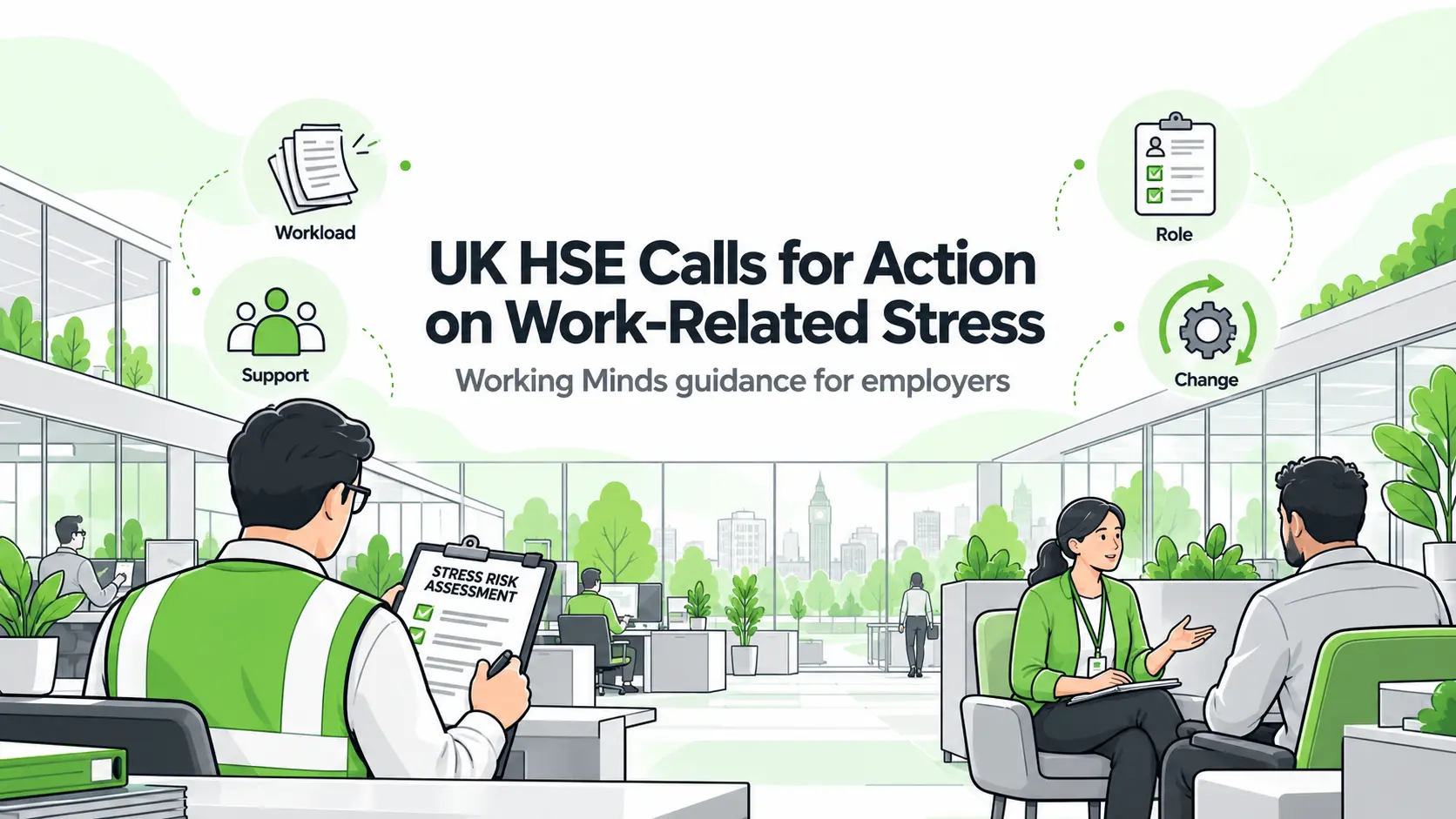
The regulator is promoting its Working Minds campaign and a five-part approach: Reach Out, Recognise, Respond, Reflect and Make it Routine. It also points employers to the HSE Management Standards, which organise psychosocial risk around six areas: demands, control, support, relationships, role and change.
Employer duties and practical action
HSE states that employers have a legal duty to assess and manage risks to workers’ health, including mental health. The regulator recommends that workplaces review stress risk assessments, speak with workers, identify current sources of pressure and take action to eliminate or control those risks.
- Review the risk assessment: check whether workload, staffing, organisational change or role clarity have shifted.
- Consult workers: use structured conversations and worker feedback rather than relying only on absence data.
- Act on causes: focus on work design, resources, supervision and control measures, not solely on individual resilience.
- Check effectiveness: document actions, assign owners and review whether controls are reducing exposure.
HSE’s emphasis is prevention. Support services can be valuable, but they do not replace controls addressing the organisational sources of harmful pressure.
Why this matters for HSE management
Psychosocial hazards can affect health, attendance, decision-making and safety performance. A credible system should therefore connect mental-health risk assessment to ordinary safety governance: leadership review, worker consultation, corrective-action tracking and periodic reassessment.
HSE Blog’s guide to building a workplace mental-health policy explains how to translate risk findings into accountable policy. Readers can also review common psychological hazards and controls and practical principles for a workplace wellbeing programme.
Source verification and current status
The announcement date, campaign dates, employer-duty statement, 5Rs framework and Management Standards themes were checked against the HSE Media Centre release and HSE’s linked Working Minds materials. The development is an official guidance and awareness announcement, not an enforcement action or a change in legislation.
Only the official regulator’s material was available within the freshness window; no independent outlet had published original reporting on the announcement at the time of preparation. The essential claims are therefore attributed directly to HSE. No documentary photograph was embedded because no event-specific image with explicit reuse permission or an authorised embed was identified.
HSE Blog analysis
The practical test for employers is whether stress is visible in the same management system used for other hazards. A poster campaign or wellbeing week is unlikely to be sufficient if workload, poor role definition or weak supervisory support remain unassessed. The strongest response is a documented cycle of consultation, risk evaluation, controls and review that continues after Stress Awareness Week ends.
Source
UK Health and Safety Executivepress.hse.gov.uk