STILFONTEIN, SOUTH AFRICA — Harmony Gold disclosed on 18 November 2026 that an employee at its Mine Waste Solutions plant in Stilfontein, South Africa, had died in hospital after reporting chemical-fume exposure during acid treatment activities. The company said the Department of Mineral and Petroleum Resources and other stakeholders had been notified and an investigation was underway.
Disclosure Distinguishes the Incident and Death Dates
The company places the workplace incident on Monday, 16 November, and the employee’s death on Tuesday, 17 November. Its announcement and corresponding Form 6-K are dated 18 November. The new development is that disclosure and the announced safety response, rather than a claim that the incident happened on publication day.
Harmony did not identify the chemical involved, provide measured exposure concentrations or publish a final medical or investigative finding. The reported fume exposure and subsequent death should not be converted into an independently established chemical cause of death. No named individual’s responsibility, regulatory charge or penalty is established by the statement.
Company Describes Group-Wide Safety Actions
Harmony said it was improving critical-control verification, strengthening accountability, hazard identification and workplace examinations, and applying investigation lessons across its operations. It also said support, including trauma counselling, was being provided to those affected. These are company-reported actions and commitments, not independently audited evidence that every measure has been completed or proven effective.
HSE Blog Analysis
Acid-treatment work requires a clear understanding of the substances, possible process emissions and how people could be exposed during routine and abnormal operations. An investigation needs to establish the relevant chemistry and work conditions before selecting a specific failure mechanism. The limited public account does not justify guessing which gas was present or which control failed.
A practical assurance programme should connect each critical control to a defined hazard and a test that shows whether it works. Responsibility for checking extraction, containment, monitoring and emergency arrangements should be explicit where those controls are required by the risk assessment. General principles of workplace chemical safety provide context, while keeping risk assessments useful at the point of work helps explain why a signed procedure cannot substitute for field verification.
Sharing lessons across sites can be useful, but the lessons need to remain tied to evidence. Early precautionary actions and final corrective measures may differ as investigators learn more. Publication of the eventual findings would allow a more specific assessment of prevention opportunities than the initial company disclosure permits.
Sources and Verification
Checked: Harmony’s dated announcement, the same disclosure filed with the US SEC, Sharenet’s SENS reproduction, Stock Titan’s filing summary and Kalkine’s announcement coverage. Four full publishing versions and Kalkine’s indexed summary were checked; the Kalkine page itself returned 404. All depend on one company account. No independent regulator finding or medical conclusion was available. That single-origin limitation is material to the attribution throughout this story.
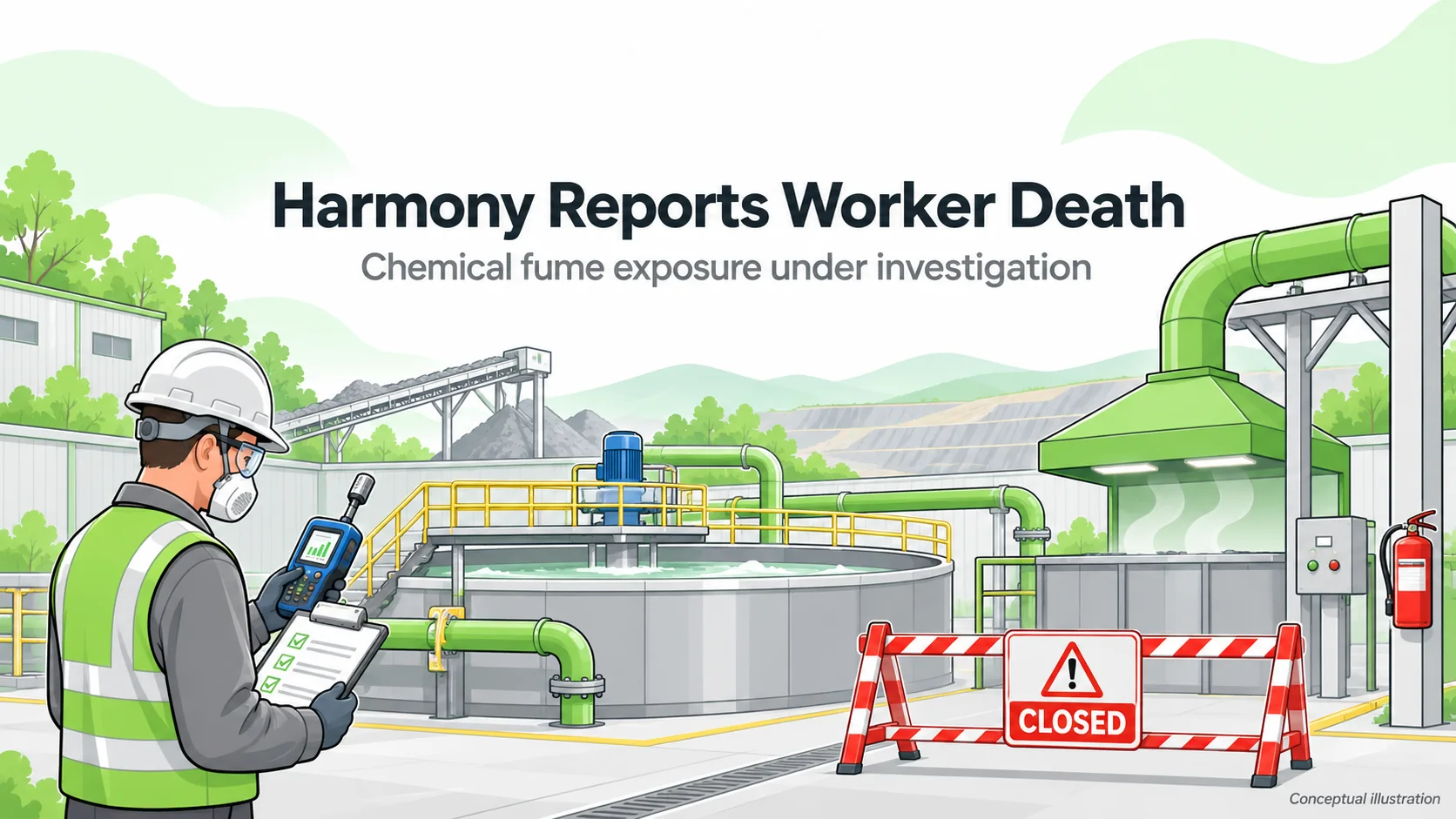
Featured image: original AI-generated conceptual illustration of exposure control. The barrier and equipment do not depict the actual incident, plant layout, confirmed controls or operational closure status.
Source
Harmony Gold Mining Company Limited; SEC Form 6-Kharmony.co.za