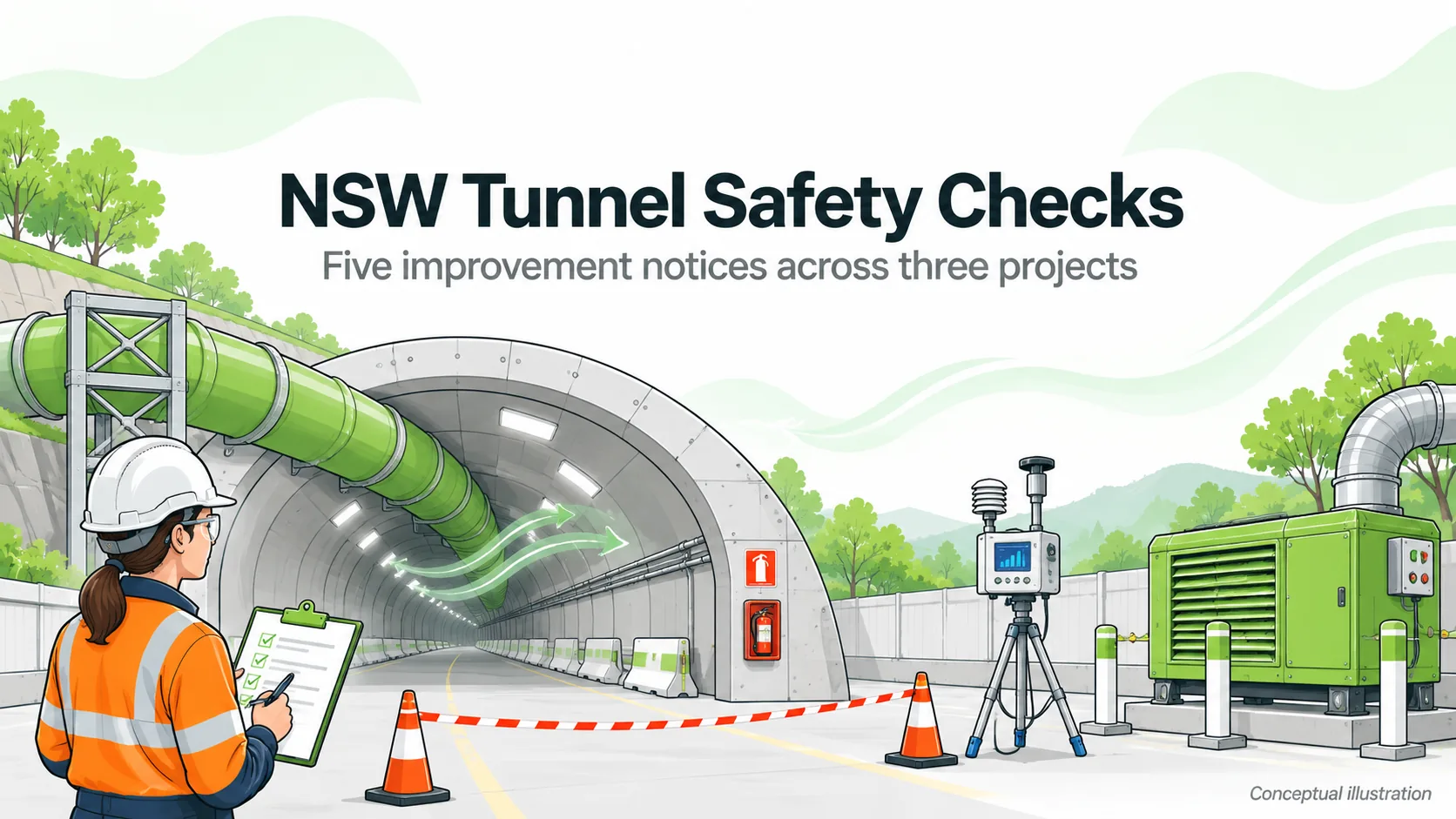
NEW SOUTH WALES, AUSTRALIA — SafeWork NSW inspectors issued five improvement notices during visits to three tunnel projects, according to results announced on 18 November 2026. The statewide operation ran from late September to early November following the introduction of the Tunnels and Shafts in Construction Code of Practice.
Inspection Results Are the New Development
The regulator said contractors showed strong awareness of the updated code and were checking their safety systems and procedures for gaps. The release did not identify the projects, describe the five individual deficiencies or announce prosecutions arising from those notices. An improvement notice should therefore not be described as a conviction or a financial penalty.
The announcement also highlighted ventilation, engineering controls, air monitoring and repeated review of measures against respirable crystalline silica and other airborne contaminants. The code replaces the 2006 tunnelling code and addresses modern excavation methods and psychosocial hazards. The latest release reports on implementation and inspection activity; it does not establish that all of these requirements first took effect on 18 November.
Tunnel Figures Differ From Statewide Silica Enforcement
Separately, SafeWork NSW reported more than 4,156 silica-related workplace visits since 1 July 2024, with 2,063 improvement notices, 520 prohibition notices and 73 penalty notices across industries. Those cumulative figures cover a much wider enforcement programme and should not be attributed to the three-project tunnel operation.
HSE Blog Analysis
The combination of industry awareness and notices requiring improvement is a reminder that understanding a code and demonstrating working controls are different tasks. A tunnel’s changing geometry, work activities and plant movements can alter how well ventilation and dust controls protect people. Checks need to follow those changes rather than remain fixed at the project’s initial design.
For employers, a useful review asks which activities generate dust, whether controls operate during those activities and how monitoring results feed into corrective action. The assessment should also consider maintenance and unusual work, when arrangements may differ from routine production. This is an application of keeping risk assessments useful at the point of work; it is not an assumption about the undisclosed deficiencies at the inspected projects.
Notice counts alone cannot measure worker exposure or the prevalence of disease. The announcement provides an enforcement snapshot, while judging protection in practice requires task-level evidence and follow-through on identified gaps.
Sources and Verification
Checked: SafeWork NSW’s 18 November release, the matching NSW Government ministerial release, Tunneling World’s coverage and The National Tribune’s republication. These are four publishing outlets or services, but the factual results trace to one government announcement; they are not four independent investigations. The code’s earlier introduction is background, and the newly reported inspection results are the news basis.
Featured image: original AI-generated conceptual illustration, not a photograph of any inspected project or evidence of a particular notice.
Source
SafeWork NSW; NSW Governmentsafework.nsw.gov.au