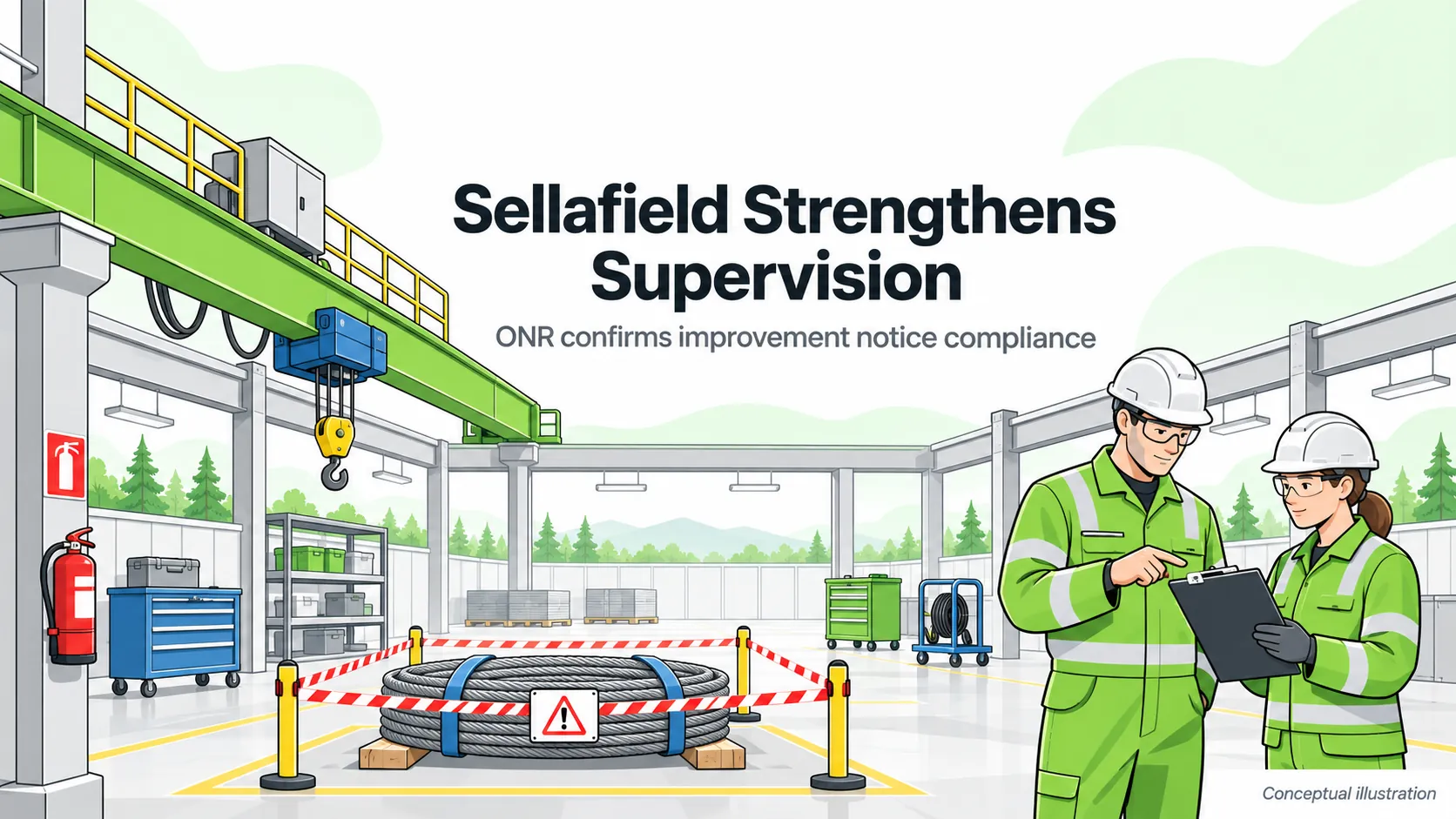
SELLAFIELD, CUMBRIA, UNITED KINGDOM — Sellafield Ltd has complied with an improvement notice addressing control and supervision after steel ropes fell during overhead-crane maintenance, the Office for Nuclear Regulation announced on 18 November 2026. The development is confirmation of completed improvements, rather than a new crane incident.
Technical Oversight Integrated Into Supervision
ONR said Sellafield had clarified the Technical Oversight role supporting examination, inspection, maintenance and testing, and incorporated it into site-wide supervisory arrangements. Updated arrangements and training are intended to help supervisors obtain subject-matter expertise when needed.
The notice followed an April 2025 event involving contractors working under Sellafield’s supervision while replacing an overhead crane’s steel ropes. ONR issued the enforcement action under Regulations 7(1) and 7(5) of the Management of Health and Safety at Work Regulations 1999, concerning health and safety assistance and supervision.
The Older Event and the New Compliance Decision
Sellafield’s published incident account dates the re-roping event to 17 April 2025. It describes an uncontrolled lowering of rope from an 80-tonne crane onto a scaffold platform approximately 18 metres below in Encapsulated Product Store 1. The company reported no physical injury to the workers involved.
The operator described an initial safety stand-down, revised maintenance methods and refresher training. Its account also records subsequent changes to control, supervision and technical oversight. ONR’s dated 18 November announcement independently confirms compliance with the notice. Neither source describes a new prosecution or fine in this announcement.
HSE Blog Analysis
Crane maintenance can change the way stored weight and mechanical restraint are managed. Effective supervision therefore depends on more than assigning a person to oversee a contractor. The work plan needs to explain who understands the equipment, who can authorize changes and when specialist engineering advice must be obtained.
A useful follow-up is to test those arrangements against a real maintenance task: can the supervisor identify the technical adviser, reach that person promptly and stop work when the method no longer matches site conditions? That practical check connects documented responsibilities with the work. Our discussion of keeping risk assessments useful at the point of work explores the same gap between written controls and what happens on site.
Compliance with one notice is a specific regulatory outcome. It should not be presented as a blanket endorsement of every lifting activity or as proof that future maintenance hazards have been eliminated.
Sources and Verification
Checked: ONR’s 18 November compliance announcement and Sellafield’s incident account on GOV.UK. These provide two organisational accounts, regulator and operator; five independent sources were not available. The older incident account is used for context, not to refresh the incident date. No quotation or unsupported finding is added.
Featured image: original AI-generated conceptual illustration of maintenance supervision, not a photograph, actual site layout or regulatory approval certificate.
Source
Office for Nuclear Regulation; Sellafield Ltdonr.org.uk