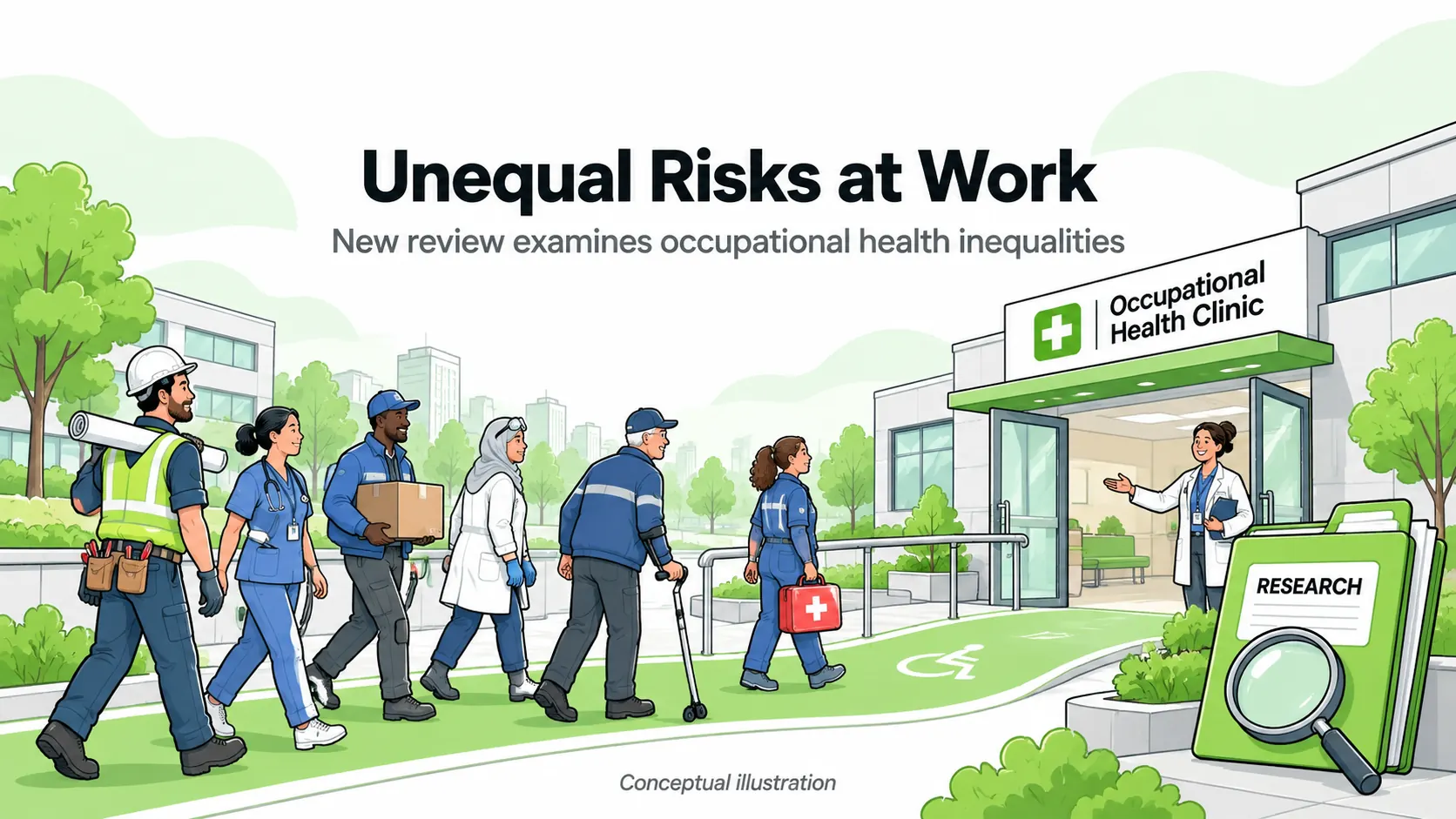
INTERNATIONAL RESEARCH — A narrative review published in Frontiers in Public Health on 27 November 2026 examines how occupational-health research addresses unequal risks among workers.
Review Maps Three Dimensions
Valenti and colleagues considered 107 publications: 91 peer-reviewed articles and 16 grey-literature sources. Their framework separates exposure to hazards, susceptibility to harm and the resources available to prevent or recover from it.
The authors report that coping capacity received less attention than exposure or susceptibility. None of the 91 peer-reviewed studies addressed all three dimensions together.
Findings Have Important Limits
The review used no registered protocol or formal risk-of-bias appraisal. Its study counts describe research attention, rather than pooled effects or the strength of evidence. Geographic and methodological differences restrict generalisation. The authors’ policy recommendations are proposals for adaptation and evaluation, not interventions proven effective by this review.
HSE Blog Analysis
A workplace can offer the same written procedure to everyone while leaving very different routes to assistance. Someone employed through a contractor, working remotely or unfamiliar with a reporting system may face additional steps before a concern reaches the person who can act.
For managers checking risk assessments against real work, the practical question is whether a control can be accessed by all the people who need it. That includes how information is explained, how concerns are raised and what happens when someone needs an adjustment or follow-up.
These questions should be explored with workers rather than answered through assumptions about a group. A category such as “temporary worker” does not describe an individual’s health, knowledge or ability, and it should not become a reason to exclude that person from work.
The review provides a framework for asking better questions. It does not supply a numerical risk score for an employer or establish which intervention will work in a specific organisation.
Sources and Verification
Checked the original Frontiers paper in HTML and PDF, including methods and limitations. Both versions belong to one publication. Five independent reports or replications were not located; HSE Blog did not independently reanalyse the included evidence. No research graphics or photographs are reused. Read the original source.
Featured image: original AI-generated conceptual illustration, not an event photograph, technical design or reconstruction.
Source
Frontiers in Public Health; Valenti and colleaguesfrontiersin.org