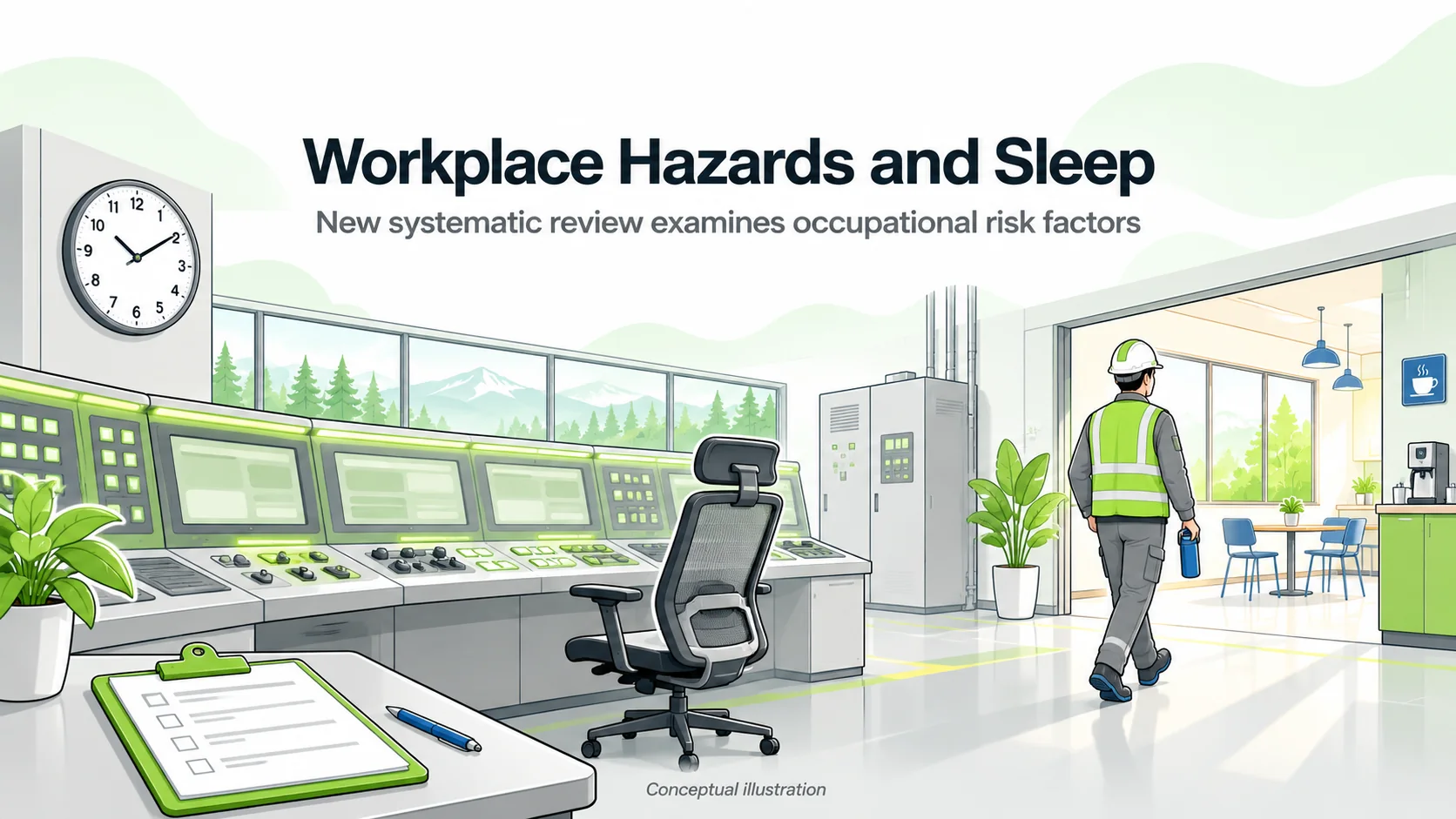
INTERNATIONAL RESEARCH; IRAN AND PORTUGAL — A systematic review published in BMC Public Health on 27 November 2026 examines occupational factors associated with sleep disorders.
Research Extends Beyond Shift Patterns
Darvishi and colleagues included 122 studies and examined chemical, physical, ergonomic, psychological and organisational factors. Noise, job stress, musculoskeletal pain, shift work and solvent exposure feature among the concerns identified.
The publisher labels the work an article in press, subject to further editing. Publication is new; the underlying studies cover earlier years.
Associations Are Not Individual Diagnoses
The authors say differing exposures and sleep measures prevented meta-analysis or comparison of effect sizes. Much of the evidence is observational, so the findings should primarily be understood as associations rather than definitive causation.
HSE Blog also found inconsistent initial search-record totals between the publisher’s web abstract and PDF. This account therefore reports the agreed included-study total and does not repeat a disputed screening figure.
HSE Blog Analysis
A conversation about fatigue can become narrowly focused on a worker’s bedtime while leaving work arrangements unexplored. The breadth of this review provides a reason to ask what happens during the working day as well as outside it.
In checking risk assessments against real work, a manager can ask whether the assessment considers the combination of demands people describe. A shift pattern, an uncomfortable task and an unpredictable workload may be managed by different departments, making their interaction easy to overlook.
That does not establish that work caused a particular person’s symptoms. Health concerns need appropriate individual assessment, and workers should be able to raise them without having to prove a diagnosis before anyone examines the job.
The research also does not justify ranking every workplace hazard by a single sleep-risk score. Its stated limitations make that kind of comparison inappropriate. The useful management response is to investigate the actual conditions, assess controls and seek competent advice where needed.
Sources and Verification
Checked the original BMC publisher page and full article-in-press PDF, including limitations; Scienmag’s coverage was also read but shares the same study origin. Five independent confirmations were unavailable. No clinical advice or independent data reanalysis is claimed. No third-party research image is reused. Read the original source.
Featured image: original AI-generated conceptual illustration, not an event photograph, technical design or reconstruction.
Source
BMC Public Health; Darvishi and colleagueslink.springer.com