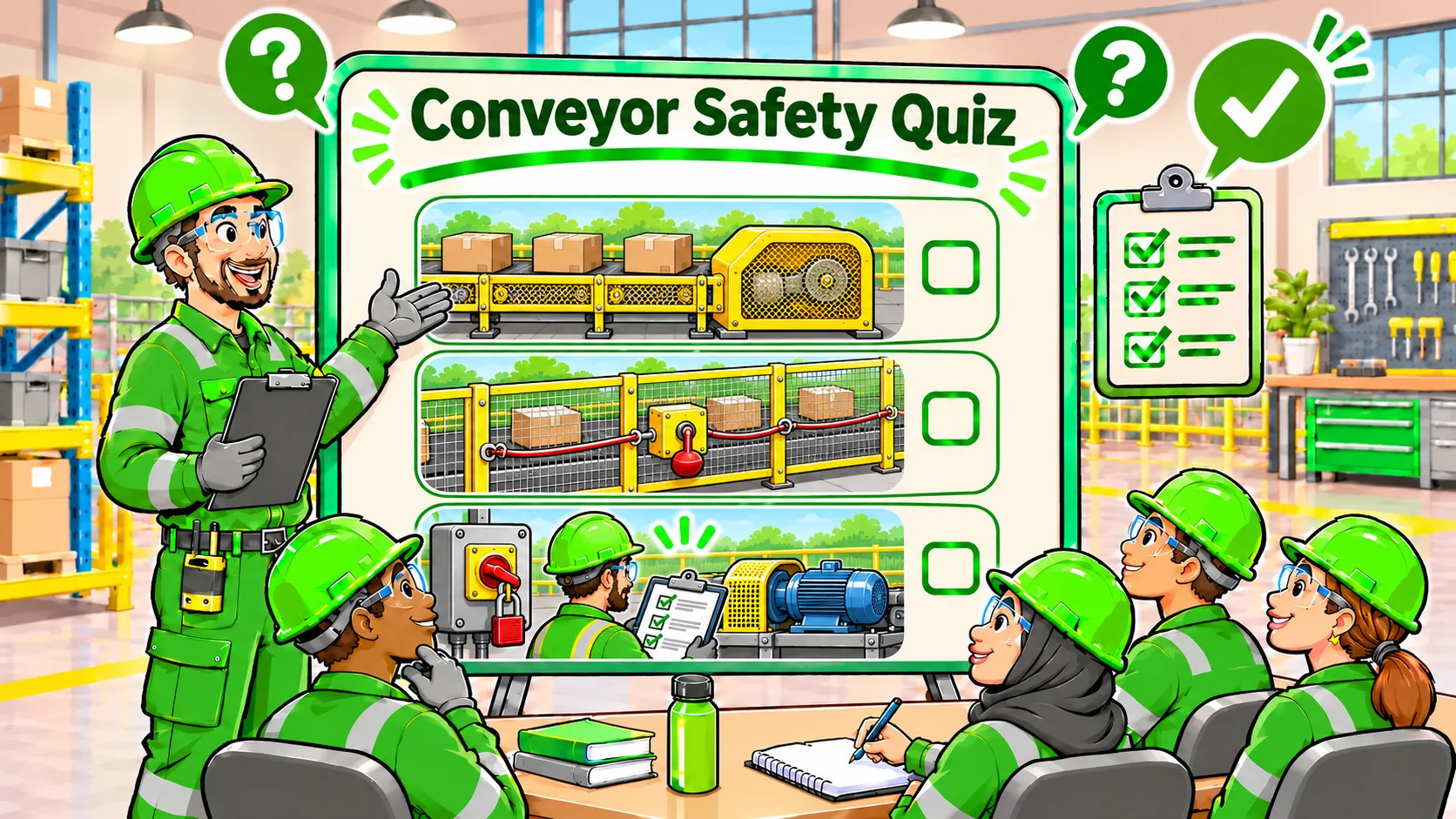
Conveyor Safety Quiz: Nip Points, Guards, and Emergency Stops
25 questions
About 13 min
Updated
0 of 25 answered
Score 0
Question 1 of 25
Where is an in-running nip point likely to occur on a belt conveyor?
Question 2 of 25
What is the main purpose of a fixed conveyor guard?
Question 3 of 25
A guard is missing from a conveyor drive. What should an operator do?
Question 4 of 25
Does an emergency stop replace hazardous-energy isolation for maintenance?
Question 5 of 25
Under US OSHA 1926.555(a)(1), what is required immediately before conveyor startup?
Question 6 of 25
Under US OSHA 1926.555(a)(3), what must happen before restart after an emergency stop?
Question 7 of 25
What is appropriate before restarting a conveyor after an overload stoppage?
Question 8 of 25
Can workers ride a conveyor designed to carry materials?
Question 9 of 25
How should a person cross a conveyor route?
Question 10 of 25
What additional protection does OSHA 1926.555 require where conveyors pass over work areas or aisles?
Question 11 of 25
What conveyor-specific hazard should be controlled during cleaning?
Question 12 of 25
May a jam be pulled free by hand while the conveyor is running?
Question 13 of 25
Why can a stopped inclined conveyor still present a movement hazard?
Question 14 of 25
Which clothing issue increases entanglement risk?
Question 15 of 25
Does wearing gloves make reaching into a conveyor nip safe?
Question 16 of 25
What should be done if an emergency-stop pull wire is inaccessible behind stored materials?
Question 17 of 25
How should an interlocked guard be treated?
Question 18 of 25
Before returning a serviced conveyor to use, what should be checked?
Question 19 of 25
Why should conveyor workers know the location and operation of emergency stops?
Question 20 of 25
Under US OSHA 1926.555(a)(4), what must screw-conveyor guarding prevent?
Question 21 of 25
Which workers need protection from conveyor hazards?
Question 22 of 25
Can a sign saying 'Keep Hands Clear' replace a required physical guard?
Question 23 of 25
Why should conveyor spillage be controlled?
Question 24 of 25
What should a guard inspection consider besides whether a guard exists?
Question 25 of 25
Under US OSHA 1926.555(a)(7), how are hazardous conveyor repairs or maintenance controlled?
About This Quiz
Conveyors create trapping, entanglement and falling-material hazards during production, cleaning and maintenance. This conveyor safety quiz checks how guards, accessible stops, controlled access and effective isolation work together to protect everyone near the system.
What this quiz covers
Practise conveyor safety with 25 questions about nip points, guards, emergency stops, safe access, cleaning, maintenance isolation and restart.
How to use the quiz
Answer 25 multiple-choice questions with one correct answer each. The practice pass mark is 70%, requiring at least 18 correct answers. There is no time limit. Answer options are shuffled, explanations are available and retakes are allowed. Review the explanations and official guidance for any missed topics.
Scope and limits
Independent knowledge practice, not a qualification or authorisation to operate or maintain equipment. Questions explicitly naming OSHA 1926.555 concern United States construction work. General guarding and isolation principles also draw on US OSHA, Great Britain HSE and Ireland HSA guidance; follow the applicable local requirements and actual conveyor instructions. An emergency stop or interlocked guard is not a substitute for the required hazardous-energy isolation. Special tasks requiring powered movement need a separately assessed safe system; this quiz does not authorise them.
Sources and further reading
Guidance checked on 23 November 2026. Use the current official requirements and the instructions for the actual process or equipment.
Check the decisions that prevent wheel breakage and loss of control during grinding and cutting. These 25 original questions cover accessory compatibility, inspection, mounting, guards, safe operation, dust and protective equipment.
Test your understanding of mobile elevating work platform selection, setup and use. These 25 original questions cover scissor and boom lifts, ground support, loading, entrapment, traffic, fall protection and emergency lowering.
Check your understanding of machinery hazards and safeguards with 25 original questions on points of operation, rotating parts, trapping points, fixed guards, interlocks and protective devices. Scenarios also examine defect reporting, safe servicing and the controlled restoration of guards after maintenance.
Unexpected startup and released stored energy can injure people during maintenance. This quiz focuses on recognizing all relevant energy sources and following a verified energy-control procedure.