DSEAR Awareness Quiz: Flammable Substances and Explosion Risks
25 questions
About 13 min
Updated
0 of 25 answered
Score 0
Question 1 of 25
What does DSEAR stand for?
Question 2 of 25
Which risk is central to a DSEAR assessment?
Question 3 of 25
Is DSEAR limited to large chemical factories?
Question 4 of 25
Who should be considered when assessing DSEAR risks?
Question 5 of 25
Which material can create an explosive atmosphere?
Question 6 of 25
Does a high-flashpoint liquid automatically fall outside DSEAR considerations?
Question 7 of 25
What should come first when controlling a dangerous-substance risk?
Question 8 of 25
If the risk cannot be eliminated, what is an important early control?
Question 9 of 25
Why keep containers closed when they are not being used?
Question 10 of 25
What should ventilation for a flammable release achieve?
Question 11 of 25
Which item can be an ignition source?
Question 12 of 25
Does a 'No Smoking' sign alone control all ignition risks?
Question 13 of 25
Why keep incompatible dangerous substances apart?
Question 14 of 25
What does hazardous-area classification primarily consider?
Question 15 of 25
Does a hazardous-zone designation mean an explosion is occurring continuously?
Question 16 of 25
May any electrical or mechanical equipment be used in a classified area?
Question 17 of 25
What is the role of an EX warning sign where needed?
Question 18 of 25
Why can suitable antistatic clothing or footwear be required?
Question 19 of 25
Before a new workplace containing zoned areas first operates, what does HSE say is needed?
Question 20 of 25
What is mitigation in this context?
Question 21 of 25
Which emergency arrangements should follow the DSEAR assessment?
Question 22 of 25
What should employee information and training cover?
Question 23 of 25
Does a DSEAR assessment replace COSHH assessment of health hazards?
Question 24 of 25
Since 2015, which additional hazards does HSE explicitly include in DSEAR guidance?
Question 25 of 25
What does passing this DSEAR quiz establish?
About This Quiz
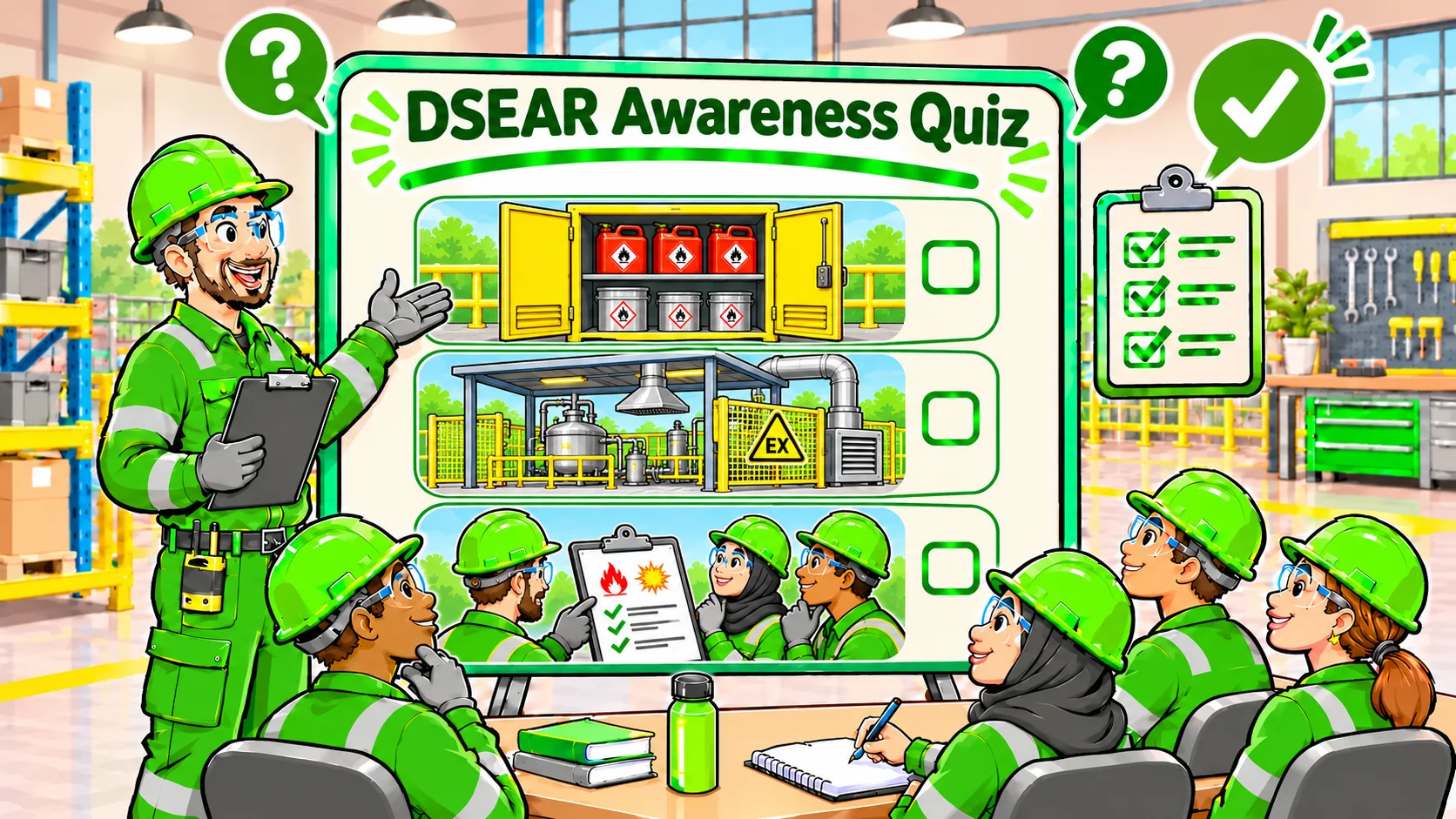
Fire and explosion risks depend on the substance, the work and the conditions in which it is used. This DSEAR awareness quiz checks how to recognise dangerous substances, prevent releases and ignition, understand hazardous-area controls and prepare for emergencies. It also covers pressure and metal-corrosion hazards included in current HSE guidance.
What this quiz covers
Practise DSEAR awareness with 25 questions on flammable substances, explosive atmospheres, risk controls, hazardous areas and emergency arrangements.
How to use the quiz
Answer 25 multiple-choice questions with one correct answer each. The practice pass mark is 70%, requiring at least 18 correct answers. There is no time limit. Answer options are shuffled, explanations are available and retakes are allowed. Review the explanations and official guidance for any missed topics.
Scope and limits
Independent awareness practice about Great Britain's Dangerous Substances and Explosive Atmospheres Regulations 2002, following HSE guidance checked on the date below. This is not an official HSE examination, a DSEAR assessment or proof of competence to classify zones or select explosion-protected equipment. Northern Ireland and other jurisdictions have their own applicable legal arrangements. Use the actual substances, process conditions and workplace assessment; no universal storage quantity or zone distance is supplied. Health risks such as toxicity also need the appropriate assessment and controls.
Sources and further reading
Guidance checked on 25 November 2026. Use current official requirements and the instructions and procedures for the actual equipment, substances and task.
Test combustible-dust safety with 25 questions about the explosion pentagon, secondary explosions, hidden deposits, housekeeping and protective systems.
Practise HAZWOPER awareness with 25 questions on recognising hazards, making notifications, understanding response roles and avoiding untrained intervention.
Test HAZOP fundamentals with 25 questions on design intent, study nodes, guide words, deviations, causes, consequences, safeguards and action follow-up.