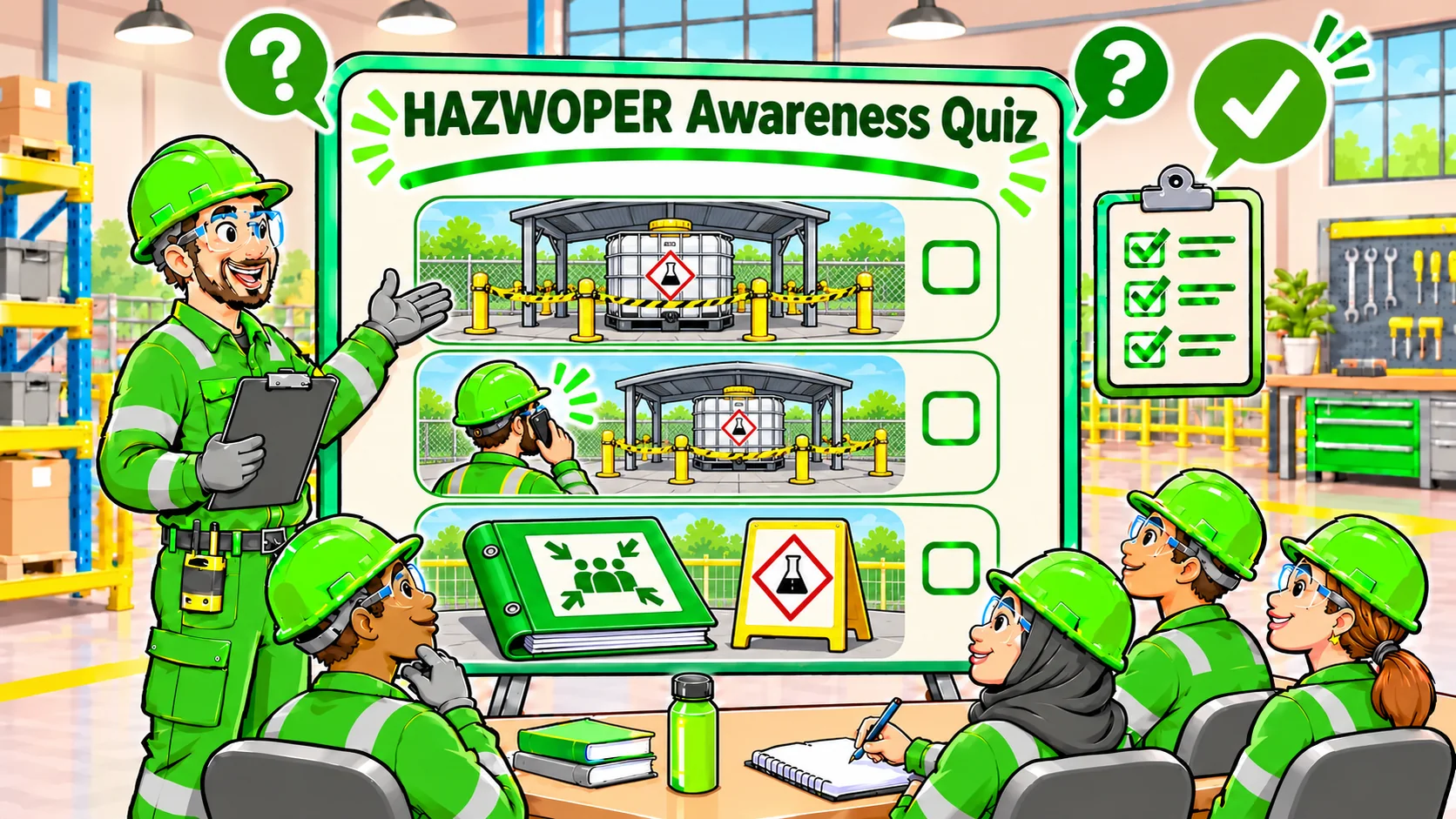
HAZWOPER Awareness Quiz: Hazardous Waste and Emergency Response
25 questions
About 13 min
Updated
0 of 25 answered
Score 0
Question 1 of 25
What does HAZWOPER refer to in US OSHA terminology?
Question 2 of 25
Does HAZWOPER apply automatically to every job involving any chemical?
Question 3 of 25
What is the emergency role of a first responder at awareness level under OSHA 1910.120(q)(6)(i)?
Question 4 of 25
An awareness-level worker sees a leaking container of unknown material. What is appropriate?
Question 5 of 25
Does first-responder awareness training have a universal eight-hour minimum under paragraph (q)(6)(i)?
Question 6 of 25
Who responds defensively to contain a release from a safe distance under OSHA's role descriptions?
Question 7 of 25
Which role description includes approaching the release point to plug or patch a leak?
Question 8 of 25
What should an awareness notification communicate where safely known?
Question 9 of 25
Is smell a reliable way to decide whether an unknown atmosphere is safe?
Question 10 of 25
What should an awareness-level worker do about a person collapsed inside a suspected contaminated area?
Question 11 of 25
What is the purpose of site security and control during a hazardous-material emergency?
Question 12 of 25
Can a placard or label help identify a hazardous substance?
Question 13 of 25
What is the function of a safety data sheet in hazard recognition?
Question 14 of 25
What can make an emergency release different from an incidental release?
Question 15 of 25
If employees are instructed to evacuate and are not permitted to assist with the emergency, what does OSHA paragraph (q)(1) provide?
Question 16 of 25
Does a short online awareness quiz qualify someone for hazardous-waste cleanup entry?
Question 17 of 25
How should required responder training be chosen?
Question 18 of 25
What does OSHA paragraph (q)(8) require for trained responders?
Question 19 of 25
Does ordinary protective clothing establish safety for entering an unknown chemical release?
Question 20 of 25
Can a filtering respirator supply oxygen in an oxygen-deficient atmosphere?
Question 21 of 25
What is the purpose of decontamination in hazardous operations?
Question 22 of 25
What should happen if someone may be contaminated?
Question 23 of 25
Why are hazardous-area boundaries controlled by the incident response arrangements?
Question 24 of 25
What should awareness personnel do when trained responders arrive?
Question 25 of 25
Does absence of visible vapour prove that an unknown release is harmless?
About This Quiz
Recognising a hazardous-substance emergency does not authorise a worker to control the release. This HAZWOPER awareness quiz focuses on recognising potential hazards, notifying the right people, understanding the emergency plan and staying within the awareness role. It also introduces how site controls, protective equipment and decontamination fit into a trained response.
What this quiz covers
Practise HAZWOPER awareness with 25 questions on recognising hazards, making notifications, understanding response roles and avoiding untrained intervention.
How to use the quiz
Answer 25 multiple-choice questions with one correct answer each. The practice pass mark is 70%, requiring at least 18 correct answers. There is no time limit. Answer options are shuffled, explanations are available and retakes are allowed. Review the explanations and official guidance for any missed topics.
Scope and limits
Independent practice material about US OSHA 29 CFR 1910.120, with emphasis on first-responder awareness under paragraph (q)(6)(i). It is not OSHA certification, a completed HAZWOPER training course or a substitute for competency demonstration, workplace instruction, medical requirements or role-specific training. Awareness personnel initiate notification and take no further emergency-response action; this quiz does not authorise containment, cleanup, leak stopping, hazardous-area entry or rescue. Hazardous-waste cleanup, operations-level response and technical response have different requirements. Follow the employer's emergency plan and applicable law.
Sources and further reading
Guidance checked on 24 November 2026. Use current official requirements and the procedures for the actual task or process.
Test HAZOP fundamentals with 25 questions on design intent, study nodes, guide words, deviations, causes, consequences, safeguards and action follow-up.
Practise compressed gas cylinder safety with 25 multiple-choice questions on identification, storage, transport within the workplace, regulators and emergency awareness.