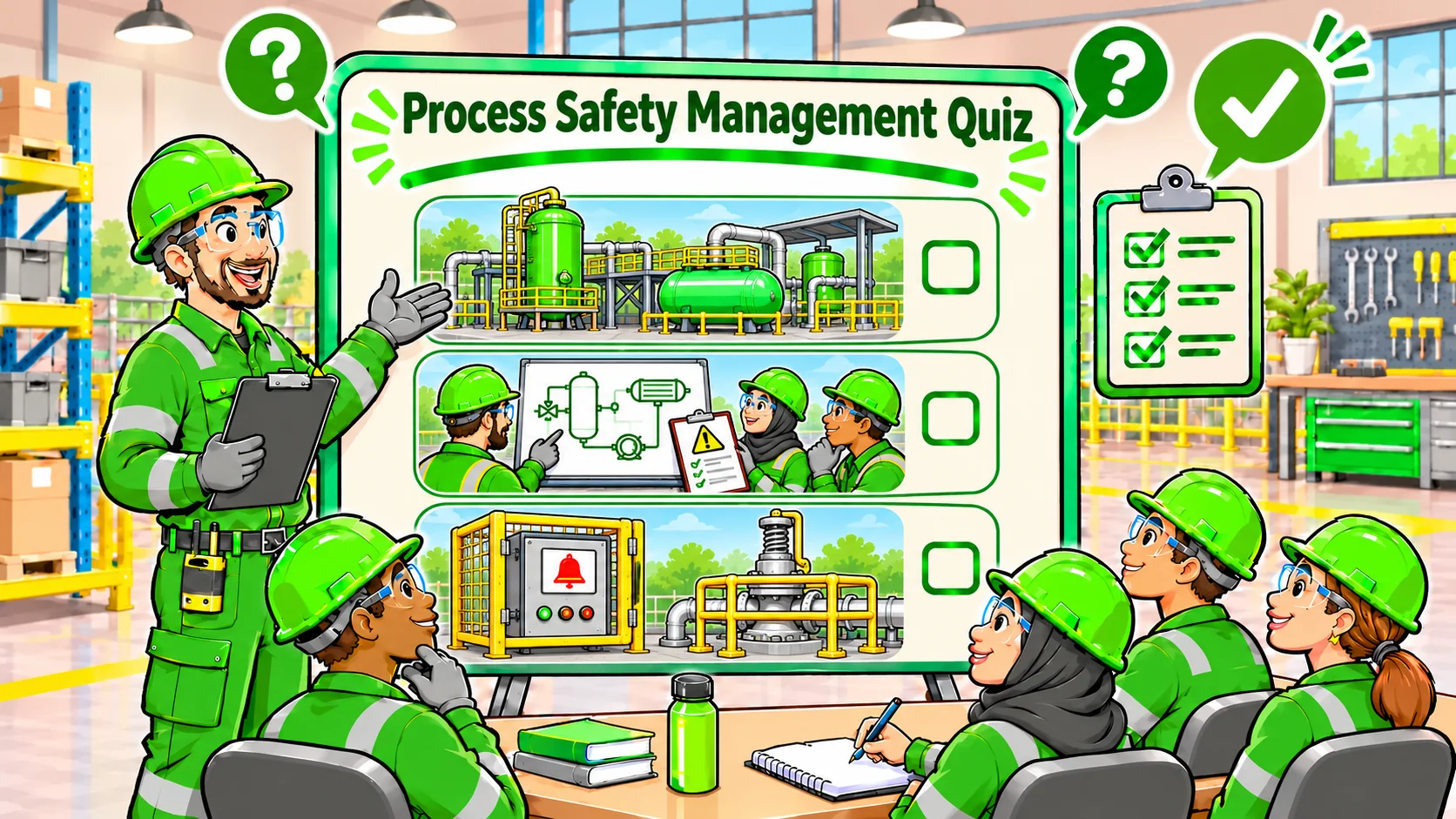
Process Safety Management Quiz: Major Hazard Prevention
28 questions
About 14 min
Updated
0 of 28 answered
Score 0
Question 1 of 28
What is the central purpose of US OSHA's process safety management standard?
Question 2 of 28
Does OSHA 1910.119 automatically apply to every workplace using any chemical?
Question 3 of 28
What can count as one process under OSHA 1910.119?
Question 4 of 28
What does employee participation include under OSHA PSM?
Question 5 of 28
When should written process safety information be compiled?
Question 6 of 28
Which information belongs in the process-technology records?
Question 7 of 28
Which equipment document helps a PHA team understand process connections and instrumentation?
Question 8 of 28
What is a process hazard analysis intended to do?
Question 9 of 28
Which is a recognised PHA method listed in OSHA 1910.119?
Question 10 of 28
What expertise must the PHA team include?
Question 11 of 28
What should happen to PHA findings and recommendations?
Question 12 of 28
Under OSHA 1910.119(e)(6), how often must the PHA be updated and revalidated at minimum?
Question 13 of 28
Which operating phases must written procedures address?
Question 14 of 28
What annual action does OSHA PSM require for operating procedures?
Question 15 of 28
Under OSHA PSM, what is the minimum refresher-training frequency for process operators?
Question 16 of 28
What should training documentation establish besides attendance?
Question 17 of 28
What must a host employer communicate to relevant process contractors?
Question 18 of 28
When is the required pre-startup safety review completed relative to introducing highly hazardous chemicals?
Question 19 of 28
Which equipment falls within OSHA PSM mechanical integrity requirements?
Question 20 of 28
What should determine process-equipment inspection and test frequency under OSHA PSM?
Question 21 of 28
What is 'replacement in kind' under OSHA PSM?
Question 22 of 28
What must management of change address before a covered change?
Question 23 of 28
When must affected operators, maintenance workers and contractors be informed and trained in a process change?
Question 24 of 28
Under OSHA PSM, how soon must investigation begin after an incident that resulted in, or could reasonably have resulted in, a catastrophic release?
Question 25 of 28
Under OSHA PSM, what is the minimum compliance-audit frequency?
Question 26 of 28
What is required for hot work on or near an OSHA PSM-covered process?
Question 27 of 28
What does OSHA PSM require for emergency planning?
Question 28 of 28
May trade-secret status be used to withhold information needed by people performing the PSM functions specified in paragraph (p)?
About This Quiz
Process safety management addresses major releases, fires and explosions through a coordinated system of technical and organisational controls. This process safety management quiz uses US OSHA 1910.119 to test hazard analysis, operating information, training, mechanical integrity, change management and emergency arrangements.
What this quiz covers
Practise process safety management with 28 questions covering major-release prevention and the core elements of US OSHA's PSM standard.
How to use the quiz
Answer 28 multiple-choice questions with one correct answer each. The practice pass mark is 70%, requiring at least 20 correct answers. There is no time limit. Answer options are shuffled, explanations are available and retakes are allowed. Review the explanations and official guidance for any missed topics.
Scope and limits
Independent practice material focused on United States OSHA 29 CFR 1910.119 for covered highly hazardous chemical processes. It is not an official OSHA examination, certification or proof of regulatory compliance. Applicability depends on paragraph (a), chemical thresholds, process arrangements and exclusions; no single inventory threshold covers every chemical. The numerical review, training, investigation and audit requirements in the questions belong to this US standard and must not be treated as universal international rules. Use the complete current standard and competent site-specific assessment for real decisions.
Sources and further reading
Guidance checked on 23 November 2026. Use the current official requirements and the instructions for the actual process or equipment.