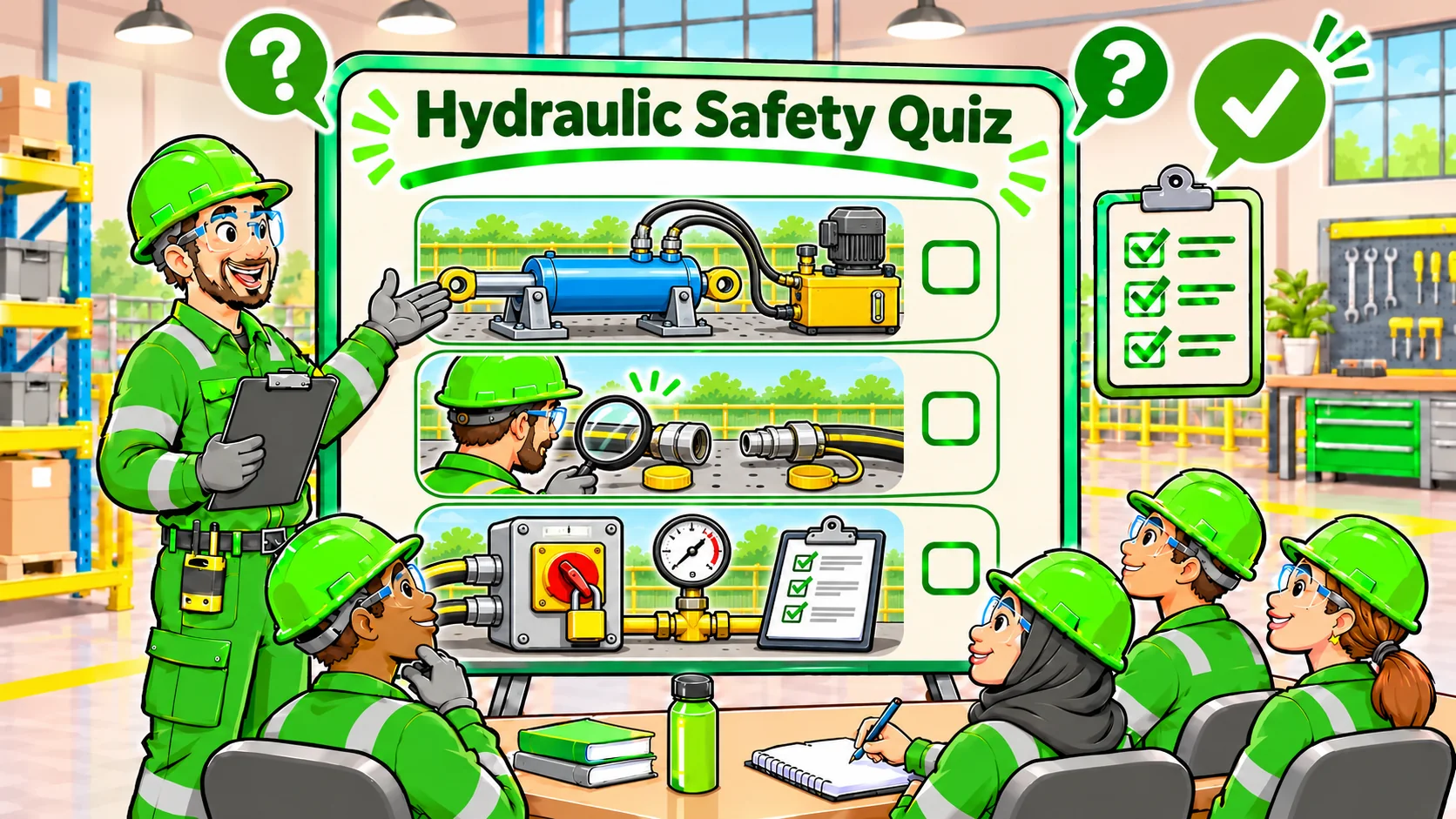
Hydraulic Safety Quiz: Stored Pressure and Fluid Injection Hazards
25 questions
About 13 min
Updated
0 of 25 answered
Score 0
Question 1 of 25
Why can hydraulic equipment remain hazardous after the pump is switched off?
Question 2 of 25
What is a hydraulic injection injury?
Question 3 of 25
What should happen after suspected hydraulic fluid injection?
Question 4 of 25
Does a pinprick-sized wound prove a hydraulic injury is minor?
Question 5 of 25
How should a suspected hydraulic leak be investigated?
Question 6 of 25
Do ordinary work gloves make a high-pressure leak safe to touch?
Question 7 of 25
Before opening a hydraulic connection for maintenance, what is needed?
Question 8 of 25
What role does a hydraulic accumulator have in an energy assessment?
Question 9 of 25
A gauge reads zero at the pump. What still needs checking before work elsewhere in the circuit?
Question 10 of 25
What is appropriate before working beneath a raised hydraulically supported machine part?
Question 11 of 25
How should a hydraulic hose showing cuts, exposed reinforcement or bulges be treated?
Question 12 of 25
What determines suitable replacement hydraulic fittings?
Question 13 of 25
Why are makeshift hydraulic hose repairs unacceptable?
Question 14 of 25
What must be considered when a hydraulic hose is routed?
Question 15 of 25
Why should hydraulic components be guarded or located away from occupied areas where practicable?
Question 16 of 25
What is the purpose of suitable overpressure protection?
Question 17 of 25
A relief valve repeatedly operates or leaks. What is appropriate?
Question 18 of 25
Can a hose-burst valve replace mechanical support for all maintenance tasks?
Question 19 of 25
Why must hot hydraulic fluid be considered during maintenance?
Question 20 of 25
What information should be checked before selecting hydraulic fluid?
Question 21 of 25
Why must leaked hydraulic oil be managed promptly?
Question 22 of 25
Who should carry out high-risk hydraulic maintenance?
Question 23 of 25
Why should a repair involving pressure fittings receive a planned verification?
Question 24 of 25
What is needed before restoring a serviced hydraulic machine to operation?
Question 25 of 25
Does switching off electrical power alone control every hydraulic maintenance hazard?
About This Quiz
A hydraulic system can retain dangerous pressure after its pump stops, and a tiny escaping jet can cause a serious injection injury. This hydraulic safety quiz focuses on recognising stored energy, protecting against unexpected movement and choosing safe inspection and maintenance arrangements.
What this quiz covers
Test hydraulic safety awareness with 25 questions on stored pressure, injection injuries, hose condition, supporting loads and safe maintenance.
How to use the quiz
Answer 25 multiple-choice questions with one correct answer each. The practice pass mark is 70%, requiring at least 18 correct answers. There is no time limit. Answer options are shuffled, explanations are available and retakes are allowed. Review the explanations and official guidance for any missed topics.
Scope and limits
Independent awareness practice using Great Britain HSE guidance and general hazardous-energy principles. It is not a practical qualification, repair instruction or permission to dismantle pressure equipment. Use the actual machine procedure to isolate energy, release pressure, secure loads and verify a safe condition; there is no universal valve sequence. Suspected fluid injection needs immediate professional medical treatment, even when the wound appears minor. Do not search for pressure leaks with hands or assume ordinary gloves protect against injection.
Sources and further reading
Guidance checked on 23 November 2026. Use the current official requirements and the instructions for the actual process or equipment.
Practise pressure-testing safety with 25 questions about hydrostatic and pneumatic tests, stored energy, safe fittings, isolation and protecting people.
Practise compressed gas cylinder safety with 25 multiple-choice questions on identification, storage, transport within the workplace, regulators and emergency awareness.