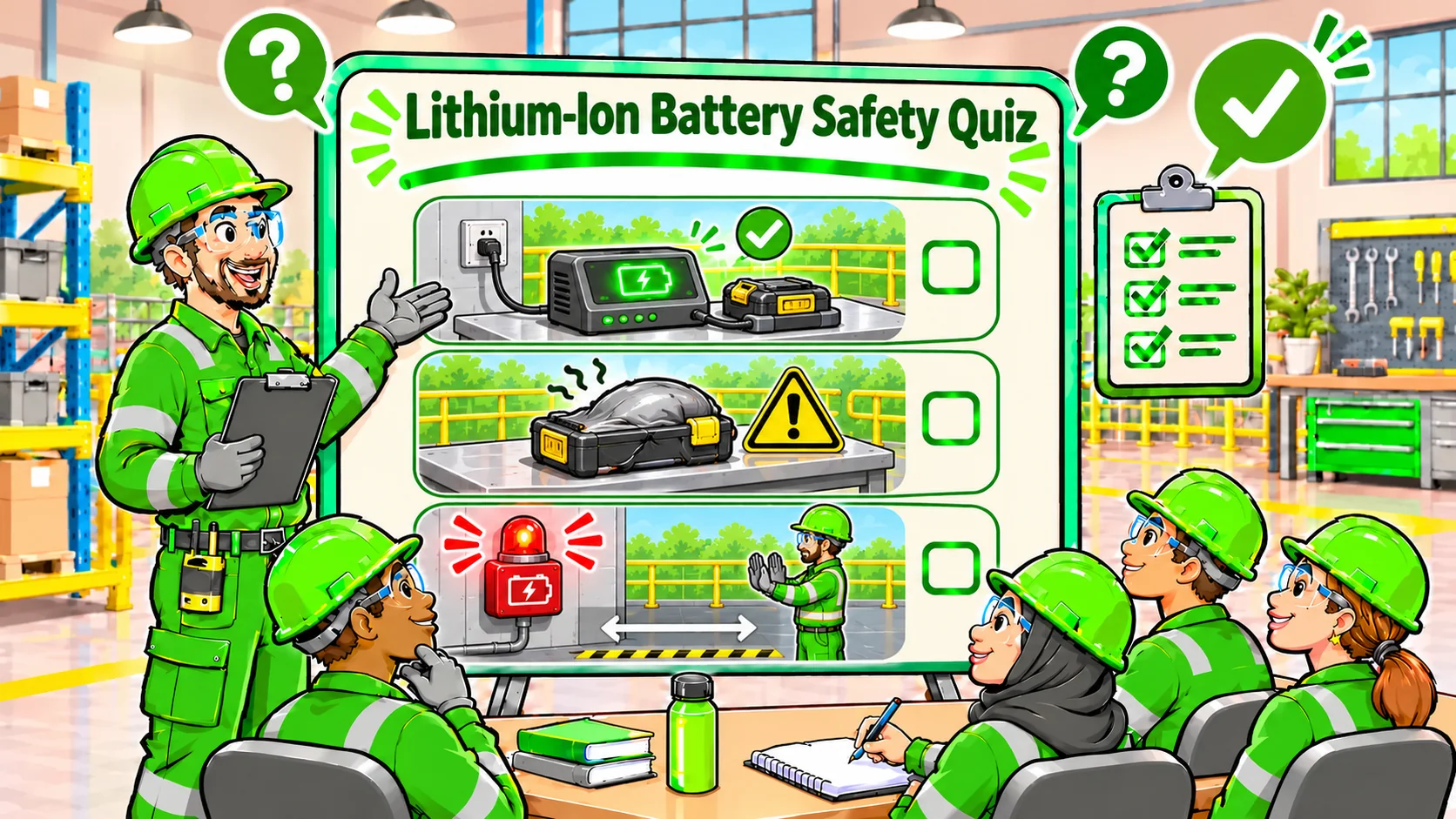
Lithium-Ion Battery Safety Quiz: Charging, Damage, and Thermal Runaway
25 questions
About 13 min
Updated
0 of 25 answered
Score 0
Question 1 of 25
What makes thermal runaway especially dangerous in a battery pack?
Question 2 of 25
Which charger should be selected for a rechargeable battery?
Question 3 of 25
A battery becomes swollen during use. What is the appropriate response?
Question 4 of 25
A charging battery begins hissing and releasing smoke. What should an untrained worker do?
Question 5 of 25
Why should metal objects be kept away from exposed battery terminals?
Question 6 of 25
Which location is most suitable for routine battery storage?
Question 7 of 25
A battery was crushed by equipment but still powers a tool. What should happen?
Question 8 of 25
Why is opening a battery pack to replace cells unsuitable for an untrained user?
Question 9 of 25
Which statement correctly distinguishes lithium-ion from lithium-metal batteries?
Question 10 of 25
Why should a charging area be kept clear of combustibles?
Question 11 of 25
Which information should guide charging-temperature limits?
Question 12 of 25
What does battery-management circuitry do?
Question 13 of 25
A battery has been recalled. What is the best action?
Question 14 of 25
Why can smoke from a battery incident be dangerous?
Question 15 of 25
Who should determine how workers respond to battery fires?
Question 16 of 25
A battery stops flaming after an incident. Which assumption is unsafe?
Question 17 of 25
How should used lithium-ion batteries normally be routed for disposal?
Question 18 of 25
For intact used batteries, why may terminals need protection before collection?
Question 19 of 25
What is the best response to a damaged charging cable?
Question 20 of 25
Why should workers report unusual battery heat promptly?
Question 21 of 25
What should be checked before introducing a larger battery storage system?
Question 22 of 25
Which practice best prevents impact damage during transport within a workplace?
Question 23 of 25
What should workers do if electrolyte leakage is discovered?
Question 24 of 25
Why is a normal-looking casing not a complete safety check?
Question 25 of 25
What should battery-safety training include?
About This Quiz
Lithium-ion batteries power tools, portable devices and larger energy systems. Safe use depends on compatible charging equipment, protection from damage and prompt action when a pack behaves abnormally. This quiz checks everyday prevention decisions and the limits of an untrained worker's emergency role.
What this quiz covers
Practise lithium-ion battery safety with 25 questions on charging compatibility, warning signs, stored energy, storage, recycling and emergency response limits.
How to use the quiz
Answer 25 multiple-choice questions with one correct answer each. The practice pass mark is 70%, requiring at least 18 correct answers. There is no time limit. Answer options are shuffled, explanations are available and retakes are allowed. Use the explanations to identify topics for further study.
Scope and limits
Independent awareness practice, not a qualification or authority to repair batteries, handle damaged packs or fight fires. General prevention principles draw on US OSHA guidance; waste examples draw on US EPA advice and do not replace local business-waste or transport requirements. Battery chemistry, capacity and manufacturer instructions matter. Large energy-storage systems need specialist assessment and engineered protection. Follow the site emergency plan and competent responder instructions.
Sources and further reading
Guidance checked on 26 November 2026. Apply current requirements and the instructions for the actual equipment and task.
Test combustible-dust safety with 25 questions about the explosion pentagon, secondary explosions, hidden deposits, housekeeping and protective systems.
Check your understanding of a fire warden or marshal's role before, during and after an evacuation. These 25 original questions explore alarms, safe area checks, escape routes, accountability, assistance and communicating with responders.