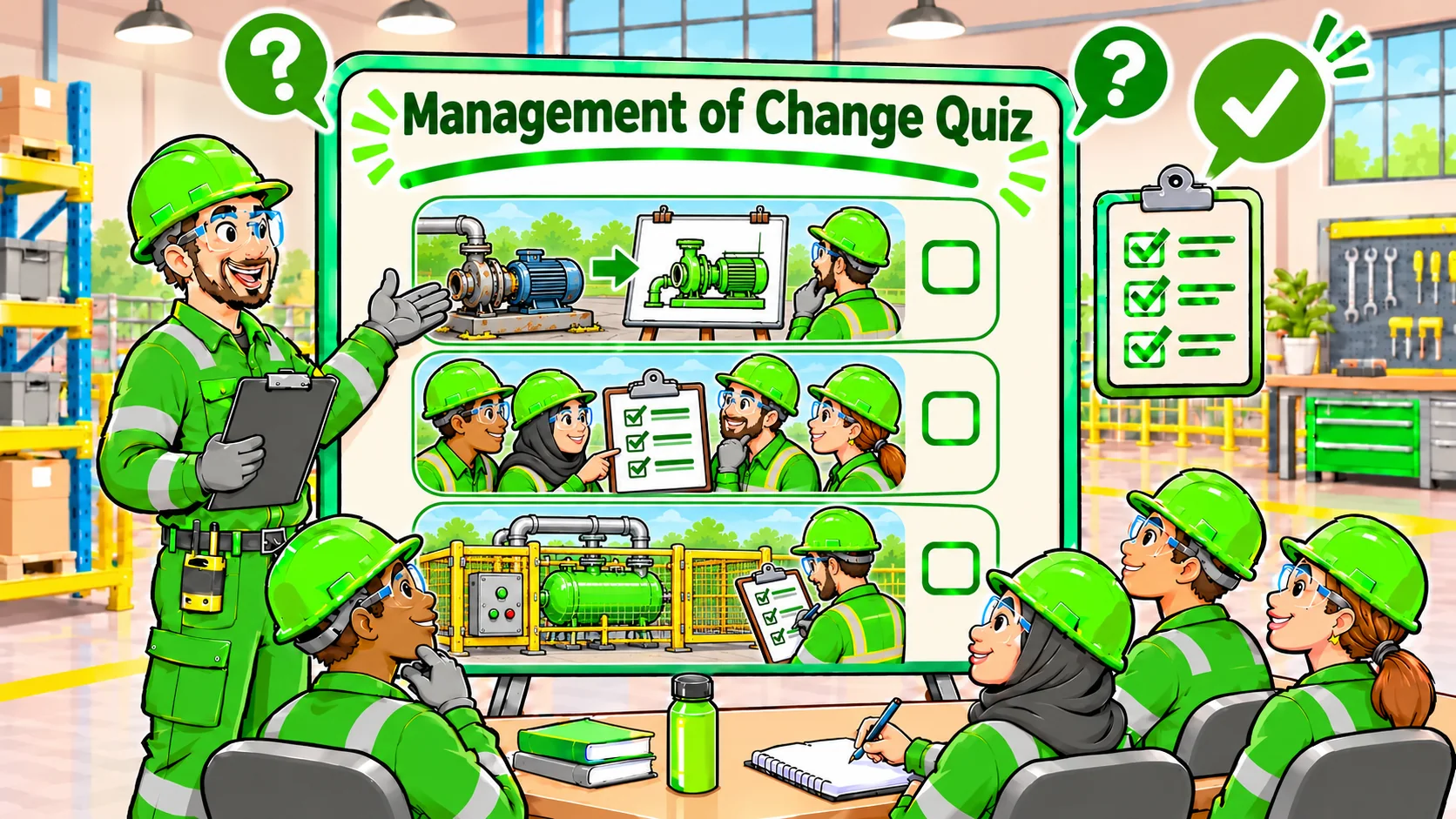
Management of Change Quiz: Controlling Process and Equipment Changes
25 questions
About 13 min
Updated
0 of 25 answered
Score 0
Question 1 of 25
What is the main purpose of management of change (MOC)?
Question 2 of 25
Under US OSHA 1910.119, which replacement is excluded from the MOC change requirement?
Question 3 of 25
A pump fits the same base but has different performance characteristics. What should happen?
Question 4 of 25
Does a temporary process change require consideration under MOC?
Question 5 of 25
What should temporary-change arrangements include?
Question 6 of 25
What must OSHA MOC procedures address before a covered change?
Question 7 of 25
When must affected operators and maintenance or contract employees be informed and trained under OSHA MOC?
Question 8 of 25
What should happen to process safety information affected by a change?
Question 9 of 25
What should happen to operating procedures affected by a change?
Question 10 of 25
Can a change to an operating procedure itself fall within OSHA MOC?
Question 11 of 25
Why examine effects beyond the equipment directly modified?
Question 12 of 25
What should approval responsibilities in MOC make clear?
Question 13 of 25
Does an emergency repair justify ignoring applicable change control?
Question 14 of 25
Why record the technical basis of a modification?
Question 15 of 25
What should happen if the installation differs materially from the approved change?
Question 16 of 25
How should changes to alarm or interlock arrangements be treated?
Question 17 of 25
What does a pre-startup safety review (PSSR) check for facilities covered by OSHA paragraph (i)?
Question 18 of 25
Which modified facilities trigger OSHA's PSSR provision?
Question 19 of 25
Does an approved MOC replace hot-work, isolation or confined-space controls needed to carry out the work?
Question 20 of 25
What should be considered if a raw material's composition changes?
Question 21 of 25
What should happen to the hazards identified in a change review?
Question 22 of 25
Why involve different relevant departments in a change review?
Question 23 of 25
Can a previous hazard study be assumed valid after every modification?
Question 24 of 25
Which record best supports traceable change control?
Question 25 of 25
Does passing this MOC quiz authorise a person to approve any process modification?
About This Quiz
A process modification can affect more than the component being replaced. This management of change quiz tests how to recognise changes, review their risks, document approvals and prepare people and equipment for safe startup. It covers hardware, procedures, raw materials, protective systems and temporary arrangements.
What this quiz covers
Practise management of change with 25 questions covering design equivalence, temporary changes, approvals, updated records and pre-startup checks.
How to use the quiz
Answer 25 multiple-choice questions with one correct answer each. The practice pass mark is 70%, requiring at least 18 correct answers. There is no time limit. Answer options are shuffled, explanations are available and retakes are allowed. Review the explanations and official guidance for any missed topics.
Scope and limits
Independent knowledge practice based on US OSHA 1910.119 and Great Britain HSE plant-modification guidance. OSHA-specific duties apply to covered processes under that US standard; Appendix C recommendations are nonmandatory guidance. The quiz is not an official examination, qualification or authority to approve modifications. Follow the site's competent review and authorisation process, including separate work permits and isolation controls. A previous hazard study or a part that merely looks similar does not establish that a change is safe.
Sources and further reading
Guidance checked on 24 November 2026. Use current official requirements and the procedures for the actual task or process.
Test HAZOP fundamentals with 25 questions on design intent, study nodes, guide words, deviations, causes, consequences, safeguards and action follow-up.
Practise HAZWOPER awareness with 25 questions on recognising hazards, making notifications, understanding response roles and avoiding untrained intervention.