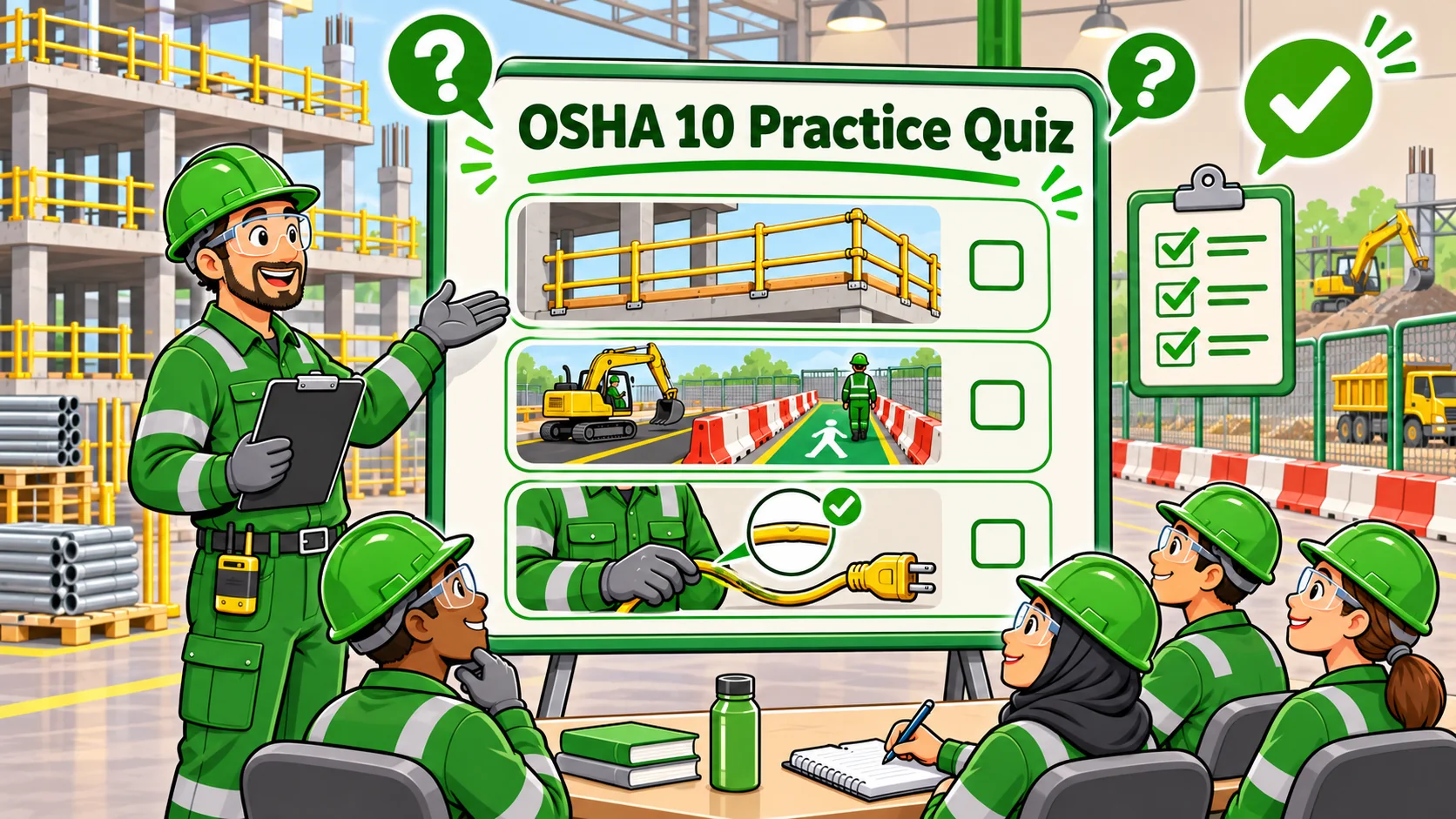
OSHA 10 Construction Practice Quiz: Questions and Answers
25 questions
About 13 min
Updated
0 of 25 answered
Score 0
Question 1 of 25
What is the main purpose of OSHA's 10-hour Construction Outreach course?
Question 2 of 25
What does passing this independent practice quiz award?
Question 3 of 25
Which hazards are OSHA's Construction Focus Four?
Question 4 of 25
Who is responsible for providing a workplace free from recognized serious hazards under applicable OSHA duties?
Question 5 of 25
Can a worker report unsafe conditions to OSHA?
Question 6 of 25
What makes a person a competent person under OSHA's construction definition?
Question 7 of 25
Under 1926.501(b)(1), when is fall protection required at an unprotected side or edge on a covered walking or working surface?
Question 8 of 25
Which action best prevents falls at an open edge used by several trades?
Question 9 of 25
What should a worker do with visibly damaged fall-arrest equipment?
Question 10 of 25
Why must fall-arrest planning include rescue?
Question 11 of 25
What is the safest place for a worker relative to a suspended load?
Question 12 of 25
How should pedestrian exposure to moving construction plant be reduced?
Question 13 of 25
A machine guard is missing. What should an unqualified worker do?
Question 14 of 25
What should happen before maintenance that could expose workers to hazardous energy?
Question 15 of 25
What is the appropriate response to a damaged extension cord?
Question 16 of 25
Before operating equipment near overhead power lines, what is needed?
Question 17 of 25
Why can a GFCI be valuable on a construction site?
Question 18 of 25
What should be checked before excavation near buried utilities?
Question 19 of 25
Under OSHA 1926.651(c)(2), what access requirement applies to trench excavations 4 feet or deeper?
Question 20 of 25
When must a competent person inspect an excavation where employee exposure can reasonably be anticipated?
Question 21 of 25
For a portable ladder used to reach an upper landing, what is the normal side-rail extension requirement?
Question 22 of 25
How should the base of a non-self-supporting ladder normally be positioned?
Question 23 of 25
What should control selection for concrete-cutting silica dust start with?
Question 24 of 25
A task involves a chemical unfamiliar to a worker. What should the worker do before using it?
Question 25 of 25
What is the appropriate first response when the site emergency alarm sounds?
About This Quiz
Practise recognising common US construction hazards through 25 original multiple-choice questions. Review worker rights, the Construction Focus Four, safe equipment use, electrical hazards, access, excavations and emergency decisions. Explanations connect each answer to practical prevention rather than relying on recall alone.
Scope and independent practice
Independent practice material from HSEBlog, not an OSHA-authorized course, official examination or substitute for required training. Completing this quiz does not award an OSHA Outreach card, certification, licence or competent-person designation. The questions use federal US construction requirements in 29 CFR Part 1926 where specified; OSHA-approved state plans and individual tasks may impose additional requirements. Outreach is awareness education and does not replace training required by specific standards.
Study before you start
For each scenario, identify the hazard before choosing a control. Distinguish the six-foot threshold in the stated unprotected-edge provision from separate rules for ladders and scaffolds. Learn where a competent person's judgment and authority are required, and why defects, utility uncertainty and changing excavation conditions need prompt action. Use the linked OSHA sources and your employer's safe work procedures for further study.
Practice format
Answer 25 original multiple-choice questions, choosing one answer per question. The learning pass mark is 70%, with no time limit. Answers are shuffled, explanations are shown after submission and retakes are allowed. Use feedback to identify learning gaps, then review the source material before trying again. This practice score is not a qualification or an assessment of practical competence.
Check your understanding of Canada's Workplace Hazardous Materials Information System with 25 original questions on supplier information, workplace labels, pictograms, safety data sheets and worker training. Scenarios emphasise how to find accurate information and recognise when a task needs clarification before work begins.
Review everyday food-handler decisions with 25 original multiple-choice questions on personal hygiene, contamination, temperature control, cleaning, allergens and safe storage. The focus is practical understanding for catering and food-service learners, rather than memorising a certificate question bank.
Test your understanding of hazardous-substance assessment and practical exposure controls with 25 original questions. This learning resource is useful for workers, supervisors and safety learners handling chemicals or working with processes that generate harmful dust, fume, vapour or biological exposure.
Revise practical construction safety with 25 original multiple-choice questions covering site induction, occupational health, safe access, plant movements, excavation hazards and emergency response. The scenarios focus on the decisions an operative may face when conditions change or a control is missing.