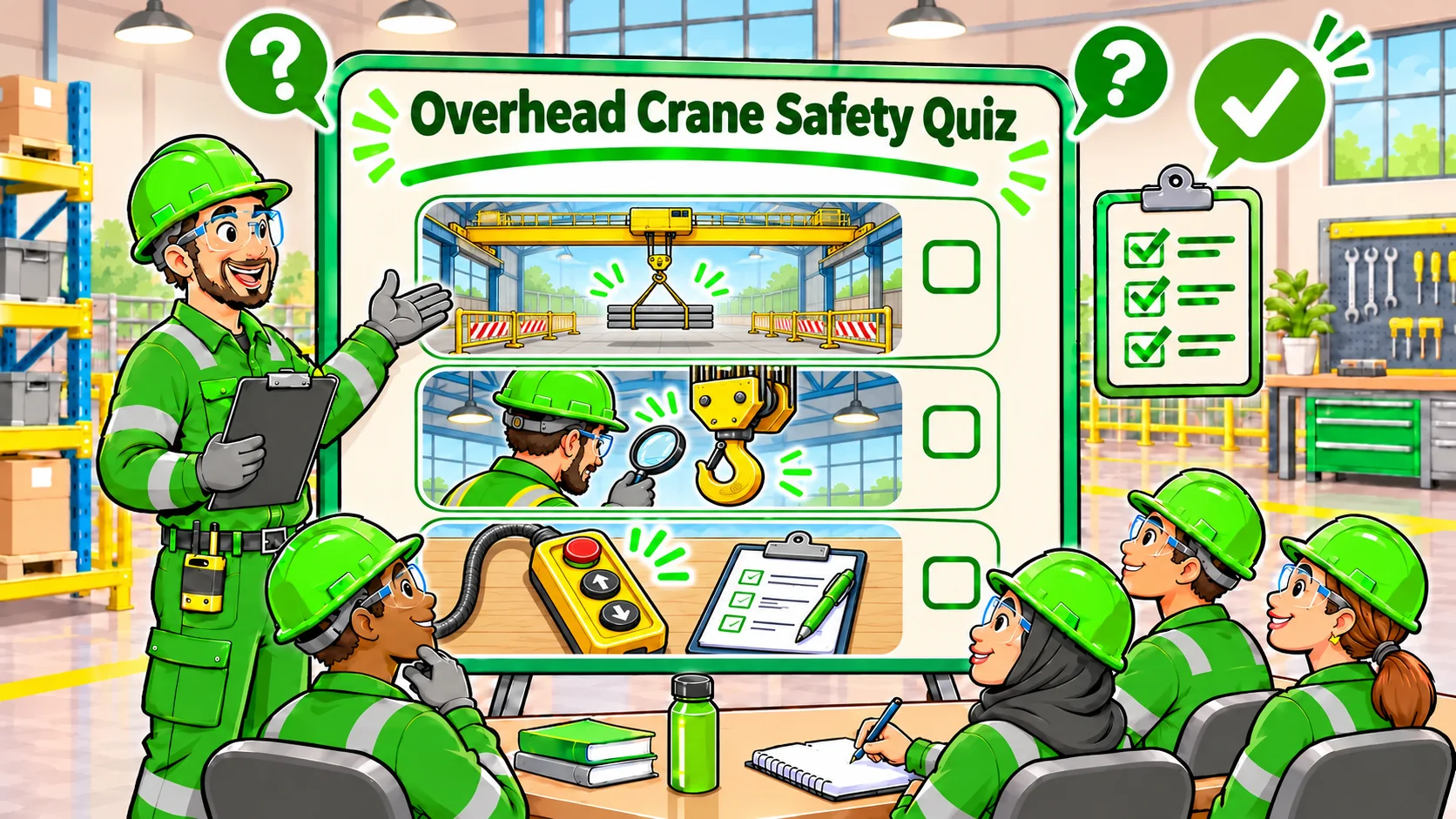
Overhead Crane and Hoist Safety Quiz: Workshop Lifting Questions
25 questions
About 13 min
Updated
0 of 25 answered
Score 0
Question 1 of 25
Under US OSHA 1910.179, who may operate a covered overhead crane?
Question 2 of 25
A crane's capacity marking is unreadable. What should happen before a production lift?
Question 3 of 25
A workshop load's weight is unknown. What is the safest next step?
Question 4 of 25
The crane is rated 5 tonnes but a selected lifting accessory is rated 3 tonnes for the intended configuration. What follows?
Question 5 of 25
Can the hoist chain itself be wrapped around a load as a sling?
Question 6 of 25
What should be checked before raising a load more than a few inches?
Question 7 of 25
Where should the hook be positioned for a normal vertical lift?
Question 8 of 25
A load is obstructed and would require a side pull. What is the appropriate response?
Question 9 of 25
How should an overhead load be started and stopped?
Question 10 of 25
The planned route crosses a staffed workstation. What should be arranged?
Question 11 of 25
Can an employee ride the hook during hoisting?
Question 12 of 25
May an operator leave the controls while a load is suspended under OSHA 1910.179?
Question 13 of 25
How is the upper limit switch checked at the start of an operator's shift under OSHA 1910.179?
Question 14 of 25
Should the upper hoist limit switch be used as the routine stopping control?
Question 15 of 25
The pendant's direction labels are worn off. What should be done?
Question 16 of 25
A control continues moving the crane after release. What is the correct response?
Question 17 of 25
A daily hook check reveals a crack. What should happen?
Question 18 of 25
A hoist chain is twisted and a link is distorted. What should the operator do?
Question 19 of 25
Do periodic inspections replace observation for defects during operation?
Question 20 of 25
What should be ready at the landing position?
Question 21 of 25
How should hands be managed as slings tighten?
Question 22 of 25
Under OSHA 1910.179, what brake check applies when handling a load approaching rated load?
Question 23 of 25
Two overhead cranes will lift one load. What does OSHA 1910.179 require?
Question 24 of 25
Does pressing emergency stop make maintenance on the crane automatically safe?
Question 25 of 25
What should happen after a safety-critical defect is reported?
About This Quiz
This overhead crane and hoist safety quiz tests workshop lifting decisions through 25 multiple-choice questions. Review rated loads, approved attachments, balance, controls, inspections, limit switches, load routes and safe responses to defects.
How to use the quiz
Choose one answer for each question. The pass mark is 70%, with no time limit. Answer choices are shuffled, explanations are shown and retakes are allowed. Review missed answers before trying again.
Scope and standards
This is independent awareness practice, not an official OSHA assessment, operator licence or practical competence certificate. Regulatory questions use US OSHA 1910.179 for the overhead and gantry cranes it covers in general industry. Do not automatically apply those provisions to construction cranes or every standalone hoist. Follow the governing law, manufacturer instructions and your employer's lifting and energy-control procedures.
Primary sources
Sources reviewed on 18 November 2026. Consult the current applicable requirements and equipment instructions before real work.
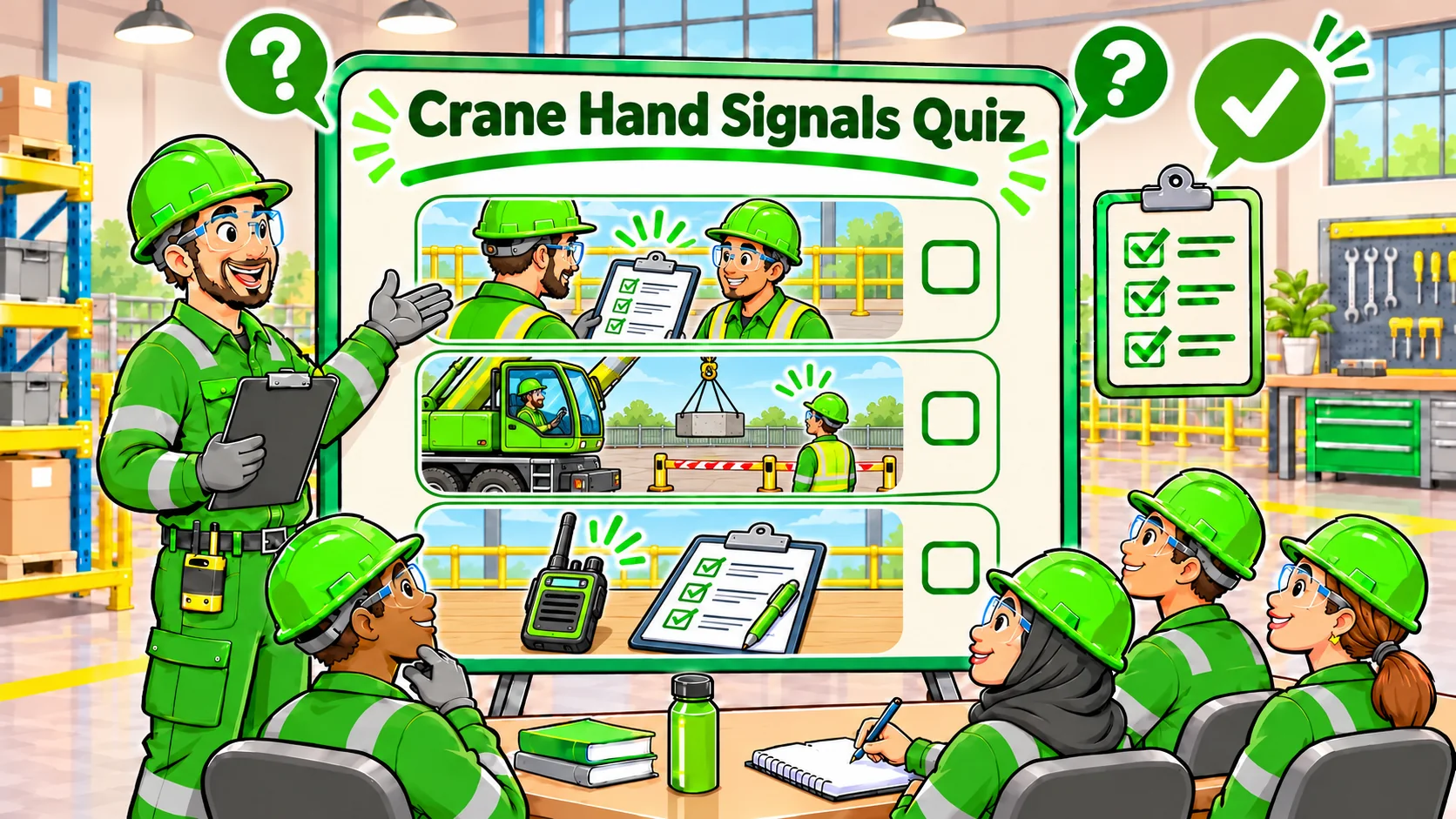
Practise crane hand signals with 25 questions on OSHA standard gestures, safe communication and signal-person duties. Includes answers and explanations.
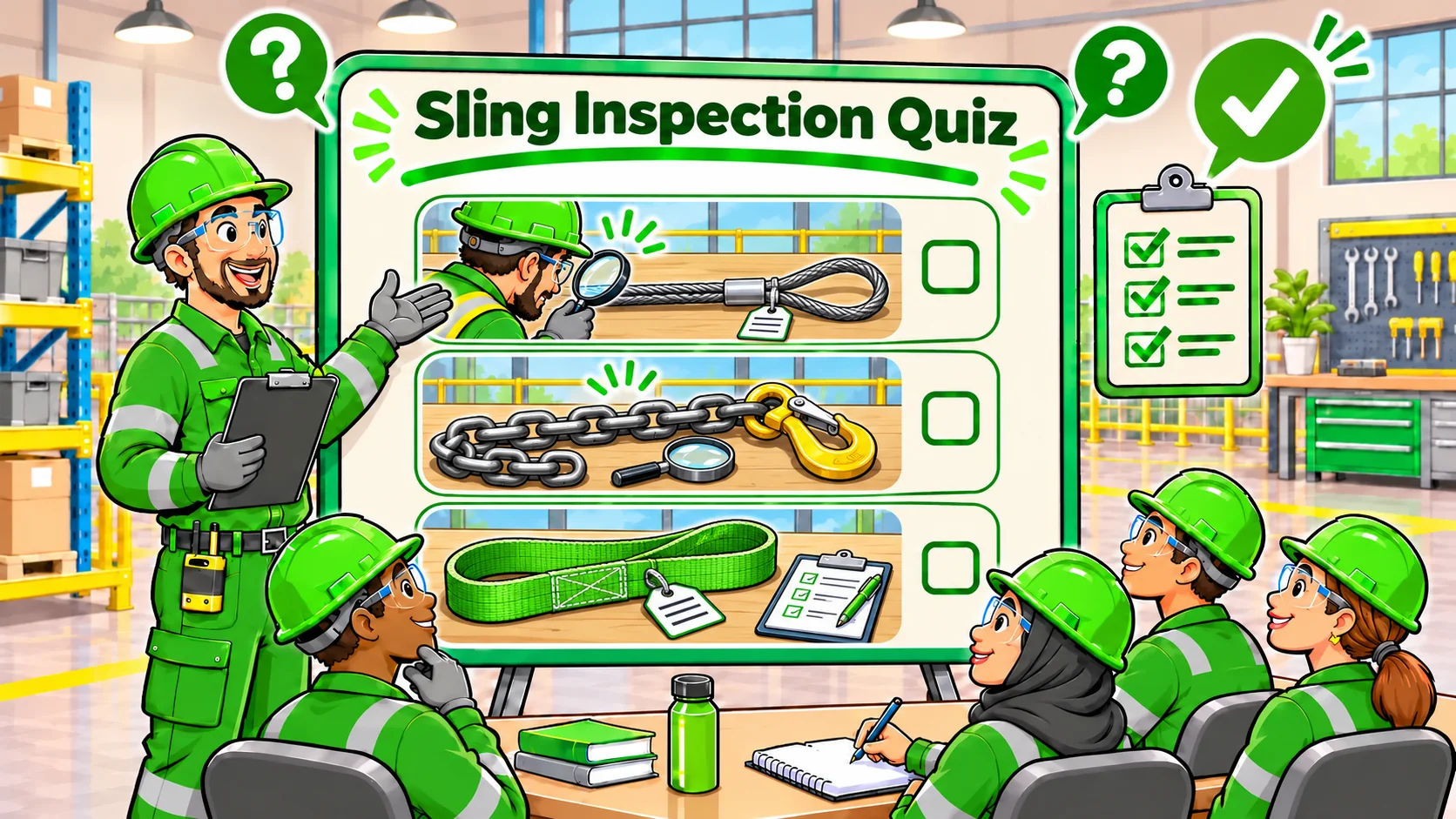
Test sling inspection knowledge with 25 questions on wire rope, chain and webbing damage, markings and safe use. Includes correct answers and explanations.
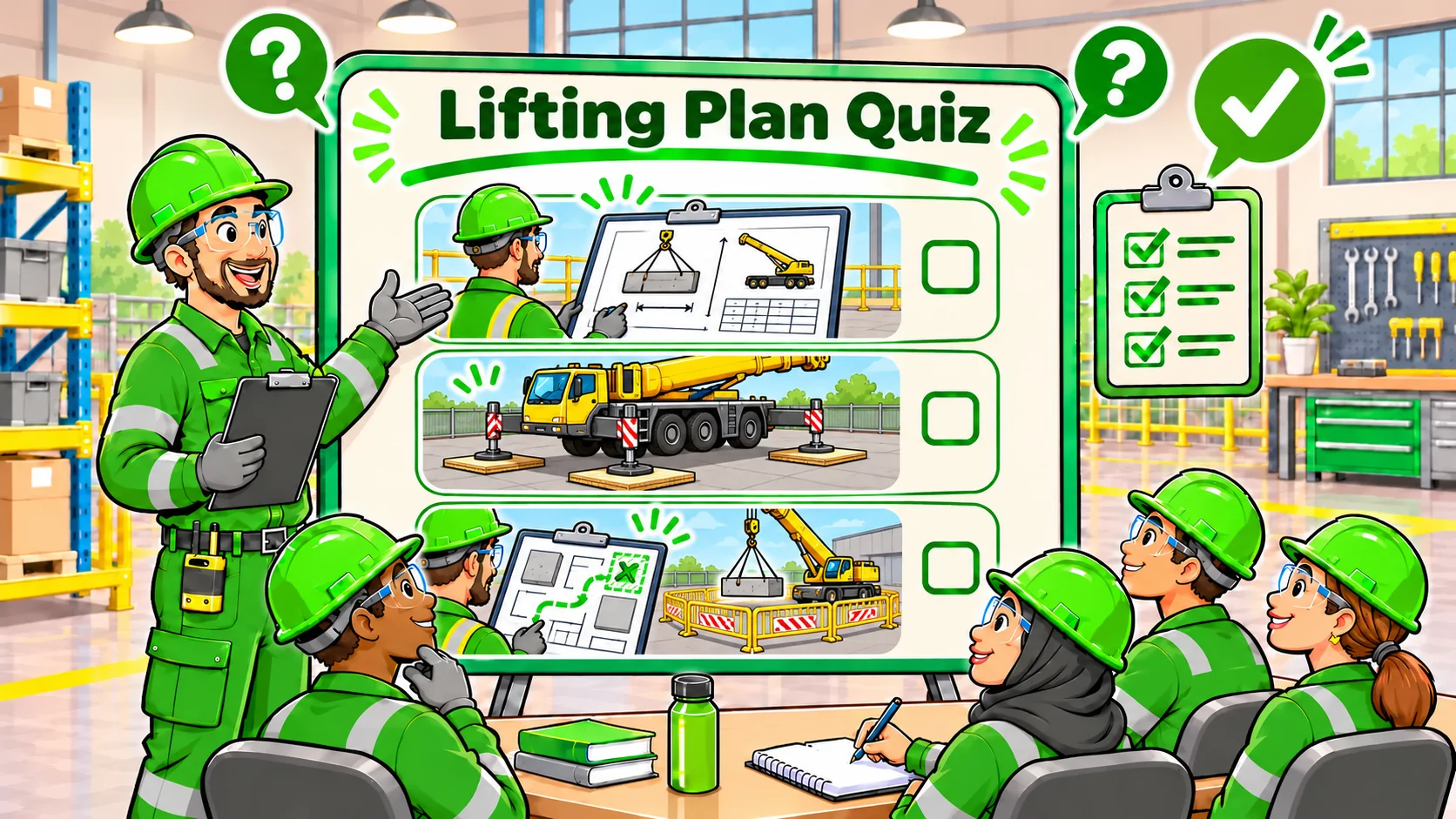
Practise lift planning with 25 questions on load weight, crane radius, charts, ground support and communication. Includes answers and useful explanations.
Check your understanding of the people and communication arrangements needed for safe vehicle and lifting movements. These 25 original questions cover vehicle banksman duties, crane signalling, slinging interfaces, protected positions, radio checks, lost communication and controlled handovers. The terms describe related activities, but each role needs the competence required for its actual work.