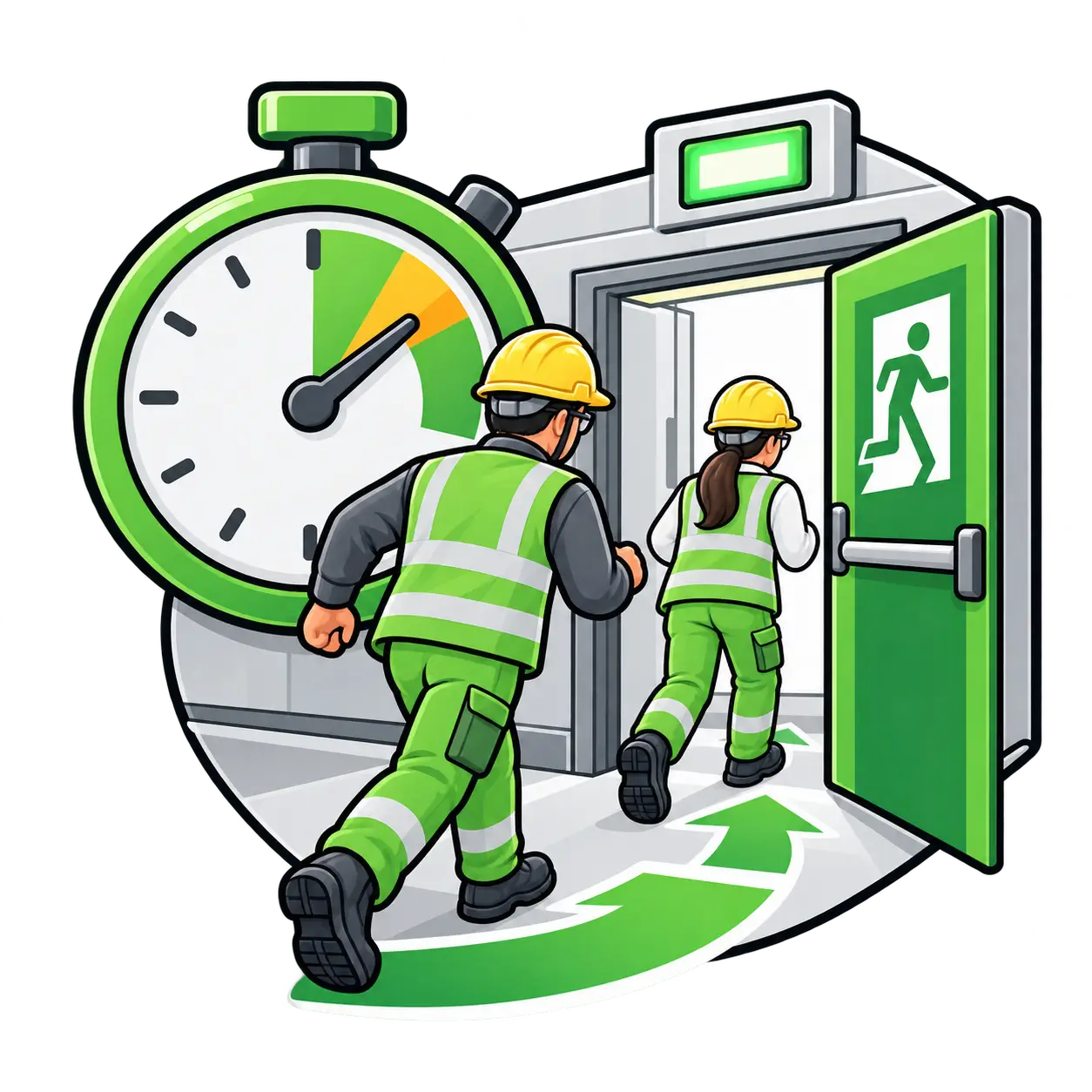

How long does an evacuation take?
Simplified planning often splits time into travel and queueing at exits (plus detection and pre-movement in full ASET/RSET studies):
t ≈ Distance ÷ Speed + Occupants ÷ (Exit width × Specific flow)
Typical unimpeded walking speeds are often taken around 1.0–1.2 m/s; doorway flow rates vary by design guidance (e.g. ~1.3 persons/s per metre of clear width as a rough teaching value).
Evacuation Time Calculator
Evacuation · travel + queue
Estimate egress time from travel distance, walking speed, occupant load, and exit width × flow. Simplified planning aid — not a full RSET study.
Formula: t ≈ t_travel + t_queue · t_travel = Distance ÷ Speed · t_queue = Occupants ÷ (Width × Flow)
- Sum usable clear widths; blocked exits do not count.
- Stairs and smoke reduce speed — this model is level-floor simplified.
- Plan assisted egress separately for mobility-impaired occupants.
Frequently asked questions
Is this RSET?
It is a simplified travel + queue estimate only. Full RSET includes detection, alarm, and pre-movement distributions.
What about stairs and smoke?
Stairs slow movement; smoke and congestion reduce speed further. Use fire-engineered models for complex buildings.
Multiple exits?
Sum effective clear widths, and check that occupants can actually reach those exits without bottlenecks.
People with mobility needs?
Plan assisted egress and refuge separately — average walking speed does not cover everyone.