
Why sling angle matters
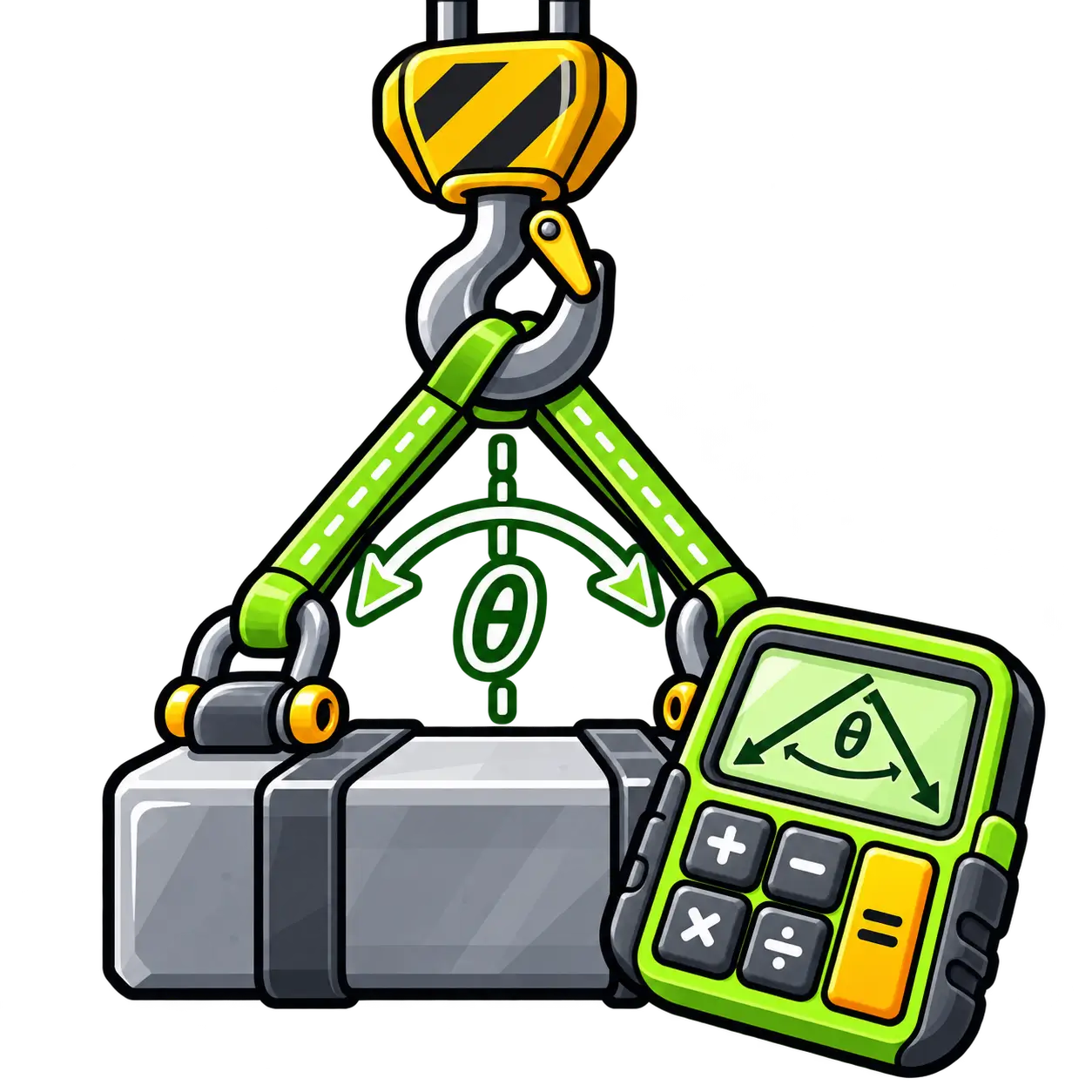
As a multi-leg sling set gets flatter, tension in each leg rises above the simple share of the load. A 30° angle from horizontal roughly doubles the tension versus a vertical hitch share; very flat angles can overload gear even when the load is “within” the sling’s vertical WLL.
Enter the load, number of legs sharing the load, and the angle between each sling and the horizontal. The calculator returns tension per leg.
Sling Angle Calculator
Sling angle · Leg tension
Tension per leg = (Load ÷ Legs) ÷ sin(θ) with θ measured from the horizontal (90° = vertical).
Formula: Tension per leg = (Load ÷ Legs) ÷ sin(θ)
- Assumes equal load share — uneven hitches need a lift plan.
- Apply manufacturer WLL and angle/choke derates separately.
- Keep clear of the fall zone; follow written lift plans for complex lifts.
Tension per leg = (Load ÷ Number of legs) ÷ sin(θ)
where θ is the angle from horizontal (90° = vertical). Keep θ high enough for your lift plan — many procedures discourage angles below 30° from horizontal unless engineered.
Worked examples (2-leg, 2,000 kg load)
- 60° from horizontal → tension ≈ 1,155 kg per leg
- 45° → tension ≈ 1,414 kg per leg
- 30° → tension ≈ 2,000 kg per leg
Safe practice
- Use the manufacturer WLL and angle charts for the exact sling type (chain, wire, synthetic).
- Protect against cutting, choking derates, and shock loading.
- Keep people out of the fall zone; follow a written lift plan for complex lifts.
Frequently asked questions
Is the angle from horizontal or vertical?
This tool uses angle from horizontal (90° = straight up). Some charts use angle from vertical — convert before comparing.
Do all legs share the load equally?
Only when the hitch is symmetrical and legs are equal length. Uneven or basket hitches need a lift plan and may load one leg more.
Does this include sling WLL derating?
It calculates tension only. Apply the manufacturer’s angle / choke / basket derating to decide if the sling is rated for that tension.
What about four-leg spreads?
Enter 4 legs only if the lift plan assumes all four share equally. Many four-leg lifts are designed so only two or three legs take the load at once.