Before a worker connects a supplied-air respirator, verify that the compressed air meets all five federal OSHA Grade D criteria, that it comes from the intended source and that it reaches the respirator at the required flow and pressure. For purchased cylinders, match the delivery to the supplier’s certificate of analysis. For a compressor, check the intake, treatment equipment and carbon monoxide safeguards, then review results representative of the air delivered. A normal pressure gauge or a silent carbon monoxide alarm cannot establish Grade D quality on its own.
Check what the Grade D result covers
A supplied-air respirator (SAR) receives air through a hose from a source independent of the air around the worker. The US Occupational Safety and Health Administration (OSHA) requires compressed breathing air to meet at least Grade D as described in ANSI/Compressed Gas Association G-7.1-1989. The following values apply to the breathing-air supply. Use a separate workplace exposure assessment to decide which types of respirators are suitable for the atmosphere outside the hood or facepiece. 29 CFR 1910.134(d) and (i)(1)(ii).
| What to verify | Acceptance criterion |
|---|---|
| Oxygen | 19.5% to 23.5% by volume |
| Condensed hydrocarbons | No more than 5 milligrams per cubic meter of air (mg/m³) |
| Carbon monoxide (CO) | No more than 10 parts per million (ppm) |
| Carbon dioxide (CO₂) | No more than 1,000 ppm |
| Odor | No noticeable odor |
Read the names and units on the analysis. A measurement of CO leaves CO₂ untested. A result for oil vapor alone does not establish the condensed-hydrocarbon result. An odor complaint warrants investigation even if the reported gas values pass. Conversely, CO is odorless, so an absence of smell gives no assurance about that hazard. Use test results rather than asking a worker to try an unverified supply. CDC information on carbon monoxide.
Moisture is an additional, source-specific check. Identify whether the respirator receives air directly from a compressor or from a filled cylinder before comparing a dew-point result with the standard. OSHA clarification, questions 2–7.
Verify the cylinder or compressor supplying the airline
Trace the breathing-air outlet back to its source. Record the cylinder or filling batch, or the compressor and treatment equipment feeding the distribution line. This makes it possible to tie a certificate or sample to the actual supply and to identify every user affected by a fault.
Purchased breathing-air cylinders. Obtain a supplier certificate of analysis covering the cylinders delivered and stating that the air meets Grade D. OSHA accepts one certificate for a batch filled on the same day from the same source. A general assurance renewed annually cannot establish which filling it covers. Check the delivery identifiers against the certificate. Hold cylinders with uncertain identity or missing documentation until the supplier resolves the discrepancy. OSHA interpretation on cylinder certificates of analysis.
Cylinder condition and dryness. Confirm that the cylinders are tested and maintained under the applicable US Department of Transportation rules in 49 CFR part 180. Their air must have a dew point of −50°F (−45.6°C) or lower at one atmosphere. Cylinder requalification addresses the pressure vessel. It does not establish the purity of the gas introduced at the last fill. 29 CFR 1910.134(i)(4).
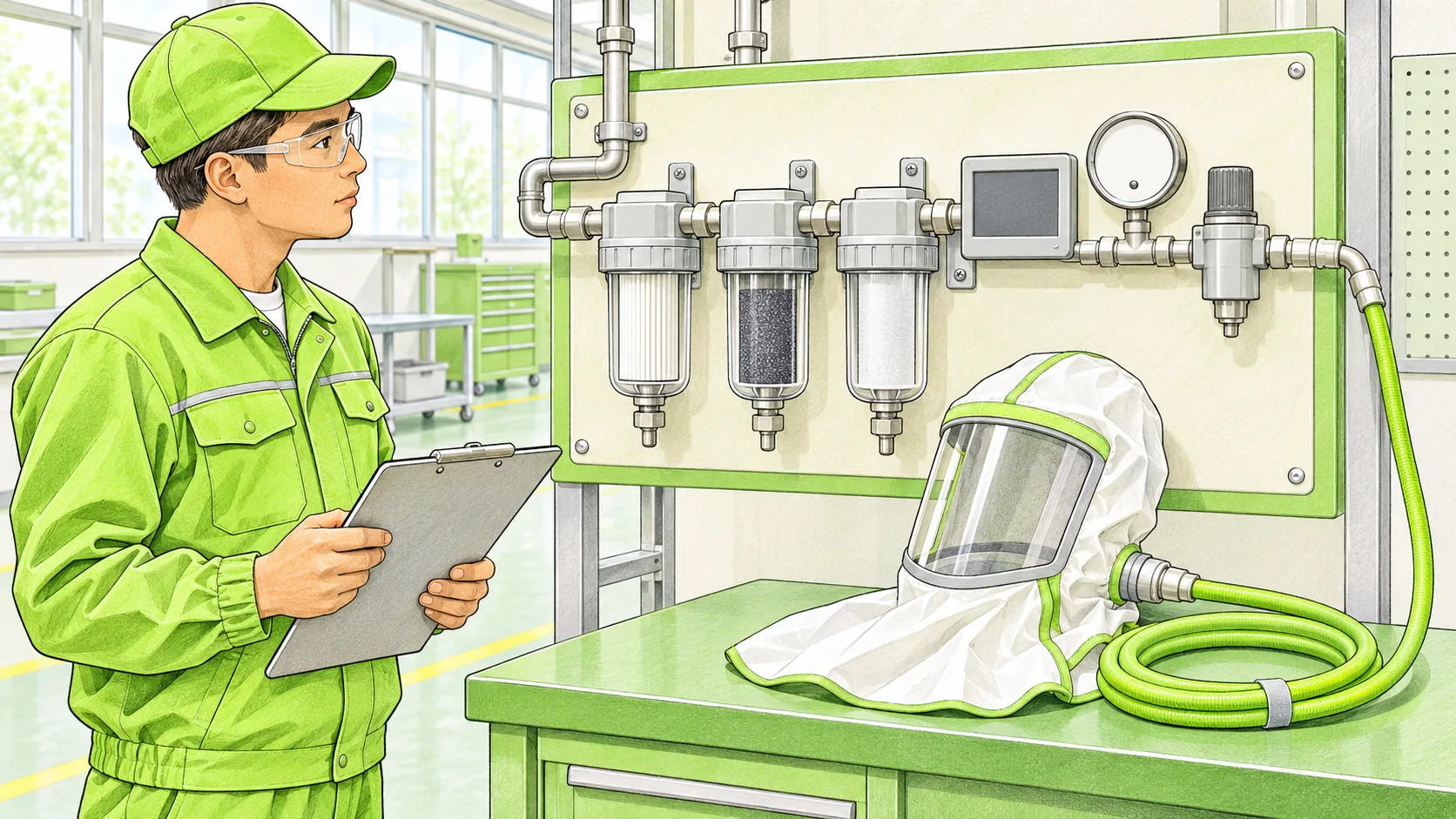
Compressor-fed airlines. Locate the intake where exhaust from vehicles, the compressor engine and nearby process vents cannot enter. Check the surroundings while the operation is running. Verify suitable in-line filters and sorbent beds, their service status and the manufacturer’s replacement or refurbishment instructions. OSHA requires a tag at the compressor with the latest change date and the signature of the person authorized to make the change. OSHA Technical Manual, section VIII, chapter 2, part X.
For a compressor supplying the airline, control moisture so the dew point at one atmosphere is 10°F (5.56°C) below ambient temperature. A dryer display may give a pressure dew point at the operating pressure. Ask for the equivalent at one atmosphere before judging compliance, and record the ambient temperature used for the comparison. Excess moisture can interfere with the equipment, including by freezing at a valve. OSHA explanation of compressor and cylinder dew points.
Match carbon monoxide monitoring to the compressor
Find out how the compressor is lubricated. An oil-lubricated machine can generate CO internally when oil enters the compression chamber and partially burns. Any intake exposed to engine exhaust can draw CO into the breathing-air line. An oil-free design removes one route of contamination while leaving the intake route open. OSHA respiratory protection questions and answers, paragraph (i).
- Oil-lubricated compressor. Federal OSHA requires a high-temperature alarm, a CO alarm, or both. If a high-temperature alarm is the only alarm used, monitor CO in the supplied air at intervals sufficient to keep it at or below 10 ppm. A normal compressor temperature cannot reveal exhaust sucked in through the intake. 29 CFR 1910.134(i)(6)–(7), compressor CO requirements.
- Compressor without oil lubrication. The employer must keep CO at or below 10 ppm. Paragraph (i)(6) does not specify a particular alarm. Verify the intake location and choose monitoring that can detect contamination under the actual operating conditions.
Portable ambient-air pumps have a separate interpretation. For these devices, also called free-air pumps, OSHA does not require sampling to establish the full Grade D specification. The employer must place the intake in clean air and measure CO each time the pump moves to a new location, keeping it at or below 10 ppm. Confirm the equipment type before applying this guidance to a mobile unit. OSHA interpretation on portable ambient-air pumps.
Make sure the alarm can reach the respirator users or a designated person who can immediately warn them. Have the responsible person check the monitor and alarm according to the manufacturer’s instructions. A filter’s color-change moisture indicator cannot detect CO. A spot check with a suitable CO detector tube or calibrated direct-reading instrument establishes a concentration at the time of the test, while a functioning continuous CO monitor can warn of a later change. Neither method measures the other Grade D constituents. OSHA inspection guidance on compressor alarms.
Sample the air delivered to the respirator supply points
Define the sampling points and the reason for each one before commissioning the system. A result taken upstream of the dryer and filters cannot demonstrate how the treatment performed. Conversely, satisfactory air at the compressor output can be contaminated downstream in a distribution line. OSHA’s 2023 clarification points to consensus guidance recommending a representative compressor-output sample before initial use and representative samples at distribution points to account for contamination along the way. OSHA clarification on representative sampling, question 11.
- Identify the supply being tested. On the sampling record, name the compressor or cylinder source, the treatment stages and the outlet where a respirator would connect. Choose representative outlets for the branches in use. Note which branch a sample covers, the date and the operating conditions, including relevant nearby sources of exhaust.
- Arrange a test that covers the decision. Give the testing provider the five Grade D criteria and the moisture requirement for the source. Confirm which constituents the laboratory or field method measures and whether its range and reporting units allow comparison with those limits. Use sampling equipment suitable for the system pressure and follow its collection instructions. A CO-only test belongs in the CO monitoring record.
- Review the report before releasing the supply. Match its identifiers to the sampled source and outlets. Check each result, including the pressure basis for dew point. Resolve a failed criterion, unreadable result or missing part of the assessment before anyone relies on the affected air. Record who reviewed it and the action taken.
- Set the next check and the triggers for an earlier one. Base the interval on the source, maintenance history, intake location, changes in nearby work and any other applicable requirements. Review the evidence when the intake moves, a distribution branch is altered, treatment fails or a worker reports unexpected odor. Recheck the affected air after corrective work.
Section 1910.134(i) gives no universal quarterly schedule for a complete Grade D analysis. A periodic laboratory test and the compressor’s CO safeguards serve different purposes. OSHA’s guidance notes that a well-maintained system with a consistently clean intake can support periodic CO checks, while an older machine prone to oil carryover or a rental with unknown maintenance history can warrant continuous monitoring. Record why the selected interval is adequate and who will act if a result exceeds the limit. OSHA guidance on carbon monoxide monitoring frequency.
Check the connection and respond to a suspect supply
At the point of use, check the complete configuration against the approval issued by the National Institute for Occupational Safety and Health (NIOSH). Follow the respirator manufacturer’s instructions for the approved hose, couplings, control valve and hood or facepiece. Verify the required pressure and flow for the hose configuration and number of users the source will serve. The written respiratory protection program must cover breathing-air quality, quantity and flow. A passing analysis addresses only the first of these. 29 CFR 1910.134(c)(1)(vi) and (d)(1)(ii).
Warning. Breathing-air couplings must be physically incompatible with outlets for tool air and other worksite gases. An OSHA investigation found that a spray-booth worker’s respirator hose fitted a nitrogen outlet equipped with breathing-air fittings. The worker received nitrogen and died. Trace the source before connection and remove any adapter that defeats the separation. Labels help identify outlets, but they cannot prevent compatible fittings from joining. Keep asphyxiating gases out of breathing-air lines. OSHA’s investigation of a fatal nitrogen cross-connection.
Never substitute compressed oxygen in an atmosphere-supplying respirator that has used compressed air. Oxygen concentrations above 23.5% require equipment designed for oxygen service. In equipment that has carried air, high-pressure oxygen can react with oil or grease and create a fire or explosion hazard. OSHA Technical Manual, breathing-air quality and use.
If an alarm sounds, pressure or flow fails, or the air is suspect, immediately warn everyone on the affected supply. Stop the task and follow the trained escape procedure to a safe area. Do not remove the respirator in contaminated air to investigate an odor. Account for the workers, obtain emergency help for anyone affected, and keep the supply out of use while the cause is investigated. Restore service only after the source and connections have been verified, the fault corrected, and the relevant quality and delivery checks passed. OSHA respirator use and emergency training requirements, paragraphs (g) and (k).