In Great Britain, employers must arrange suitable health surveillance when the conditions in the Control of Substances Hazardous to Health Regulations 2002 (COSHH) are met. For workers exposed to isocyanates, the main concerns are occupational asthma and dermatitis. Identify who could breathe in isocyanates or get them on their skin, agree the checks with a competent occupational health professional, and give workers a way to report symptoms between appointments. A urine test can help you check exposure controls. It cannot tell you whether a worker has developed asthma.
Decide which workers need surveillance
Start with the actual work. Check the safety data sheets for paints, hardeners, adhesives, resins and foams, then follow each product from preparation through application and cleaning. Record who handles it, who can be exposed nearby, and which controls keep it away from the lungs and skin. In a bodyshop, the person cleaning a spray gun or entering a booth before the mist has cleared can be exposed even if their job title is not “paint sprayer”. Health and Safety Executive guidance on isocyanate paint spraying.
Under COSHH regulation 11(1) and (2)(b), the employer must provide surveillance where exposure is associated with an identifiable disease or adverse effect, that effect is reasonably likely under the employee’s particular working conditions, and there is a valid, low-risk way to detect early indications. Isocyanates can sensitise the airways. After sensitisation, very small exposures can trigger asthma symptoms. HSE specifically calls for respiratory surveillance for motor vehicle workers liable to be exposed to isocyanate-containing materials. Assess skin contact and the need for skin surveillance alongside inhalation risk. COSHH regulation 11 and HSE guidance for motor vehicle repair.
Record the tasks and workers included, how often exposure can occur and the reasons for the decision. Revisit the list when products, methods, ventilation or staffing change. Prevent exposure where reasonably practicable and otherwise control it adequately. Surveillance can reveal that protection has failed, but a normal set of results cannot establish that a spray booth, breathing apparatus or gloves are working properly. HSE guidance on controlling and monitoring isocyanate exposure.
Set up respiratory and skin checks with occupational health
Give the occupational health provider the exposure assessment, product information, task descriptions and relevant monitoring results. Ask for a written plan covering the people to be seen, the checks, recall dates, referral arrangements and the feedback you will receive. Arrange the required appointments during working hours and pay the cost. Isocyanates are outside the special Schedule 6 list that triggers statutory medical surveillance by a relevant doctor for specified substances and processes. The ordinary COSHH health surveillance duty still applies when its tests are met. HSE COSHH Approved Code of Practice, regulation 11 and Schedule 6.
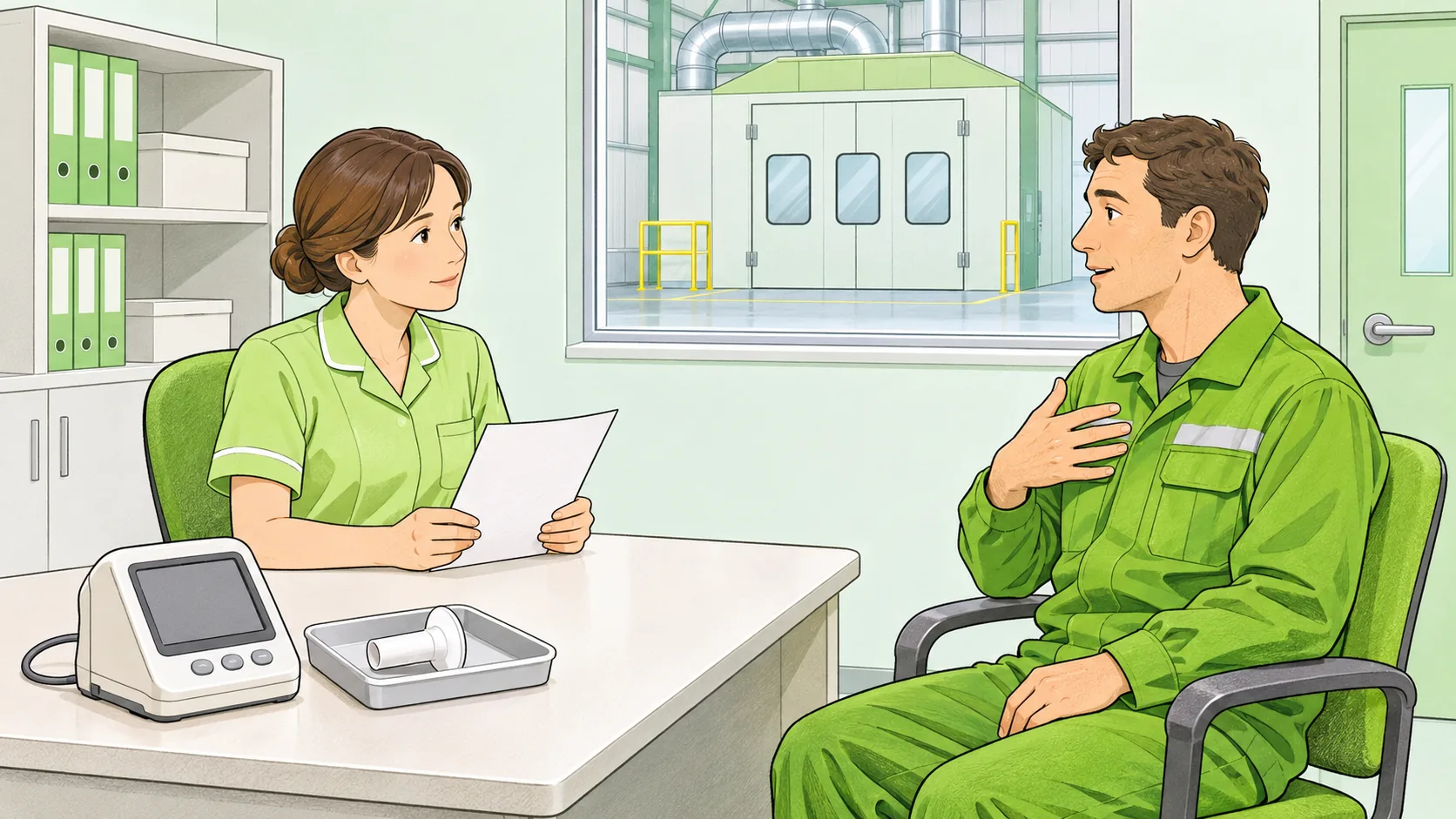
Respiratory checks normally start with a symptom questionnaire and spirometry, a test that measures how much air a person can breathe out and how quickly. Obtain a baseline before exposure wherever possible. If it has been missed, arrange it promptly and tell the provider when exposure began. For workers outside the specific spray-painting schedule below, HSE advises a frequency suited to the risk, usually annual, with earlier checks for new workers as appropriate. The competencies of occupational health providers include interpreting changes from earlier results and deciding when clinical assessment is needed. HSE G402, health surveillance for occupational asthma.
| When | What the employer should arrange |
|---|---|
| Before the first exposure | A baseline respiratory questionnaire and lung-function test. Give the provider details of the intended work. |
| After six weeks in the job | Repeat both checks. Ensure occupational health can compare the findings with the baseline. |
| After six months in the job | Repeat the questionnaire and lung-function test. Follow up any appointment missed because of a shift change or absence. |
| Annually thereafter | Continue the questionnaire and lung-function testing. Arrange an earlier assessment when symptoms or professional advice call for one. |
The intervals above come from HSE’s isocyanate paint-spraying guidance. HSE also gives that sequence for new employees spraying isocyanate products in construction. For other uses, ask the provider to explain the programme against the actual exposure. HSE paint-spraying guidance, pages 4–5, and HSE construction spraying guidance.
For workers with only occasional exposure to a known respiratory sensitiser, occupational health may advise an annual respiratory questionnaire and a health record. This may also be appropriate when exposure is adequately controlled and questionnaires and spirometry show no health problems over a representative period. Ask the provider to document why this approach suits the work. HSE guidance on selecting respiratory checks.
Skin checks have their own timetable. Where skin surveillance is indicated, arrange a baseline before exposure or as soon as possible afterwards, followed by checks at the frequency agreed with occupational health. These can include a questionnaire and inspection of exposed areas such as the hands and forearms. A trained person at work can help workers report changes under the provider’s direction. The provider should assess concerning findings. Give workers a named contact for itching, soreness, cracking or blistering between checks. HSE G403, health surveillance for occupational dermatitis.
Use urine testing to check exposure controls
Health surveillance asks whether the worker shows early signs of harm. Biological monitoring asks whether isocyanate entered the body during recent work. HSE recommends urine sampling for vehicle paint sprayers because it can detect uptake even when breathing apparatus is used. A result above the biological monitoring guidance value calls for investigation of exposure and controls. That value is a benchmark for control and has no diagnostic meaning. HSE G408, urine sampling for isocyanate exposure.
Explain the purpose of sampling, how individual results will be used and who will see them. Obtain the worker’s informed consent. Arrange collection at the end of a representative period of potential exposure, within an hour of finishing it, following the laboratory’s instructions. HSE advises that vehicle paint sprayers are typically sampled annually, with more frequent checks where indicated. Sample on the day the task is performed because delayed collection can miss uptake. HSE sampling instructions and HSE advice on interpreting paint-spraying results.
If the result indicates unexpected uptake, examine how the job was actually done. Check containment, booth clearance time, use and condition of breathing apparatus, skin contact and cleaning practices. Correct the failures and arrange repeat sampling under representative working conditions to check whether the changes worked. Continue the respiratory and skin programme. A low urine result cannot rule out ill health or override symptoms. The wider principles are explained in biological monitoring of workplace exposure.
Act on symptoms and findings between appointments
Tell workers which symptoms to report, whom to contact on each shift and how to reach occupational health confidentially. Wheeze, chest tightness, persistent cough or breathlessness can occur during work or several hours later. Symptoms that ease on days away are worth reporting. Give the clinician the task and exposure history, including any recent change or control failure. Arrange prompt assessment without waiting for the next routine test. HSE guidance on the timing of respiratory symptoms.
Warning. Severe difficulty breathing, including gasping or being unable to get words out, needs emergency help. Call 999. Use the workplace emergency arrangements and keep others clear of any uncontrolled exposure. NHS guidance on severe breathing difficulty.
A reported symptom or change in lung function is a reason for occupational health to investigate. Managers should act on advice about work restrictions while that investigation proceeds. When a doctor or occupational health professional considers an identifiable disease or adverse effect found through surveillance to result from the exposure, regulation 11(9) requires the employer to take the following steps.
- Inform the worker through a suitably qualified person. Ensure they receive an explanation of the finding and advice about further surveillance. Obtain the work-fitness advice needed to protect them.
- Review the assessment and controls. Identify the tasks the worker carried out and check what happened during them. Review the measures used to prevent or control exposure, taking professional advice into account. Assign corrective actions and check their effectiveness.
- Consider alternative work. With advice from the doctor or occupational health professional, consider assignment to work without further exposure to the substance. Tell the supervisor what restrictions apply without disclosing confidential clinical details.
- Review the health of similarly exposed employees. Identify colleagues doing the same tasks or sharing the exposure. Arrange the review, including medical examination where recommended, and check that changes protect everyone affected. COSHH regulation 11(9) and HSE guidance on acting on surveillance results.
Keep the right records and report qualifying diagnoses
Maintain an individual employer health record showing the employee’s identity, relevant jobs and hazards, dates of surveillance, fitness outcome and any restrictions. Keep it for at least 40 years from the last entry and allow the employee access to their own record on reasonable notice. The occupational health provider keeps the confidential clinical record, including questionnaire responses, clinical notes and test results. Access to that medical record requires the worker’s written consent. Supervisors normally need the restrictions and next action, not the worker’s medical history. HSE health surveillance record-keeping guidance.
Reporting a diagnosed occupational disease is a separate decision under the Reporting of Injuries, Diseases and Dangerous Occurrences Regulations 2013 (RIDDOR). For an employee, report a doctor’s written diagnosis of occupational asthma when the job involved significant or regular exposure to a known respiratory sensitiser. Occupational dermatitis is reportable when the work involved significant or regular exposure to a known skin sensitiser or irritant. Report as soon as the qualifying diagnosis is received. Symptoms, a screening result or an elevated urine result alone do not meet that disease-reporting test. HSE guidance on reportable occupational diseases and RIDDOR reporting times.
Keep the appointment list, recall dates and corrective actions up to date. Ask occupational health for group feedback where individuals’ confidentiality can be protected. Use recurring findings to identify which task or control needs attention, then tell the affected workers what changed. Record who will check the revised control during normal work and when.