Before anyone enters a cold room, agree on the work to finish inside, when and where to warm up, and how to get out or call for help. There is no single safe number of minutes for working in a freezer. A worker standing in a fan draft and a worker moving cases can need different breaks in the same room. Both need a clear exit they can open from inside.
Assess the cold where the work happens
Start at the picking aisle, packing bench or truck cab with someone who does the job. The product temperature log tells you whether stock stayed cold. It cannot tell you how much air crosses the worker’s hands, how long they stand still or whether their clothes are wet. In a U.S. study of food preparation rooms at about 40°F (4°C), investigators measured conditions at individual workstations and identified drafts and the difficulty of doing fine work in gloves as possible contributors to workers’ discomfort. Read the National Institute for Occupational Safety and Health (NIOSH) cold-room study.
Record the air temperature where the person works, the time spent there on each visit and over the shift, and which tasks leave them wet or chilled. If airflow varies across the room, have someone measure it at the affected station. Use the findings to change the job before relying on heavier clothing. Reduce drafts or condensation at the source and move fine hand work out of the cold where possible. NIOSH recommendations for indoor cold work, page 4
| Task or location | What to check | A change to consider |
|---|---|---|
| Packing or scanning at a fixed bench | Does air from the cooling unit reach the same person throughout the task? Can they use the controls with gloves on? | Move the bench out of the draft or have maintenance assess an air deflector. Move labeling or paperwork to a warmer area where the process allows. |
| Picking and moving cases | Do workers sweat while moving loads, then wait in damp layers for the next order? | Stage the order outside, share demanding lifts and build time to change before the next cold task. |
| Driving or waiting inside | How long does the operator sit in an open cab? Where can they warm up between loads? | Consider a heated cab for sustained work. With an open cab, plan access to warmth and additional breaks as needed. |
For lift trucks, the UK Health and Safety Executive (HSE) specifically distinguishes long periods of full-pallet handling from jobs that require frequent dismounts. See HSG76, paragraphs 707–710, on breaks, cabs and protective clothing.
Set freezer work periods and warm-up breaks
Set the work period for the room, the task and the people assigned to it. HSE’s food-industry guidance gives two examples. In a chiller around 32°F (0°C), suitable clothing and ordinary breaks are usually enough. In a blast freezer operating down to −22°F (−30°C), workers need both protective clothing and breaks at ambient temperature or in a warming room. Neither example sets a timer for a different workplace. HSE guidance for chill units and freezers
- Reduce the time needed inside. Prepare the pick list and equipment in a warmer place. Separate work that needs the cold room from tasks such as checking an order after retrieval. Include waiting, stock counts and repeated short entries when estimating exposure.
- Write the work and recovery periods into the shift plan. Use the site’s cold-exposure assessment to specify when each worker comes out, how long the warm-up lasts, where it takes place and who provides relief. A rotation into another cold aisle still counts as cold exposure. If the site lacks a basis for a work period, get an occupational hygienist or other qualified adviser to assess the task before assigning prolonged exposure.
- Check the plan during the shift. A buddy or supervisor should check how the worker feels and whether they can grip and handle items normally. Bring the break forward for shivering, numb hands, wet insulation or loss of grip. Arrange dry replacements and adjust the next assignment. Repeated early exits at one station are a reason to inspect that station.
Provide a warm, dry recovery space with somewhere to change. Schedule cover so that someone can use it even when orders are waiting. Give new workers time to learn the routine under supervision. Workers with recurring symptoms or a condition affecting circulation can speak privately with occupational health about adjustments. The U.S. Occupational Safety and Health Administration (OSHA) recommends regular warm, dry breaks and time to adjust to cold work in its refrigerated warehousing guidance.
Choose clothing that lets workers do the job
Try the protective clothing on with the equipment the worker actually uses. Can they grip a case, press scanner keys, turn their head to look behind them and operate the door release with their gloves on? Learn where people take gloves off to finish a task. A different glove, a larger control or a warmer place to do the fine work can remove the reason for exposing bare hands.
- Dress for changes in activity. Use a wool or synthetic base layer that draws sweat away from skin, an insulating layer and an outer layer suited to drafts and moisture. Leave enough room for movement. Adjust layers before heavy work makes them damp and add insulation when activity drops.
- Protect hands, feet, head and ears. Choose insulated gloves with the grip and any cut protection the task requires. Keep bare skin off cold metal. Use insulated, slip-resistant boots with water protection where floors or stock are wet. Check that head coverings work with any required helmet and allow the worker to see clearly.
- Keep dry replacements at the warm-up area. Stock the sizes people wear, including spare gloves, socks and base layers. Change out of wet gear promptly. Allow time and space for damp clothing to dry before it is issued again.
The Canadian Centre for Occupational Health and Safety’s cold-work guidance explains how layers retain warmth. NIOSH explains why sweating during heavy work can increase cooling once activity stops.
Check the exit and the call for help before entry
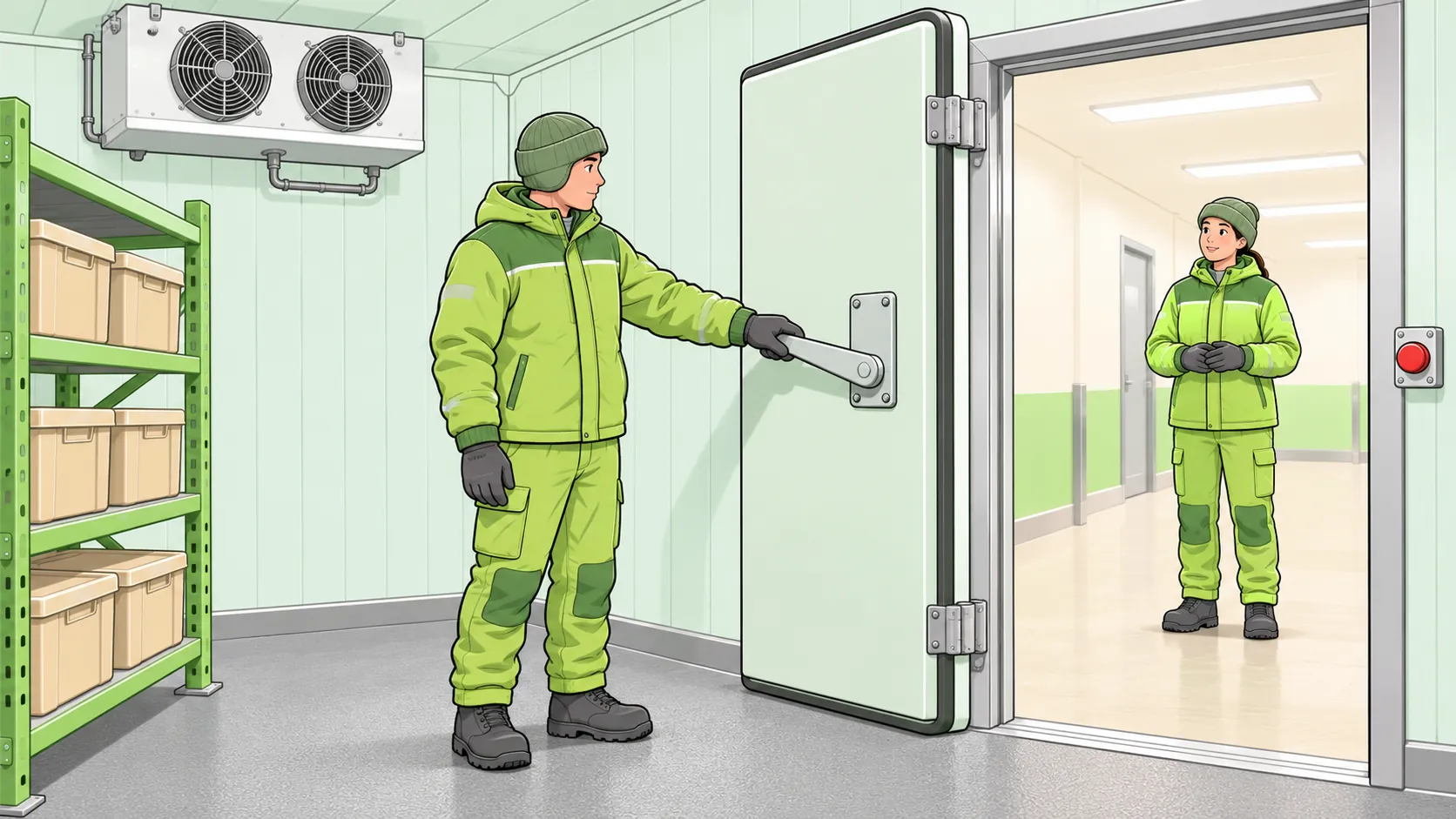
Walk the route with each new worker while someone remains outside. Show them the inside release, the alarm or other way to call for help, and the way back from their work area. Under U.S. federal OSHA rules, a worker must be able to open an exit-route door from the inside at any time without a key, tool or special knowledge. 29 CFR 1910.36(d)(1)
Warning. A worker may be trapped if the release is damaged or ice blocks the door. Hold entry if the exit does not work or the planned means of calling for help fails. Report the fault and verify the repair before reopening the room.
Use these checks when opening the room, assigning work and securing it at the end of the shift.
- Trace the escape path. Keep stock, carts and pallets clear of the door and its swing. Address ice or standing water on the approach. Check that a person can see the route and find the release with the door closed.
- Verify the release and the alarm. Use the site’s safe test procedure with someone outside. Confirm that the inside release opens the door and that an alarm call reaches the person assigned to answer it. Include regular tests and maintenance. Never lock someone inside to prove the system works.
- Agree on contact. Name the person who knows who is inside, where they are working and when to expect them back. Use a buddy for freezer work. If a radio or phone is part of the plan, test it from the work position with the door closed, using the same safeguards. A signal at the doorway does not establish coverage at the back of the room.
- Account for everyone at closing. Assign someone to check the room is empty before securing it. Include cleaners and maintenance staff as well as the picking crew.
Cold-storage guidance from South Australia’s workplace regulator covers regular release and alarm tests, buddy working, communications and emergency drills. HSE’s warehouse guidance, paragraphs 695–697, explains how to arrange for an occupied location to receive the alarm and for an appointed person to make the closing check.
Act on an overdue worker or signs of cold injury
A missed check-in and a trapped-person alarm both need an immediate response. Agree beforehand who will raise the alarm, how responders will find the right entrance and who will meet them. Practice these handoffs on each shift. SafeWork SA emergency arrangements for cold rooms
Warning. If a refrigerant leak or unsafe atmosphere is suspected, stay out of the affected area, follow the site’s evacuation procedure and tell responders about anyone missing. Leave entry and rescue to the trained, equipped response team. HSE precautions for an accidental refrigerant release, paragraphs 698–704
If you are trapped, try the inside release and use the alarm or tested communication device to call for help. If you are the outside contact and a worker fails to respond or the alarm sounds, start the site’s emergency procedure immediately. Give responders the room, entrance and last known work position.
A coworker can be the first to notice signs and symptoms of cold stress. Leave the cold together if shivering, numbness or clumsy hands develop. Pay particular attention to a worker who fumbles familiar controls, struggles to speak clearly or seems confused. Cooling can impair their ability to recognize what is happening. NIOSH signs of cold-related illness in workers
Suspected hypothermia is a medical emergency. Call emergency services immediately (911 in the U.S.). Move the worker gently to a warm, sheltered place if safe. Remove wet clothing, cover the body, head and neck with dry blankets, keep the face clear and stay with the person. Follow the dispatcher’s instructions. Shivering can stop as the condition worsens. OSHA first-aid instructions for cold stress
Suspected frostbite needs medical attention. Numb skin that feels firm or looks pale and waxy can indicate frozen tissue, especially on fingers, toes, ears or the nose. Get the worker to warmth, loosely protect the affected area and seek prompt care. Avoid rubbing, direct heat or walking on affected feet. Follow medical instructions about rewarming. OSHA frostbite precautions
Before the next shift, identify what allowed the exposure or delayed help. Record the room and task, the condition of clothing, the actual time inside, and whether the exit and alarm worked. Assign someone to correct the cause and check the fix with the people who do the work.