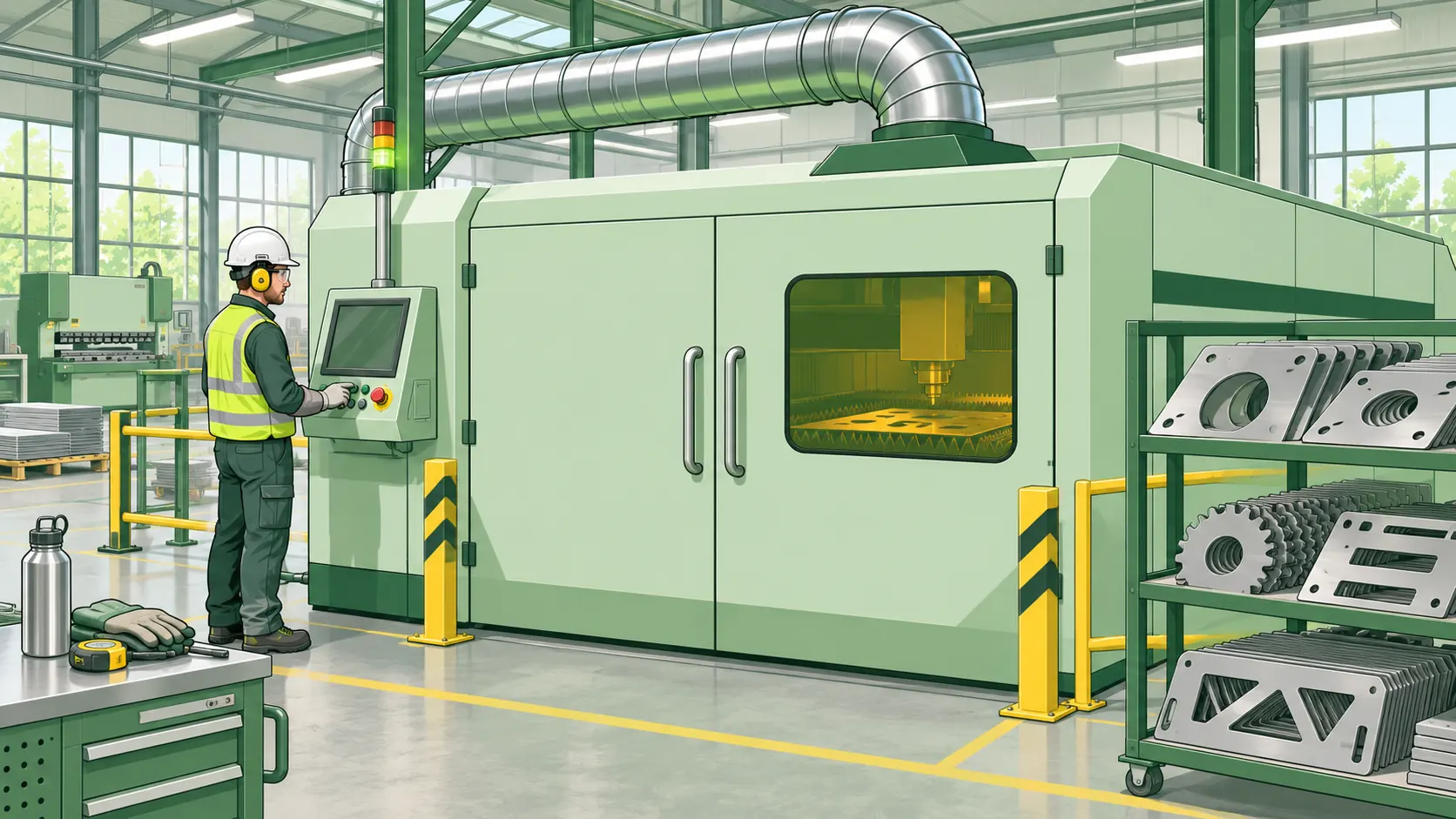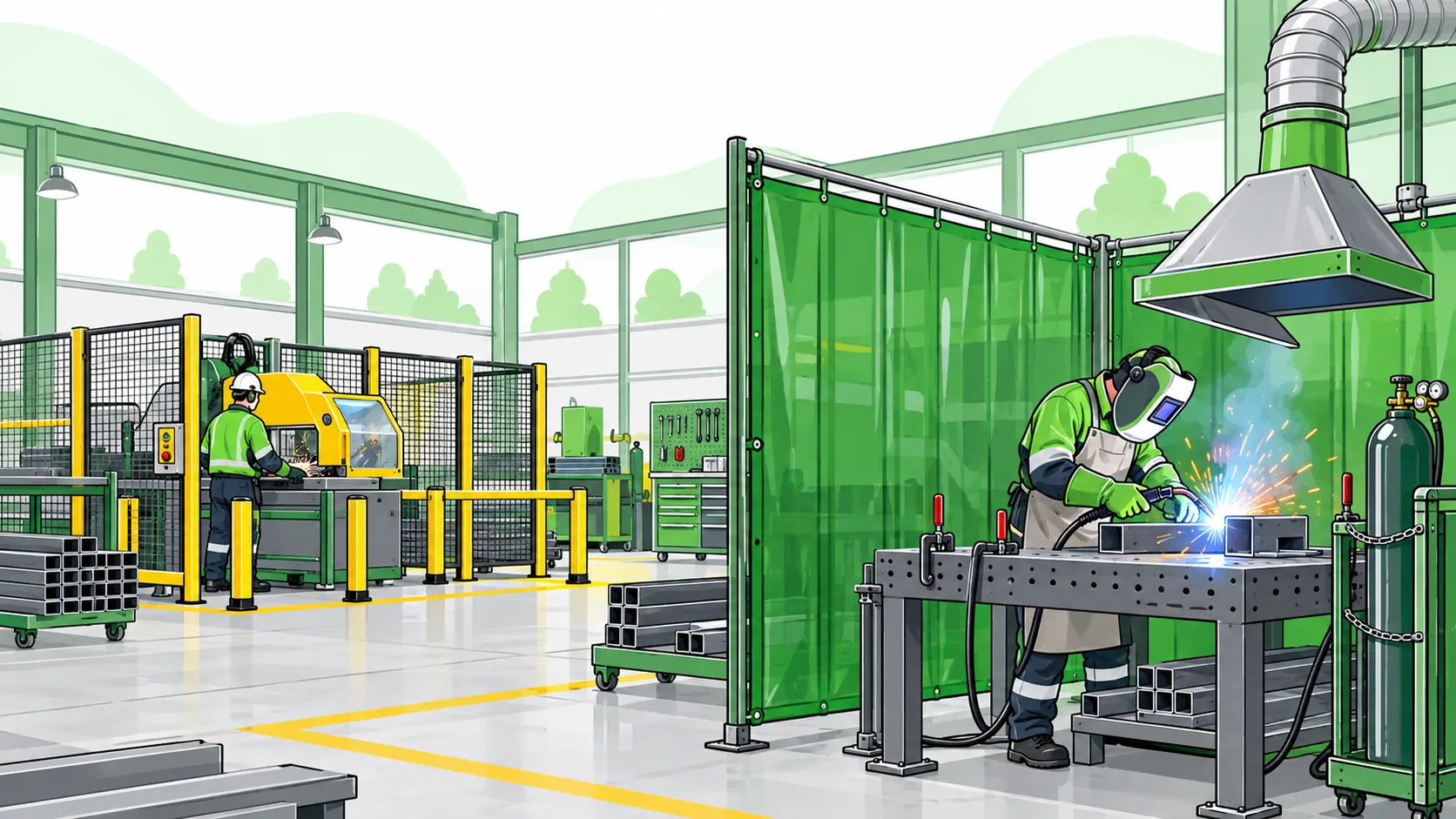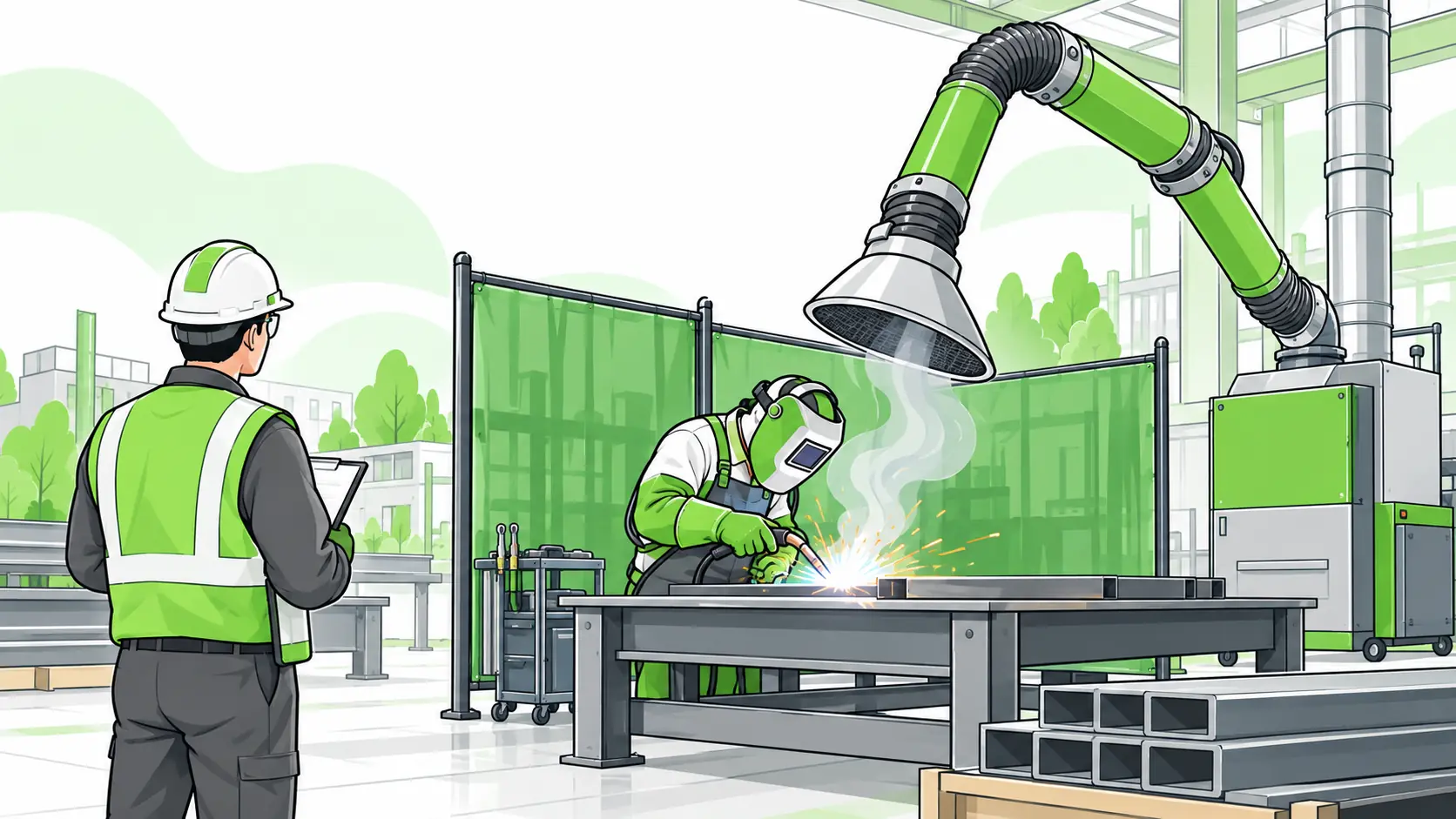
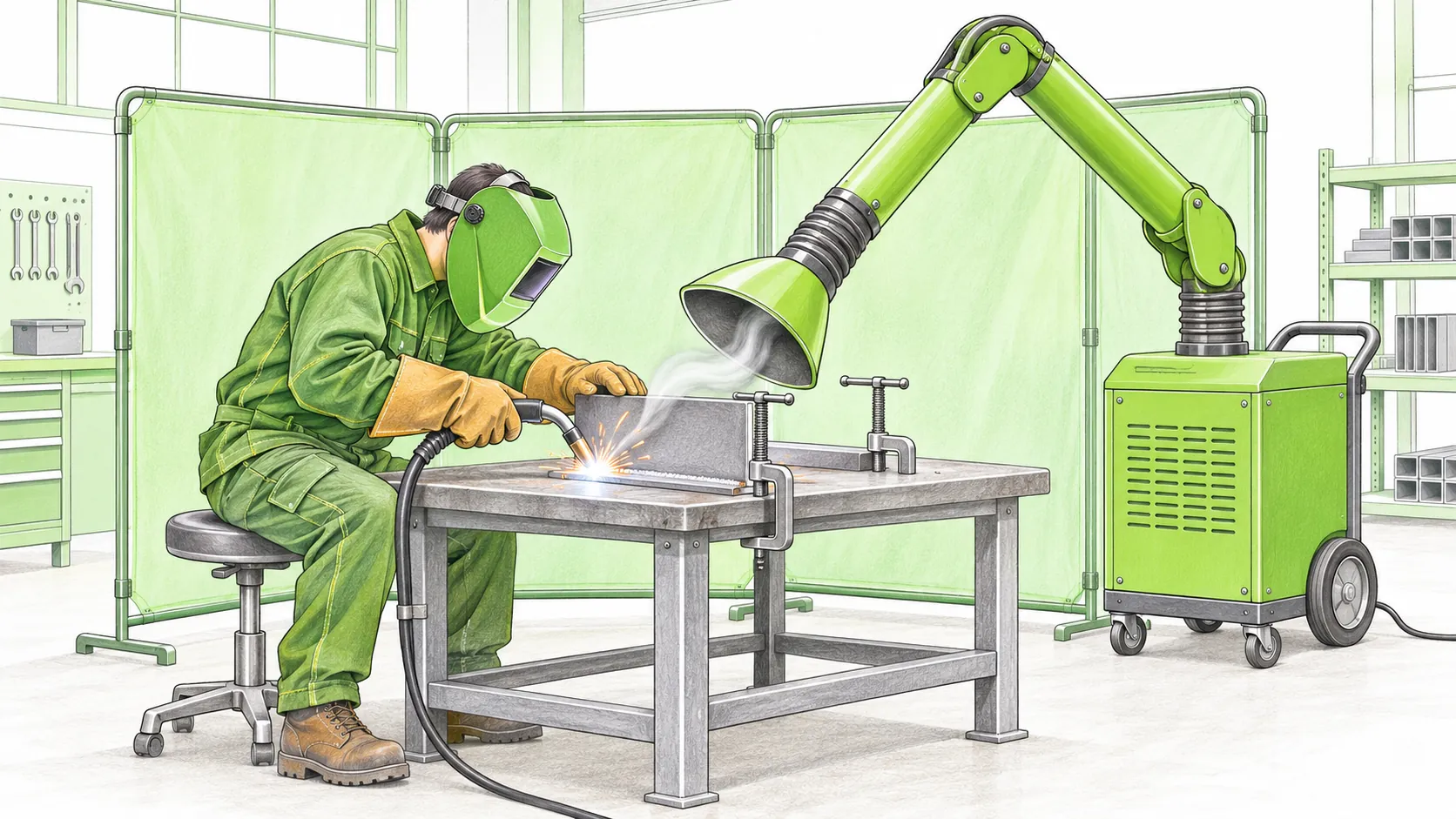
Choose a welding fume extraction system by following the weld from start to finish. On a small part, a bench that draws fume away from the welder can cover the whole joint. On a large fabrication, a compatible extraction torch can follow the arc. A movable hood works only while the weld stays within its reach. Ask the supplier to demonstrate capture on the parts your welders actually make. The Health and Safety Executive (HSE) shows these three arrangements in use.
These decisions apply to regular manual welding in a workshop. The HSE guidance and legal intervals below apply in Great Britain. Local exhaust ventilation (LEV) draws contaminated air away where the fume forms, before it reaches the air around anyone’s nose and mouth. First consider whether the joint can be made without welding or with a process that generates less fume. The metal, its coating and the consumable affect what the welder breathes. See HSE’s order of controls and the overview of welding fume exposure limits.
Which extraction system suits the work?
Give the supplier the workpiece dimensions, joint positions, welding process, arc time and number of welders who work at once. Have a welder demonstrate where they stand and how they reach the far end of the joint. Leave the usual clamps and fixtures in place for the demonstration so any obstruction is apparent. HSE’s guide to specifying LEV recommends involving the people who do the work.
| Work at the station | Extraction to consider | What to check on the job |
|---|---|---|
| Small or medium parts carried to a bench | A backdraft bench draws air through slots behind the work. A downdraft table draws it through the work surface. | Keep the joint in the extraction area. Check whether the part or fixture blocks the slots or covers too much of the table. |
| A larger part that can turn inside a booth | A rear-extracted booth with a jig or turntable. | With the joint inside the booth, turn the part through its working positions. Fume should travel away from the welder towards the rear inlet. |
| Long runs of metal inert gas (MIG) welding | A compatible on-torch extractor. Its inlet travels with the arc. | Try the joint angles the job requires. The torch must reach the joint, capture fume and maintain the gas shield that protects the weld. |
| Large, fixed or changing assemblies | A movable hood on an articulated arm, mounted on the wall or on a portable unit. | Move the hood along the seam. Check that it reaches and holds its position without making the welder lean into the plume. |
HSE’s welding fume control sheet WL3 describes the workpiece and joint positions suited to each method. The Canadian Centre for Occupational Health and Safety explains how large parts can obstruct a downdraft table.
Check where the air goes. This matters particularly for portable welding fume extractors that discharge into the shop. Prefer a safe outdoor discharge away from doors, windows and air intakes. For indoor discharge, ask how the unit reduces returned particles to a negligible concentration, how it signals filter failure and how the assessment addresses gases such as ozone. A particle filter alone cannot remove those gases. See HSE’s welding discharge guidance and HSG258, chapter 7, on air cleaners and recirculation.
How to position a movable welding hood
The hood’s capture zone is the space in front of its opening where air movement can draw the fume in. It can be surprisingly small. For movable welding hoods, HSE’s WL3 advises placing the opening within one hood diameter of the welding point. Use the working distance demonstrated for your hood and job, which may be shorter. A draught across the bench can carry fume away even at that distance. See WL3, movable hoods and HSG258, paragraphs 142–149.
- Check the equipment before striking the arc. Look for a split or kinked hose, a loose connection or an arm that sags. Switch on extraction and check the airflow indicator against the range recorded for the hood. Resolve faults before starting.
- Set the path from weld to hood. Position the opening close to the joint so the rising plume turns into it without crossing the welder’s face. Leave room to see the weld with the helmet down. Check where the welder’s head will be when they reach the far end.
- Plan when to move the hood. With the arc off, trace the weld path. Identify where it leaves the capture zone. Pause there and reposition before welding the next section. Marking the effective reach can help welders repeat a proven setup.
- Watch the first run and each change of position. Use suitable welding eye protection when observing an arc. Look for fume escaping past the inlet, rising around the helmet or drifting into the next bay. Pause and correct the setup if capture is lost.
If the plume misses the hood while the indicator reads normally, check the hood position, the welder’s posture and draughts from doors or fans. If repositioning the arm repeatedly interrupts capture, review the equipment choice. Turning the work towards a fixed inlet or using a compatible extraction torch can remove the need to move a hood between sections. HSE explains how to observe fume capture safely.
How to verify capture before accepting the system
Commissioning means testing the installed system under the conditions in which people will use it. Ask a competent LEV specialist to demonstrate capture on a representative weld while the welder works in their usual position. Include the hardest joint to reach and the combination of stations that normally run together. This gives the supervisor a working setup to reproduce and a reference for investigating later changes. See HSE’s commissioning guidance.
- Record the working arrangement. Identify the hood or torch, the weld position, where the welder stood, and any doors or air supplies that affected the trial. Ask the specialist to show the operator the effective hood position and what escaping fume looks like.
- Record the right measurement. For a movable hood, the specialist can measure air speed at the welding point as well as observing capture. For on-torch extraction, compare the volume of air drawn through the torch with the manufacturer’s specification. A hood air-speed target does not apply to an extraction torch.
- Resolve uncertainty about exposure. Tungsten inert gas (TIG) welding produces little visible fume. A specialist can use a dust lamp to reveal fine particles. Where the adequacy of control remains uncertain, an occupational hygienist can measure the welder’s personal exposure to the relevant contaminants.
Keep the commissioning report, the normal indicator range, the user manual and the logbook accessible at the workshop. Have each operator demonstrate the setup and explain what they will do if the indicator reads low or the plume escapes. HSE sets out the different checks for hoods and extraction torches. For the components and terms in the report, see how local exhaust ventilation works.
Warning. When extraction leaves workers exposed, stop and reassess the task. In Great Britain, HSE calls for suitable respiratory protective equipment (RPE) when LEV alone cannot adequately control exposure or when providing LEV is not reasonably practicable. Select protection for the contaminants and the wearer, and face-fit test tight-fitting equipment. Keep unprotected workers clear and provide effective general ventilation for fume that escapes. A welder’s respirator protects only its wearer. See HSE’s guidance on RPE and people working nearby.
Maintaining welding fume extraction between tests
Use the log to spot repeated faults at the same station. An arm that slips after every adjustment needs repair even if it holds long enough for the first weld. Record which hood was in use, its indicator reading, the fault, who corrected it and how capture was checked before work resumed. When servicing filters, follow the supplier’s procedure for removing and containing collected dust so it stays out of the workshop air. HSE describes the responsibilities of operators, supervisors and maintenance staff.
- Before use, inspect the hood or torch inlet, hose and indicator. Check again after moving a portable unit. If the reading falls outside its normal range, take the affected station out of use while the cause is investigated.
- Each week, HSE’s WL3 recommends a recorded visual check that extraction is working. Review loose joints, repeat alarms and sections of weld where fume still escapes. Arrange repairs and have an appropriately competent person confirm that a failed system is effective before returning it to service. See WL3 on maintenance and HSE’s guidance on failed hoods.
- At the formal examination, have a competent ventilation engineer assess the equipment and its performance against the commissioning results. For ordinary welding LEV in Great Britain, regulation 9 of the Control of Substances Hazardous to Health Regulations (COSHH) requires thorough examination and testing at intervals of no more than 14 months. Keep the examination and test records for at least five years. See COSHH regulation 9(2) and (4) and HSE’s welding maintenance guidance.
Review capture when the work changes. Pay particular attention to fixtures that cover a bench inlet, extra hoods connected to a shared system and changes in weld position. Check the altered arrangement with the welder and specialist before relying on the old settings. HSE lists the operating conditions and performance benchmarks to record.
Frequently Asked Questions
Moving work out of the usual bay changes the control decision. Two common cases need a fresh look at where fume and shielding gas can travel.
Can I use the workshop extractor for outdoor welding?
Wind can carry the plume past the inlet or towards someone working nearby. HSE advises employers in Great Britain to provide suitable RPE for outdoor welding and consider who else may be exposed. Moving a portable extractor outside does not establish adequate control. See HSE’s guidance on outdoor welding.
Is a portable extractor enough to weld inside a tank?
No. Shielding or purge gas can displace oxygen inside a tank even while a hood captures visible fume. Avoid entry where possible. If entry is unavoidable, a competent assessment must establish a safe system of work and rescue arrangements before entry, including the ventilation and atmospheric testing the space needs. See HSE’s guidance on asphyxiation hazards in welding.