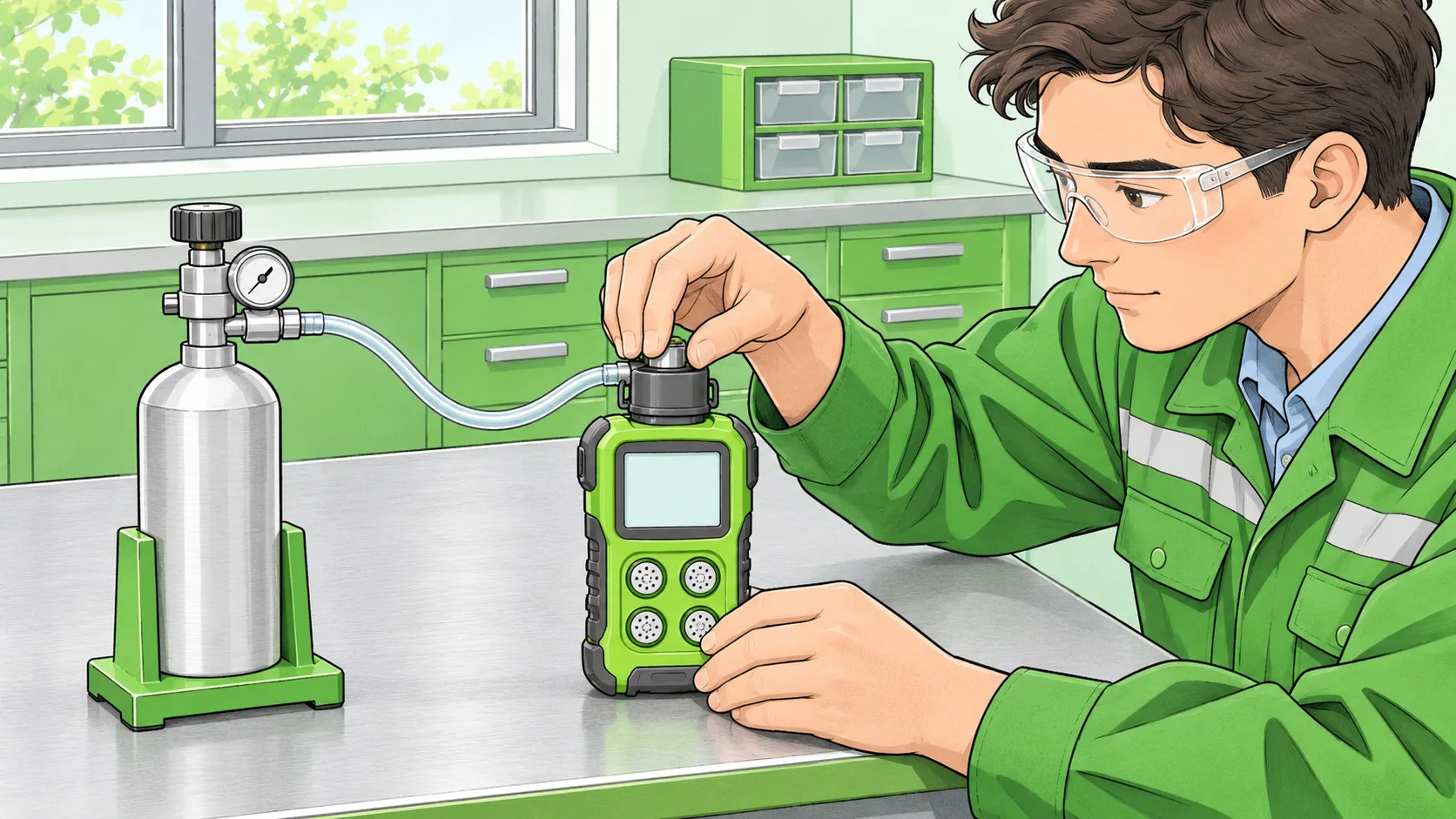
Before each day you use a portable multi-gas detector, give it the gas test its manufacturer specifies. That can be a bump test or a calibration check. Schedule full calibration at the interval for your model. If either pre-use test fails, the monitor needs full calibration before anyone uses it again. See the International Safety Equipment Association (ISEA) guidance, section 2.
For the Ventis MX4, Industrial Scientific recommends full calibration before first use and at least monthly afterward. Its operating instructions also recommend zeroing and bump testing the monitor before each use. For the ALTAIR 4XR, MSA recommends full calibration at least once every six months under normal conditions and a bump test before each day’s use. See the Ventis MX4 Product Manual, pages 24–25, and the ALTAIR 4XR instructions for calibration and bump testing.
What does each gas test tell you?
A sensor can still respond to gas after its sensitivity has changed. If the reading drifts low, the air can reach a dangerous concentration before the alarm sounds. Knowing how different types of gas detectors work helps explain why a contaminant can affect one sensor more than another. Read the result for each installed sensor using the ISEA test definitions, section 1.
| Test | What to look for |
|---|---|
| Bump test (function check) | Apply the specified test gas long enough to challenge the sensors. Confirm that gas reaches each sensor being tested and that the expected alarm indicators operate. A pass shows the monitor responds. The accuracy of the displayed number is a separate question. |
| Calibration check | Compare each reading with the known concentration on the cylinder. The reading must fall within the manufacturer’s tolerance for that sensor and the expected alarms must operate. The check leaves the calibration settings in place. |
| Full calibration | Follow the model’s zero and span procedure. The zero establishes a baseline, and the span uses a known gas concentration to adjust the response as specified for that sensor. Confirm a successful result for every required channel. |
A beep, flash or vibration during startup can tell you the alarm hardware works. Gas still needs to travel through the inlet to the sensor. The ALTAIR 4XR, for example, runs a startup self-test and has a separate daily bump test.
How to set the full-calibration date
Find the model number on the instrument and check which sensors are fitted. Look up its current operating instructions, including any conditions attached to the interval. Compare that interval with the site’s maintenance policy and the rules that apply to the work. Enter the earliest applicable due date against the instrument’s serial number. A daily bump-test pass leaves that date in place. See ISEA’s recommended frequency, section 2.
In the United States, the Occupational Safety and Health Administration (OSHA) publishes advisory guidance on calibration. A regulation may also require a calibrated instrument for a specific task. For example, when a general-industry employer uses the alternate permit-space entry procedures, it must test the atmosphere before entry with a calibrated direct-reading instrument. That clause specifies the condition of the instrument at entry and gives no calendar interval for servicing it. See 29 CFR 1910.146(c)(5)(ii)(C).
When should you check or calibrate ahead of schedule?
A fall, immersion, heavy contamination or exposure above a sensor’s measuring range can affect a detector that passed earlier that day. Keep it out of use while you check what its manual requires for that event. The distinction matters even for two instruments carried on the same job. See ISEA’s checks after unusual conditions, section 2(c).
- After impact or immersion. MSA directs ALTAIR 4XR users to recheck calibration after physical shock or complete submersion. Industrial Scientific recommends immediate calibration of a Ventis MX4 after a drop, significant impact or exposure to water. See the ALTAIR 4XR safety precautions and Ventis MX4 recommendations, page 24.
- After exposure that can damage a sensor. MSA calls for more frequent bump tests if its ALTAIR 4XR encounters high contaminant levels or certain substances, including organic silicones that can reduce combustible-sensor sensitivity. Industrial Scientific recommends recalibrating the Ventis MX4 immediately after repeated over-range gas exposures. Follow the recovery instructions for the affected model. See the MSA contaminant precautions and Ventis MX4 recommendations, page 24.
- After sensor replacement. Check the setup and stabilization instructions before issuing the instrument. Industrial Scientific recommends calibration after installing a new or replacement sensor in the Ventis MX4, page 24.
How to get a trustworthy result before issuing the monitor
Have a trained operator test in a known safe area. Where possible, choose conditions close to the temperature, humidity and atmospheric pressure at the worksite, within the limits for the instrument. Allow any stabilization time the manufacturer specifies. See OSHA’s calibration guidance and the ALTAIR 4XR instructions on temperature stabilization.
Before starting, check the cylinder label against the instrument settings. The gas mixture and concentrations must suit the installed sensors. Use unexpired, certified traceable gas and the specified regulator, flow rate, tubing and adapter. The equipment can differ even between pumped and diffusion versions of the same model. See the Ventis MX4 supply table, page 26, and OSHA’s guidance on calibration gas.
Warning. Zeroing a detector in contaminated air can teach it to display a falsely low reading. For the zero step, use air known to be clean or the specified zero-air cylinder, as the manual directs. Then apply the test gas using the model’s procedure. See the Ventis MX4 zeroing instructions, pages 24–25.
If a sensor or alarm fails, the next decision concerns the whole monitor. Follow the OSHA bulletin’s failed-test guidance when deciding whether it can go back to work.
- Withhold the detector after a failed bump test or calibration check. Have a trained operator perform a full calibration before anyone relies on it. Use another verified monitor if work requires one.
- Remove it from service if full calibration fails. Identify the failed channel, mark the instrument so another worker cannot take it, and contact the manufacturer or its service provider. A pass on the other channels leaves the failure unresolved.
- Verify it before release. After corrective work, confirm successful calibration of the required sensors and complete the pre-use checks the manufacturer specifies, including the alarms. Record the result before returning the unit to the issue point.
OSHA recommends keeping calibration records for the life of each instrument. A useful log identifies the monitor by serial number, the date and operator, the test performed, the cylinder or lot and its expiry, each channel’s result, any service performed and the next full-calibration date. Keep failed results alongside the successful ones so the person reviewing the history can spot a sensor that repeatedly drifts or an instrument that needs service. See OSHA’s calibration recordkeeping guidance.