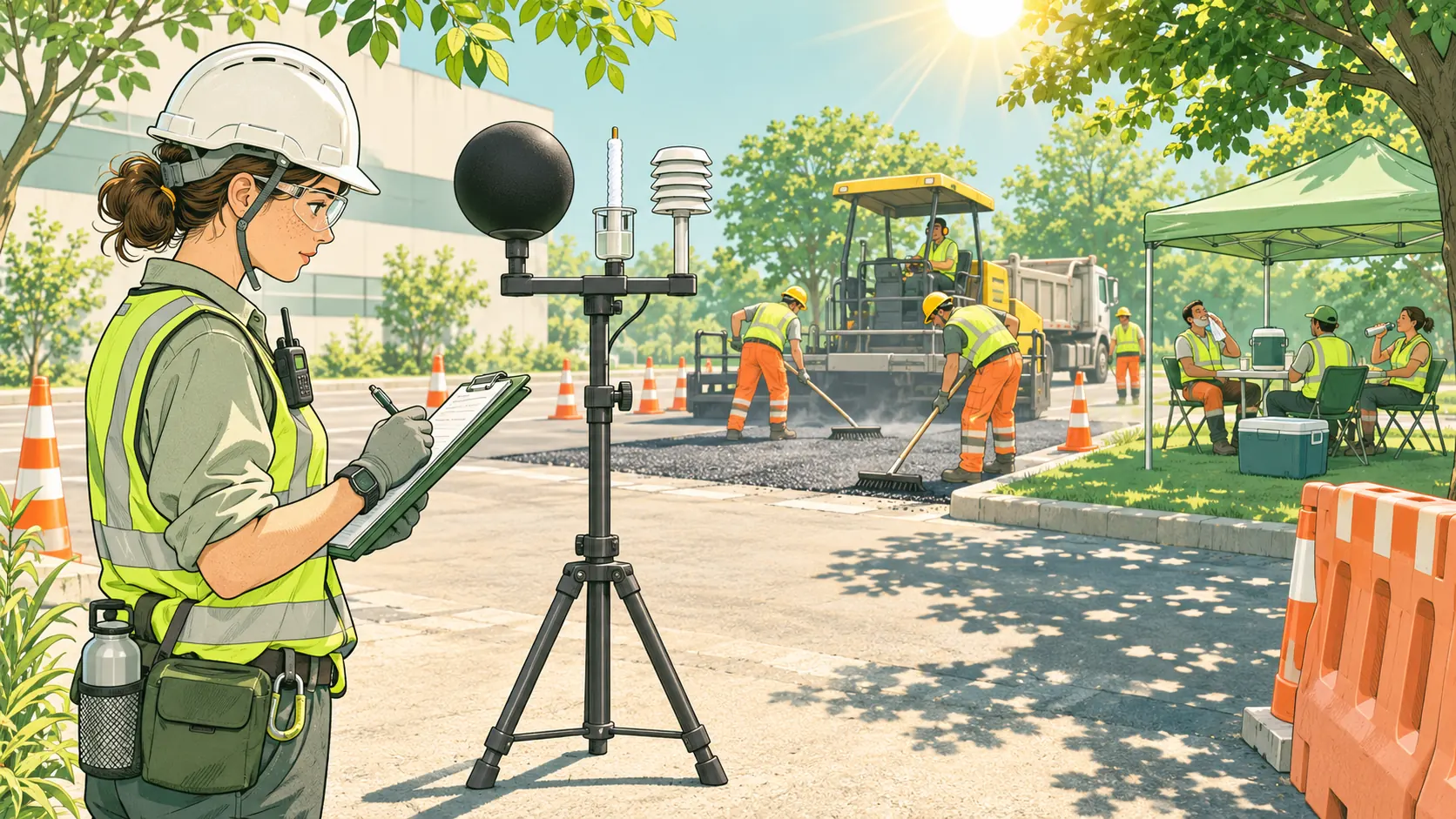
Measure wet bulb globe temperature (WBGT) where the person works, while the task is under way. Give the meter time to settle, record the reading and units, and measure the recovery area separately when conditions differ. To decide what needs to change, use the result alongside the worker’s clothing, physical effort, time in the heat and recent experience of similar work.
WBGT is an index of environmental heat. Its natural wet-bulb component reflects the opportunity for sweat to evaporate, the black globe responds to radiant heat, and the dry-bulb sensor measures air temperature. Together they can reveal a heat exposure that the temperature on a wall display misses. The meter cannot tell how much heat a worker generates while lifting or how much heat their protective clothing traps.
1. Map the job before placing the meter
Follow the route of the person whose exposure you are assessing. Note where the work is hardest, where direct sun or hot equipment reaches the worker, and where they take breaks. Ask when demand peaks. On an indoor line, the critical period may occur when several pieces of hot equipment run together. Outside, moving shade and changing wind can alter the exposure at a fixed workstation.
Choose a safe position close to the worker that receives comparable sunlight, radiant heat and airflow. A reading beside a cool doorway describes conditions at the doorway. If a worker moves into a hotter bay, measure there as well. Identify the actual rest location, especially if a break is spent near the same hot equipment. Keep the instrument clear of traffic and moving machinery.
2. Set up the WBGT meter and take a stable reading
Use a WBGT instrument suitable for the assessment. Check its calibration status, sensor condition, units and manufacturer’s instructions. On a model with a physical wet-bulb wick, check the wick and required water supply. Some validated meters use sensors to derive this measurement. A handheld thermometer that only reports air temperature and relative humidity supplies different information.
- Set the measurement mode. Choose the instrument setting for direct sun when the worker is in direct sunlight. For indoor work or outdoor work without direct sun, use the corresponding shade or indoor setting specified by the manufacturer. The globe still senses radiant heat from indoor machinery. Record which setting you used.
- Allow the sensors to settle. Move the meter into the work position early enough for it to respond. Give it time again after moving between contrasting areas. Globe size and instrument design affect response time. Use the manufacturer’s stabilization period and confirm that the reading has settled.
- Record what the reading represents. Note the location, time, units, task, sun or shade, relevant equipment in operation and clothing worn. Keep the raw measurement even if you later apply a clothing adjustment. Record any sudden change during the sampling period.
OSHA’s Technical Manual describes WBGT instruments and worksite sampling. It relays the NIOSH recommendation for at least hourly environmental heat measurements during the hottest part of shifts in hot months and during actual or predicted heat waves. Recheck when a change in workload, protective clothing or conditions could alter the decision before the next planned check.
3. Account for movement, clothing and workload
A worker who spends part of an hour in a hot area and part in a cooler one has a different exposure from someone who stays in the hot area throughout. Under the US National Institute for Occupational Safety and Health (NIOSH) method, use a one-hour time-weighted average for environmental exposure and metabolic workload. Include work and recovery periods within that hour.
For the environmental average, multiply each area’s WBGT by the minutes the worker actually spent there, add the products and divide by the total minutes in the hour. Use consistent units. Give each location its actual share of time. A plain average of two readings would give a short visit the same weight as most of the hour. Keep individual readings and times so the reviewer can see when the highest exposure occurred. NIOSH’s occupational heat criteria explain the averaging method and exposure recommendations.
Observe the activities in that same period to classify workload. Note the time spent carrying, pushing, climbing, operating controls and resting. Then identify the clothing ensemble. Apply the adjustment for that ensemble using the method’s table and the same temperature units as the meter. Record the resulting effective WBGT separately. If the clothing is outside the table, particularly a fully encapsulating suit, get a competent occupational hygienist to assess the job before relying on a screening number.
4. Use the result to change the work
Compare the effective WBGT with the guidance for the relevant workload and acclimatization status. OSHA’s simplified screening table illustrates why the distinction matters. For moderate work, it lists 25°C effective WBGT for unacclimatized workers and 28°C for acclimatized workers. Other workload categories have different values. These are screening recommendations for the stated conditions. The recommended response also depends on the job and the time spent working and recovering. OSHA publishes the workload examples, clothing adjustments and screening table together.
When the assessment indicates excessive exposure, reduce the heat reaching the person, reduce physical demand or change the timing of work and recovery. Shield a radiant source, move a demanding task to a cooler period, provide mechanical handling assistance or arrange longer recovery in a genuinely cooler area. Provide accessible drinking water. Use a heat acclimatization schedule for new and returning workers when planning assignments. Record who will make the change and repeat the assessment under the revised conditions. NIOSH describes workplace heat controls and recovery arrangements.
Watch people as well as the readings. In a retrospective review of 25 US outdoor occupational heat illnesses, estimated exposures exceeded the applicable recommendations in all 14 fatal cases and in eight of 11 nonfatal cases. Some workers therefore became ill even though the estimate fell below the recommendation. The investigators reconstructed environmental conditions from weather data. Read the investigators’ findings and limitations. If a worker develops confusion, loses consciousness or shows other signs of heat stroke, call emergency services immediately and begin rapid cooling while help is on its way. OSHA gives first-aid guidance for heat illness.
Frequently Asked Questions
These questions come up when a supervisor has a weather forecast, a calculator or readings from several locations.
Can I use a heat index app instead of measuring WBGT?
Use the forecast to plan ahead. The usual heat index describes air temperature and humidity in shade. WBGT also accounts for radiant heat and air movement. Direct sun, a sheltered work bay or a nearby hot process can make a regional weather value a poor match for the task. The US National Weather Service compares WBGT with the heat index.
When is a WBGT calculator useful?
A WBGT calculator can combine valid sensor readings using the corresponding formula. Weather-based tools estimate outdoor conditions using other inputs. Label an estimate as such and check how closely the inputs represent the site, particularly its sun exposure and airflow.
Can several crews share one WBGT reading?
They can use a representative environmental reading if their locations and conditions genuinely match. Assess each crew’s work rate, clothing, time in the area, recovery periods and acclimatization separately. Take additional measurements when crews move into different shade, airflow or process heat.