Measure office carbon dioxide (CO₂) while people are using the room, with the monitor at breathing height and away from anyone’s face. Record how many people are there, how long they stay and what the ventilation is doing. Readings that stay high across several normally occupied meetings are a reason to check the fresh-air supply. An early-morning reading in an empty room tells you little about the air at the end of a full meeting.
Which office rooms are worth measuring?
Start with the room and time people actually complain about. In an ordinary office, people breathe out CO₂ and incoming outdoor air dilutes it. That makes CO₂ useful for investigating whether enough outdoor air reaches a group. A busy, enclosed meeting room used by the same people for an hour or more is a better place to start than a large floor with two people working at opposite ends.
Find out how the room gets outdoor air. It may enter through windows, a mechanical supply or a combination of the two. A cool room or an audible fan can still have a poor supply of outdoor air. If the arrangement is unfamiliar, HSE Blog explains the different types of ventilation.
This approach assumes that people are the main indoor source of CO₂. Dry ice or a leaking gas cylinder changes the question from office ventilation to a possible hazardous release. Follow the site’s emergency arrangements for a suspected release and have the hazard assessed by a competent person. Britain’s Health and Safety Executive explains the hazards of CO₂ at work.
How to take CO₂ readings during the working day
A useful monitoring record lets a colleague reconstruct what was happening when the number changed. Set up the meter before the room fills, and leave it in the same representative position through the period you want to understand.
- Choose a meter that measures CO₂ directly. Britain’s Health and Safety Executive (HSE) recommends a portable non-dispersive infrared (NDIR) monitor for workplace checks. Check the manufacturer’s calibration instructions and make sure you can retrieve the readings and their times. A meter with a logging function is useful through a long meeting. With a display-only unit, assign someone to record repeated readings.
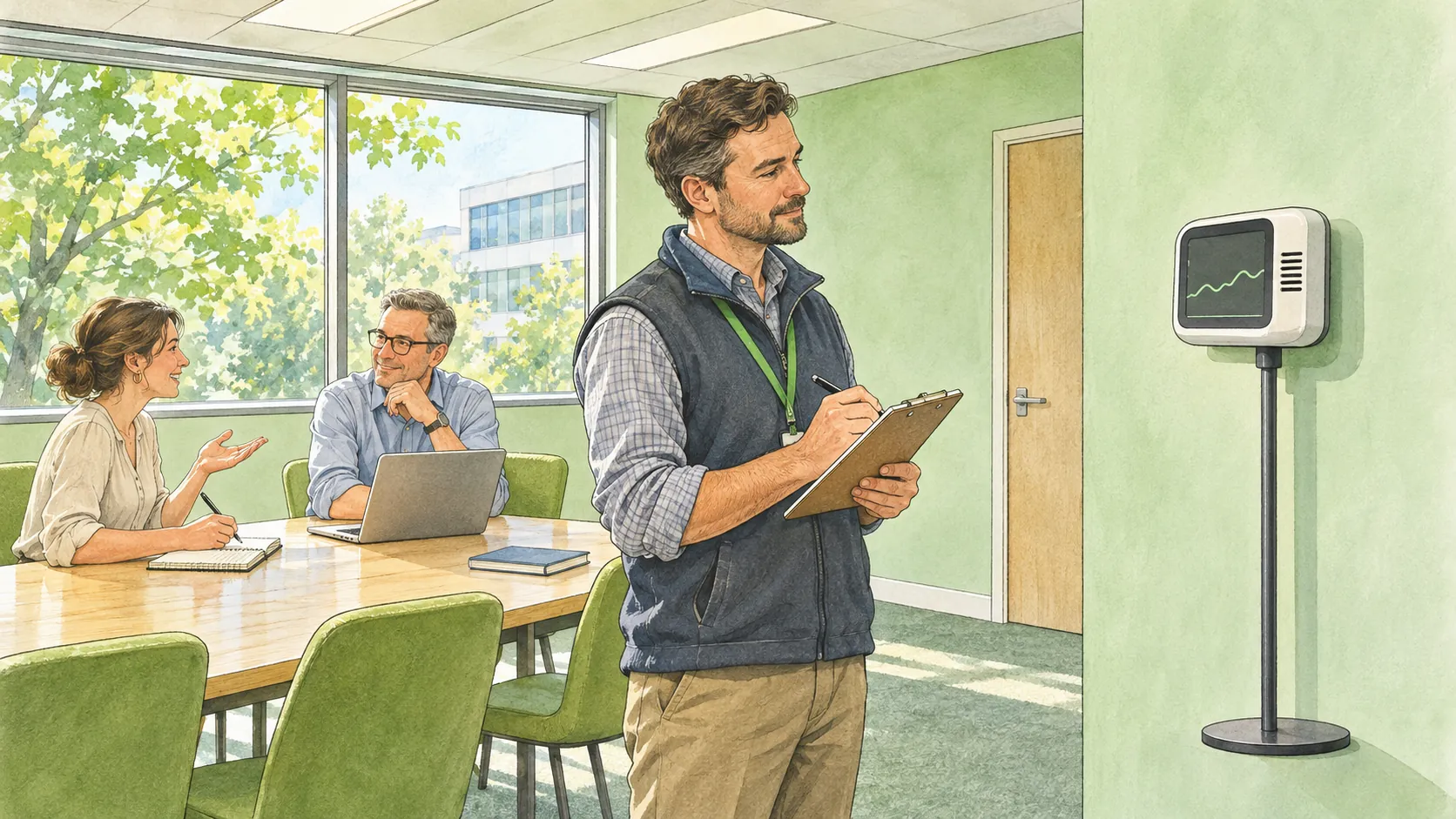
- Place it where people breathe. For seated staff, use seated head height. Keep the sensor more than 50 cm from the nearest person and clear of windows, doors and supply vents. Someone leaning over the meter can drive the reading up. A stream of supply air can drive it down. In a larger office, sample more than one occupied location.
- Track changes in the room. Record the room, sensor position, time, CO₂ in parts per million (ppm), headcount and ventilation settings. Note when people arrive or leave, a window opens or the mechanical supply switches on. Capture the busiest part of the meeting, then follow what happens after people leave. Flag any reading taken while someone was handling the sensor.
- Repeat under comparable conditions. Use the same location during another normally occupied session. Record differences in headcount or duration. In a naturally ventilated room, changes in weather and window use can alter the result. If facilities staff have already checked outdoor airflow against the room’s design, keep the readings recorded under those conditions as a baseline.
For the placement and room-selection criteria, see HSE’s instructions for using CO₂ monitors. The U.S. National Institute for Occupational Safety and Health (NIOSH) explains how to establish a room-specific baseline.
What do 800, 1,000, 1,500 and 5,000 ppm mean?
These numbers answer different questions. Before acting on a display, check whether the figure you are using describes a particular room, an indicator of poor ventilation or a worker’s exposure averaged over a shift.
| CO₂ reading | How it applies in an office |
|---|---|
| Below 800 ppm | U.S. NIOSH gives this as one possible baseline target when assessing ventilation. Its method starts with verifying the system’s outdoor-air supply for the way the space is used. A low reading during light occupancy leaves the full-room question open. |
| 1,000 ppm | There is no universal pass or fail at this number. Research by the U.S. National Institute of Standards and Technology (NIST) explains why the expected reading changes with occupancy, outdoor-air supply and time since people entered. NIST’s research on interpreting indoor CO₂. |
| Consistently above 1,500 ppm | HSE treats this pattern in an occupied room as an indication of poor ventilation and advises action to improve it. Use the occupied-room log to establish whether the pattern persists. A brief spike next to someone’s face has a different explanation. |
| 5,000 ppm | For U.S. federal OSHA general industry, this is the permissible exposure limit for CO₂ as an eight-hour time-weighted average. It answers an exposure question. Using it as a target for everyday office ventilation would miss problems at much lower readings. See OSHA Table Z-1 and the averaging rule in 29 CFR 1910.1000(a)(2). |
Why one office reading can miss the problem
NIOSH investigators visited a medical office building after workers reported odors. During an hour of occupied-time checks, they measured 600 to 1,600 ppm indoors and 395 to 408 ppm outdoors. Readings generally rose as the investigators moved farther from the point where the outdoor-air duct supplied each floor. The pattern pointed to uneven air distribution. A meter left at the well-supplied end would have missed conditions farther away.
The inspection also uncovered plumbing defects and malfunctioning ventilation components. Management later reported fewer odor complaints after several repairs. That follow-up matters because it leaves open which repair made the difference. For a facilities team, the lesson is to map the readings and investigate the complaint itself. NIOSH’s medical office investigation, including the measured ranges in Table 1.
How to lower high CO₂ levels and check the fix
When occupied readings stay high, give facilities staff the room log and identify who will check the supply. In a naturally ventilated room, check whether the intended vents and windows can open and be used safely. Keep fire doors closed as required. In a mechanically ventilated room, have the building operator check the operating schedule, the outdoor-air intake and delivery to the affected area. Ask for an airflow check if the room stays stuffy while the system appears to be running. HSE’s guidance on improving workplace ventilation.
While the issue is being corrected, move long meetings to a better-ventilated room, reduce the number of occupants or shorten the session as appropriate. HSE describes meeting rooms where readings indicated poor ventilation after about two and a half hours. The windows had been painted shut. Managers temporarily shortened meetings, arranged for the windows to open again and continued monitoring. Once the windows reopened, the readings indicated adequate ventilation. HSE’s meeting-room account.
To check your own repair, use the same meter position during a session with a similar headcount and duration. Compare the occupied readings and ask the people who raised the issue what they observed. Record the change, who checked it and whether further work is needed. A lower number on a day when half the seats are empty leaves the repair untested.
Frequently Asked Questions
A CO₂ meter measures one gas. What else needs checking depends on the equipment in the room and the concern workers raised.
Will an air purifier bring down office CO₂?
A conventional HEPA air purifier captures airborne particles. Exhaled CO₂ is a gas and passes through the particle filter. The unit can reduce particles while the CO₂ reading stays high. To bring down occupant-generated CO₂, look at outdoor-air delivery and how many people are using the space. HSE explains this limitation of air cleaning.
What if the reading looks normal but staff still report a problem?
Keep the complaint open. Record where and when it occurs, then check factors the meter cannot measure, including moisture damage, odors and pollutants from work in or near the building. Facilities staff can investigate the building, and an occupational hygienist can select measurements that fit a suspected exposure. OSHA’s indoor air quality questions and HSE Blog’s overview of occupational hygiene assessment methods explain those next steps.
Does a CO₂ meter also warn of carbon monoxide?
A CO₂-only sensor measures carbon dioxide. Carbon monoxide (CO) requires a detector designed for that gas. Follow the building’s emergency procedure if a CO alarm sounds. An ordinary office CO₂ reading cannot clear a CO alarm. See the difference between carbon monoxide and carbon dioxide and the U.S. EPA’s explanation of monitor and alarm functions.