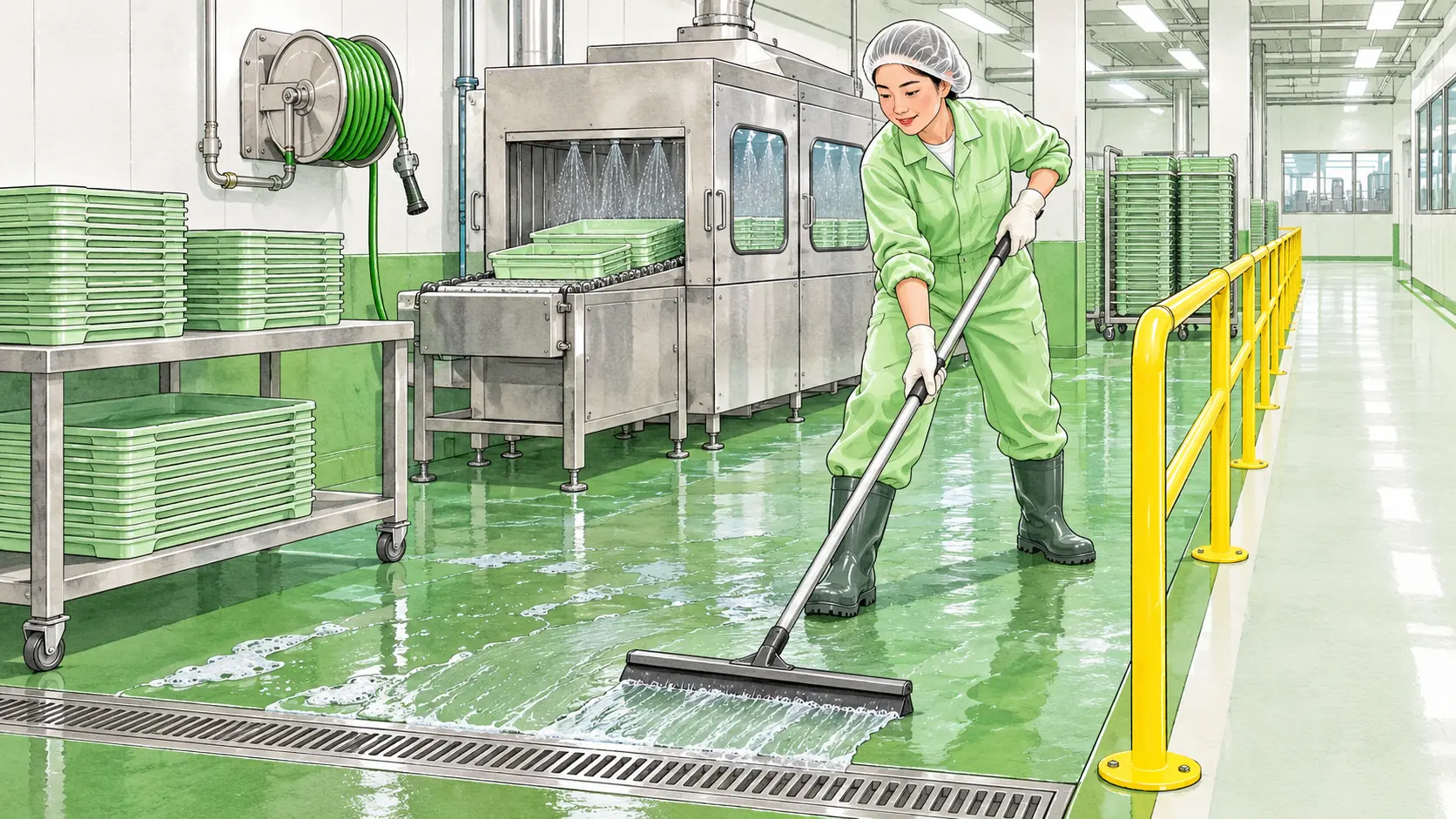
Before reopening a food factory aisle after washdown, check where the water and food residue went. A clean production line can still have a strip of grease where trolley wheels turn into packing. Keep people on a protected route, stop the source of fresh contamination and clear anything that can catch a boot or a wheel. Reopen the aisle when the person responsible has checked the whole route, including the approach from the next room.
Why the liquid on a bakery floor matters
At a commercial bakery, a worker slipped in caustic liquid while walking to help with another task. The worker was hospitalized with burns to the right leg. OSHA’s summary of the 2021 incident lists sodium hydroxide and sodium hypochlorite as possible substances. It leaves open which chemical was present and how the liquid reached the floor.
A worker arriving from another line may mistake a wet patch for rinse water. If its identity is uncertain, keep people clear, report its exact location and have the designated team follow the plant’s chemical spill procedure. Tell the next shift which door or aisle to use. Once the team identifies the product, section 6 of its safety data sheet gives precautions and methods for containing and cleaning up a release. OSHA’s safety data sheet requirements.
Trace the slip or trip back to its source
Ask a line operator and a member of the cleaning crew to show you, from a safe position, where the trouble starts. Watch during the task that produces the spill.
At a filled-pastry factory, Britain’s Health and Safety Executive (HSE) found that the visibly wet tray-wash floor still gave workers adequate grip. The pastry-preparation floor was too smooth for the food residue that collected there. The bakery fitted drip trays around machines and conveyors, revised its cleaning routine and introduced footwear with a tread that resisted clogging. After these changes, the bakery reported fewer than a quarter as many slip accidents as before. HSE’s bakery case study gives the result for the measures together.
For a slip, trace what came between the sole and the floor. For a trip, look for the obstruction or change in level that interrupted the step. Use a slip and trip risk assessment procedure to record the task, the people exposed and the person who can correct the cause. HSE identifies water and food contamination as common causes of slips in food manufacturing, and obstructions and uneven surfaces as common causes of trips. HSE guidance for food and drink manufacturers.
| What staff report | What to fix and how to check it |
|---|---|
| Tray-washer spray reaches the pedestrian turn. | Keep the turn closed while engineering checks spray containment and the path to the drain. Observe a full rinse from the protected side before handing the turn back. |
| Fat returns beside a fryer after every clean. | Restrict access and give maintenance ownership of the leak. In one documented bakery injury, a leaking valve put fat on the floor and a worker slipped and burned her hand and arm in hot fat. The bakery replaced the valve and introduced spill checks. HSE’s fryer investigation. |
| A hose or loose wrap catches boots at changeover. | Put the hose reel where the hose is used and the waste bin where the wrap comes off. Check the doorway again during the next changeover, when both crews use it. |
| A drain cover rocks when loaded racks pass. | Close the affected route and have the cover and its seating repaired. Before release, have maintenance confirm that the cover is secure, sits flush and suits the traffic it carries. |
Check the approach to the freezer
For this article, HSE Blog compared a factory scene photograph with the Singapore Workplace Safety and Health Council’s account of a fatal fall. On page four, the freezer is on the right. A circle marks the worker’s possible fall location out on the bread-cooling floor. The council identified condensation outside the freezer as the source of the water. A worker on her way to the freezer fell, struck her head and later died. The council’s case photograph and findings.
Include both sides of a cold-room doorway on the inspection route. Ask the people moving racks where moisture first collects and when it returns. If the same patch reappears, protect the route while maintenance investigates how moisture reaches that part of the floor. Give the next shift a location it can find, such as the turn on the packing side of the freezer door.
How to hand a walkway back after washdown
Before cleaning begins, production and sanitation should agree which aisle will close, which route people can use and who can reopen it. A detour has to work for someone pushing a full rack. Keep emergency exits accessible and keep the detour clear of moving vehicles. If the layout offers no safe passage, change the timing or sequence of the work.
Close every approach. Use a barrier or a controlled doorway to keep people off the wet section. If the crew cleans in sections, protect the dry path from spray and from water carried across it on wheels.
Remove the product film. Follow the plant’s approved cleaning method for the residue and floor finish. Use the specified detergent concentration and contact time. A quick pass with a wet mop can spread grease along the aisle.
Check where the water ended up. Use the approved squeegee or extraction equipment. Look beyond the drain, under the edge of the rack parking area and around the corner into the next room. Keep a smooth aisle closed while it is still damp.
Release the route and hand over defects. The shift lead or designated person checks the floor, covers, hoses and detour before lifting the barrier. If a leak continues, record who owns the repair and tell production which route is still available.
Include hose storage, empty trays and wrapping waste in routine checks for workplace housekeeping hazards. For the cleaning crew, HSE explains how to select the method, allow detergent to work and keep pedestrians clear while the floor dries. HSE floor-cleaning guidance.
What floor tests and footwear trials can tell you
If people still lose grip after the source and cleaning method have been checked, ask a competent assessor to examine the installed floor. Identify the exact turn, the direction people travel and the contaminant present during work. A dry test on a new tile answers a different question from a test on the worn aisle where staff handle fatty product.
HSE’s guidance classifies a pendulum test value of 36 or higher as low slip potential under the conditions tested. Ask the assessor to identify the surface condition and test direction alongside the result. A result measured with water applies to those test conditions. If grease reaches the route, the assessor needs that information before advising on the floor. HSE guidance on measuring floor slip resistance.
At the pastry factory, one boot was first tried by men. Women who later wore it reported that it felt heavy and left them tired. Workers also found food lodged in some tread patterns. Include cleaners, operators and temporary staff when trialling food processing PPE. Ask workers to report where a tread fills with food, how easy it is to clean and whether the boots remain comfortable through a shift. Use normal duties with the existing controls in place. HSE recommends a representative trial and checking that the supplier’s slip-test evidence matches the workplace. HSE footwear selection guidance.
At a pet-food factory, managers and workers tested a different shoe for seven months. The existing-footwear group recorded 15 slip injuries. The group wearing the trial shoe recorded zero. HSE gives the counts but no group sizes or hours worked. For a trial on your line, log the hours spent in each pair as well as slips and near misses. That lets you compare groups even if one worked more shifts. HSE’s account of the factory footwear trial.
Floor and drainage duties in Great Britain and the United States
Great Britain. Regulation 12 of the Workplace (Health, Safety and Welfare) Regulations 1992 requires floors and traffic routes to suit their use and requires effective drainage where necessary. So far as reasonably practicable, walking surfaces must be kept free of obstructions and substances that could cause someone to slip, trip or fall. Regulation 12 and HSE’s accompanying guidance.
United States. Federal OSHA’s general-industry rule, 29 CFR 1910.22(a)(2), requires clean workroom floors, kept dry as far as feasible. Wet processes require maintained drainage and, where feasible, dry standing places. Paragraph (d)(2) requires a hazardous surface to be corrected before employees use it again or guarded against use until it can be corrected. Check the rules applicable to your site, including any OSHA-approved state plan. OSHA’s walking-working surfaces rule.
Frequently Asked Questions
At handover, record which aisle is open, where a restriction still applies and what the incoming shift needs to check.
How many minutes should an aisle stay closed after cleaning?
Use the condition of the aisle to decide. For a smooth walkway, keep access restricted until the surface is dry, the residue is gone and equipment is clear. Check the doorway from both directions. A dry patch by the barrier can hide water farther along the route.
What if part of the process has to stay wet?
Contain the wet operation, maintain drainage and provide suitable footing for the people who work there. Give through traffic a protected route around it. Check what happens when someone wheels a rack from the wet area onto the dry route.
What should the next shift check before closing a repeat-spill report?
Return during the operation that produced the spill. If spray crossed the aisle only during rinsing, check through that cycle from a protected position. Record the task observed, whether the aisle stayed clear and who checked it. Keep the restriction and repair open if contamination returns.